Healthy Scrolling: How to Spot and Filter Social Media Misinformation
By: Chinenye Abel, B.Tech. Information Systems. Reviewed by the DLHA Editorial Team
September 24, 2026
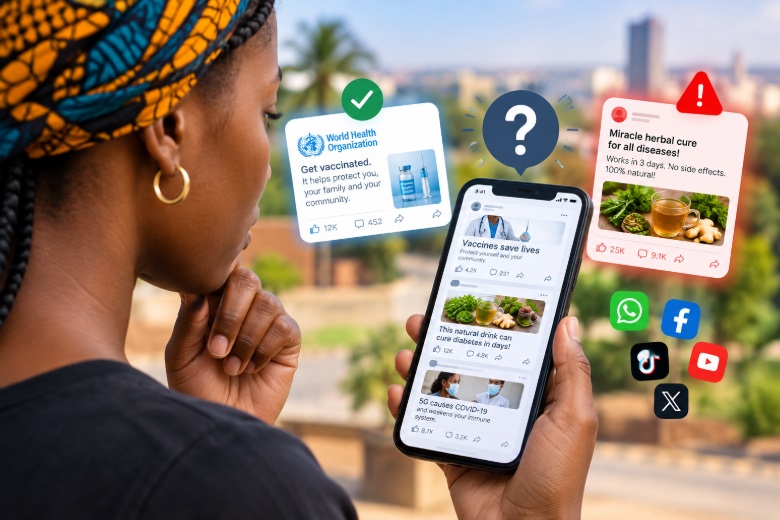
Close up of a partial side view image of an African woman wearing a colourful head tie and reading from a smartphone held in her right hand. In the background are various social meda icons and thumbnail images of document screenshots. Image of credit: ChatGPT. Click on image to enlarge.
Imagine waking up with a fever, noticing a strange rash, or becoming worried about a child's symptoms. Before visiting a clinic, the first thing you might do is reach for your phone. You search online, scroll through social media, or ask a question in a WhatsApp group, hoping someone has an answer.
For many people, this is becoming a normal way of seeking health information. Social media is quick and convenient, and it can provide information at a time when visiting a healthcare facility may not be easy. But convenience comes with a challenge as not everything shared online is accurate.
A health post does not have to be supported by medical evidence to attract thousands of views, likes, or shares. Sometimes, a claim becomes believable simply because it has been repeated by many people or shared by someone we trust. The World Health Organization (WHO) has warned that the rapid spread of misleading health information can create confusion and influence people's health behaviours.
The problem, therefore, is not simply that people use social media to look for health answers. Social media can be a useful source of health information. The concern is what happens when popularity begins to look like proof, and when people make important health decisions based on information that has never been properly checked.
Read on to learn more about how health misinformation shapes health decision making in sub-Saharan Africa and how healthy scrolling can protect you from being misguided.
Health misinformation is any information about health, medicine, or wellness that is false, inaccurate, or misleading based on the best available scientific evidence at the time and shared accidentally or without any deliberate intent to deceive.
Health misinformation has become an important part of the wider health-information problem in sub-Saharan Africa, particularly during disease outbreaks and other public-health emergencies. Social media has become an important place where people encounter information about diseases, treatments and prevention, which means that misleading information can reach large audiences alongside accurate information.
A structured review of research on health misinformation and social media in Africa examined 41 articles published between 2010 and 2022. Most of the studies focused on COVID-19, while others examined health emergencies involving diseases such as Ebola, HIV and Mpox.
The review found that social media played an important role in the spread of health misinformation during these emergencies. It also showed that misinformation was not caused by one factor alone.
The researchers identified six broad factors connected with the spread of health misinformation:
These findings are important because they show that health misinformation cannot always be explained by individual behaviour. The environment in which people receive information also matters. When people are uncertain about a disease, searching for answers and receiving information from many different sources, it can become difficult to tell which claims are supported by evidence. The researchers therefore recommended that governments consider infodemics as part of their communication strategies during public-health emergencies, rather than treating misinformation as a separate problem.
Vaccination provides another example of how health misinformation can spread across different African settings. A study involving 5,307 participants across Ghana, Kenya, Nigeria, South Africa, Tanzania and Uganda examined the sharing of false information about HPV, polio and COVID-19 vaccines on Facebook. The study found that people did not always share false information deliberately. Some participants shared misinformation because they believed it was true, meaning that people could contribute to its spread without intending to deceive others.
This distinction is important when thinking about how misinformation should be addressed. If someone shares a false health claim because they genuinely believe it, simply accusing them of spreading lies may not solve the problem. Providing clear explanations, showing reliable evidence and making trustworthy information easier to access may be more useful.
The problem also changes as new health issues emerge. During public-health emergencies, people often need information quickly, while health authorities may still be gathering evidence or developing their response. This creates an opportunity for rumours and unsupported claims to fill information gaps. The WHO-hosted Africa Infodemic Response Alliance (AIRA) was launched in 2020 to help address this challenge by bringing together health organisations, fact-checkers, media organisations and other partners to identify information gaps and respond to health misinformation across the continent.
AIRA's work includes monitoring what people are saying and asking about health issues, identifying misleading information and supporting the spread of reliable health information. This approach recognises that correcting misinformation is not only about telling people that a claim is false. It also involves understanding why people are concerned and providing information that answers those concerns in a clear and accessible way.
The African experience therefore shows that health misinformation is more than a social media problem. It is also a communication and public-health challenge. Addressing it requires reliable information from health authorities, better ways of responding to rumours and stronger skills among individuals for checking what they see online.
Social media itself can still be useful. It can help health organisations reach people quickly, allow communities to ask questions and make reliable information available to people who may not have immediate access to health professionals. The challenge is making sure that accurate information is easy to find and understand before misleading claims take its place.
For individuals, this raises a practical question: when a health claim appears on a phone screen, how can you tell whether it is something you can trust?
Related: Caution: Health misinformation abound on the internet
Knowing that health misinformation exists is one thing; knowing how to recognise it is another. Social media users do not need to be health experts to question a claim. A few simple checks can help determine whether information is worth trusting before acting on it or sharing it with others.
This checklist will not make every health claim easy to judge, but it provides the basis for healthy scrolling and can help reduce the chance of acting on information that has not been properly verified. When a claim concerns a serious health problem or a decision about treatment, checking with a qualified healthcare professional remains important.
Related: How To Spot Health Misinformation and What To Do About It, According To Experts
Health misinformation can spread quickly on social media because the platforms make it easy to create, share and repeat information. Unlike information published by health organisations or medical journals, a social media post does not have to go through a fact-checking process before it reaches an audience. Several factors make it easier for misleading health claims to gain attention and they are:
A person can create a post, forward a message to a WhatsApp group or share a video, allowing the information to reach thousands of people within a short time. During health emergencies, people may be especially eager to find answers, creating an environment where both useful information and false claims can spread quickly.
The World Health Organization (WHO) uses the term infodemic to describe an overwhelming amount of information, including false or misleading information, that can make it difficult for people to find reliable information.
The way information is presented can also affect how quickly it spreads. Posts that create fear, anger, surprise or excitement can attract attention and encourage people to share them.
This can be particularly concerning with health information because alarming claims may cause people to react before checking whether the information is accurate.
People are often more willing to believe information that comes from someone they trust, such as a friend, family member, healthcare worker, influencer or community member.
However, trusting the person who shared a health claim does not mean the claim itself is accurate. Someone can unknowingly pass on false information while genuinely believing that they are helping others.
Another reason misinformation can spread is repetition. When people encounter the same health claim across different posts, videos or WhatsApp messages, the claim can become familiar. Familiarity, however, is not evidence that something is true.
This is why a health claim should not be considered reliable simply because it has been shared many times.
Together, these factors make social media a powerful channel for both useful health information and misinformation. The speed at which information travels makes it important for people to check where a health claim came from and whether there is reliable evidence behind it before accepting or sharing it.
1. Reliance on unsafe alternatives: The concern about health misinformation is not only that people may read something that is false. The bigger concern is what they may do after believing it. Health information can influence decisions about treatment, prevention, medicines and when to seek medical care.
One way this can happen is through reliance on unsafe and unproven treatment methods. A social media post may present a food, herb, supplement or other product as a cure for a health condition, even when there is not enough scientific evidence to support the claim. A WHO review found that unreliable health information on social media can promote unproven treatments and contribute to vaccine hesitancy.
2. Avoidance of proven care: The same problem can affect decisions about healthcare choices. For example, exposure to unreliable health information can contribute to vaccine hesitancy, particularly when misleading claims about vaccine safety or effectiveness create doubt and influence people's willingness to be vaccinated.
3. Delayed diagnoses: Also, decisions based on misinformation can also affect how people respond when they become ill. Someone who believes an unverified health claim may follow advice from social media instead of seeking information from a qualified health professional promptly. This makes access to credible, science-based health information important, especially when online information can influence decisions about health and treatment.
4. Erosion of trust: Repeated exposure to medical misinformation generates loss of public confidence in science, health workers and the healthcare systems.
5. Clinical Strain: When health workers spend valuable time during patient encounters debunking medical misinformation obtained from non-credible online sources, effective treatment planning and care significantly becomes more difficult and time-consuming.
6. Emotional Distress: People may have severe anxiety around basic needs like food, diet, and disease management with significant psychological impact on choices and self-care.
This does not mean that everyone who sees misinformation will believe it or act on it. However, a recent systematic review found that exposure to health misinformation is common across different health topics, platforms and populations, making it an important public-health concern.
Given that social media can be useful for learning about health, one must be mindful that information found there should not automatically be treated as sound medical advice. Checking the source, looking for evidence and discussing important health concerns with a qualified healthcare professional can help people make decisions based on more reliable information.
Health misinformation cannot be addressed by social media users alone. Health organisations, healthcare professionals, governments, journalists, fact-checkers and communities all have a role in making reliable information easier to find and understand.
The goal is not to stop people from using social media for health information. Instead, the aim is to create an environment where accurate information is easier to find, easier to understand and easier to trust. That requires both stronger health communication and people who are better equipped to question what they see online.
Related: Should You Take Health Advice from Tiktok? Study says Verify First!
Social media has changed the way people find and share health information. A phone can provide answers within seconds, but the speed and convenience of social media also make it easier for false or misleading health claims to reach large audiences.
The solution is not to stop people from using social media for health information. Instead, people need better ways to recognise reliable information, question claims that lack evidence and check important health advice with trusted sources.
Health organisations and professionals also have an important role to play by making accurate information clear, accessible and easy to find. When reliable information is available and people know how to evaluate what they see online, social media can become a useful tool for health education rather than simply a source of confusion.
Before believing or sharing a health claim, it is worth taking a moment to ask: Who provided this information? What evidence supports it? And can I confirm it through a reliable source?
Sometimes, that short pause can make the difference between sharing information and sharing misinformation.
Sources
1. World Health Organization (WHO). Infodemic. [Internet, n.d.]. [Cited September 19, 2026]. Available from here.
2. World Health Organization (WHO). Infodemics and Misinformation Negatively Affect People’s Health Behaviours, New WHO Review Finds. [Internet]. 1 September 2022. [Cited September 19, 2026]. Available from here.
3. World Health Organization Regional Office for Africa (WHO AFRO). Africa Infodemic Response Alliance (AIRA). [Internet, n.d.]. [Cited September 19, 2026]. Available from here.
4. World Health Organization (WHO). Using the Internet and the Media to Get Health Information. [Internet]. Updated: 30 September 2022. [Cited September 19, 2026]. Available from here.
5. Hove C, Cilliers LA. Structured Literature Review of the Health Infodemic on Social Media in Africa. Journal of Disaster Risk Studies. 2023;(15)1, a1484. DOI: org/10.4102/jamba.v15i1.1484. Available from here.
6. PLOS One. Who Shares Fake News on Social Media? Evidence from Vaccines and Infertility Claims in Sub-Saharan Africa. [Internet]. April 9, 2024. [Cited September 19, 2026]. Available from here.
7. World Health Organization (WHO). Building Capacity and Managing Information to Save Lives: An Infodemic Management Impact Story from Nigeria. [Internet, n.d.]. [Cited September 19, 2026. Available from here.
Related:
How to Use AI to Combat Health Misinformation in Africa
Tech Age Woes: How Digital Health Misinformation Costs African Lives
The Influence of Social Media on the Health of African Youths
Misinformation and disinformation in the era of Covid-19 are no exception.
How To Spot Health Misinformation and What To Do About It, According To Experts
Caution: Health misinformation abound on the internet
Published: September 24, 2026
© 2026. Datelinehealth Africa Inc. All rights reserved.
Permission is given to copy, use and share content for non-commercial purposes without alteration or modification and subject to source attribution.
DATELINEHEALTH AFRICA INC., is a digital publisher for informational and educational purposes and does not offer personal medical care and advice. If you have a medical problem needing routine or emergency attention, call your doctor or local emergency services immediately, or visit the nearest emergency room or the nearest hospital. You should consult your professional healthcare provider before starting any nutrition, diet, exercise, fitness, medical or wellness program mentioned or referenced in the DatelinehealthAfrica website. Click here for more disclaimer notice.