Vaccine Tracking Made Easy: A 3-Step Guide for Busy African Parents
By Helen Ohunene Otailku, B.Sc., Health Education, Freelance Health Writer and DLHA Volunteer. Medically reviewed by the DLHA Team.
September 22, 2026
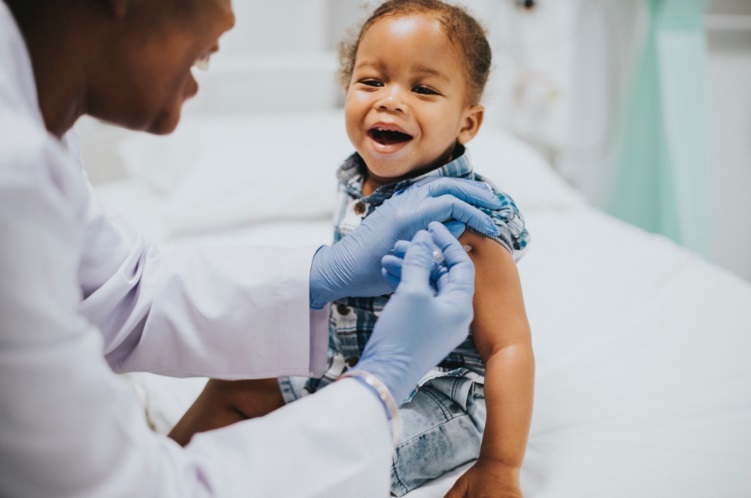
African male toddler getting a vaccination by a male health worker. Photo Credit: Magnific. Click on image to enlarge.
Are your child's vaccines up to date? Missed or late doses are common in child vaccination across Nigeria and other sub-Saharan African countries, and many parents only find out years later. Routine immunisation, the set of vaccines every child should receive on a national timetable, protects against serious illnesses such as measles, polio and pneumonia. Checking whether your child is fully vaccinated should be simple.
Your child's vaccination card, compared with the national immunisation schedule, shows what has been given and what is missing. This guide shows you how to check if your child is missing a vaccine or is up-to-date in three steps. Routine vaccines are free at government health centres, so cost should not stop you from getting your child fully vaccinated.
Vaccines work best when your child gets every dose on time. A missed dose can leave a gap in protection, even if your child looks healthy.
In 2023, 2.1 million children missed all routine vaccines [1]. Behind that number is a child who could catch a preventable illness.
The schedule also changes. Nigeria is adding the measles-rubella (MR) vaccine to its routine schedule [2]. A child vaccinated a few years ago may now be due for something new.
A clear record also helps when you enrol your child in school or travel. Checking takes only a few minutes.
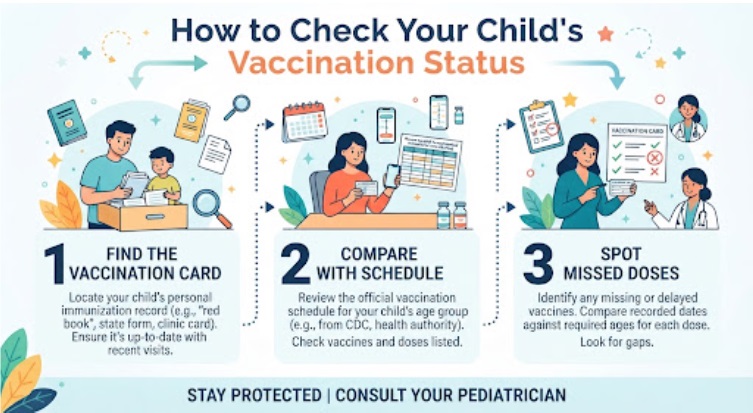
An infographic with caption reading: "HOW TO CHECK YOUR CHILD'S VACCINATION STATUS". It features three numbered steps against a light background: Step 1 shows people looking through documents to find a vaccination card; Step 2 shows a person comparing the card with an immunization schedule; Step 3 shows someone checking off doses and identifying gaps or missed vaccines. The bottom includes the text "STAY PROTECTED | CONSULT YOUR PEDIATRICIAN". Photo Credit: Google Gemini. Click on image to enalarge.
Your child's vaccination card is a small booklet, often called the child health card. A health worker fills it in at each visit. It is usually given at birth or at the first vaccination.
Keep your child’s vaccination card in a safe place where you can easily find it when needed. A folder, drawer, or bag with other important papers can be a good place to store it. You can also take clear photos of the card and keep them on your phone as a backup. If you cannot find the card, ask your partner, grandparents, or anyone who has taken your child to the clinic. Check your phone too, since you may have photographed the card.
Once you find it, check three things:
Take a clear photograph of every page.
The immunisation schedule is the national timetable showing which vaccine is due at which age. The National Primary Health Care Development Agency (NPHCDA) sets it [3]. You can ask for a copy at any health centre or download it from the UNICEF Nigeria website [3].
Here is a simplified, fictional example. Esther is 11 months old. Some vaccines are left out to keep it simple, so always use the official schedule for your own child.
Sample Immunisation Comparison Card: Schedule vs. Received/Gaps
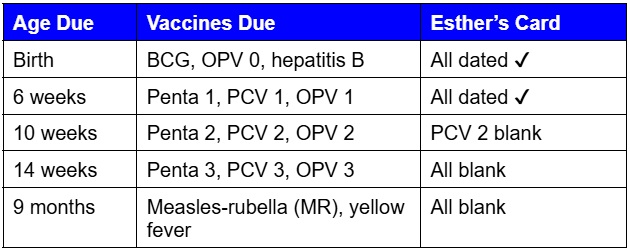
Table showing a sample child's immunization card comparing scheduled vaccines against what Esther’s card shows. Click on image to enlarge.
Keys to abbreviations in the table:
Match each row to your child's age. Every vaccine due by that age should have a date beside it.
Step 3: Look For Gaps and Late Doses
Now look for gaps by asking yourself three questions:
1. Is every dose due for my child's age dated?
2. Was any dose given later than planned?
3. Is another dose due now or soon?
A blank space usually means the dose was not given or not recorded. Either way, take the card to a health worker.
Esther’s card shows three gaps: PCV 2, the 14-week vaccines and the 9-month vaccines. All of them are due now.
A late dose is not a wasted dose. It still counts, and the sequence does not start again [4].
Do not panic. Many parents lose cards, and you can still get help.
Go to the health centre where your child was vaccinated. Many centres keep a register of every child they vaccinate. Ask a health worker to check it and record the doses on a new card.
Bring anything that helps:
If no record can be found, do not guess dates. Tell the health worker honestly. They will decide which vaccines your child needs, based on age.
If you live abroad, ask your child's previous clinics for a copy of their records. Share it with your current doctor.
Catch-up vaccination means giving the missed vaccines as soon as possible, at the right spacing. Most children do not need to restart. The health worker continues from the last dose given [4].
Several vaccines can usually be given at the same visit [4]. That means fewer trips to the clinic.
Older children can catch up too. Nigeria is now offering the MR vaccines to children aged 9 months to 14 years. Girls aged 9 to 14 years can receive a single dose of the HPV vaccine, which protects against cervical cancer [5].
Bring the card to every visit and ask the health worker to update it before you leave.
Tracking your child's vaccines takes three steps. Find the card. Compare it with the immunisation schedule. Look for gaps and late doses. If you find a gap, visit a health centre this week. It is free, and it is never too late to catch up. Photograph your child's card today and keep the picture on your phone. Then share this guide with another parent.
1. World Health Organization (WHO). Global childhood immunization levels stalled in 2023, leaving many without life-saving protection. [Internet]. 15 July 2024. [Cited September 21, 2026]. Available from here.
2. World Health Organization Regional Office for Africa. Nigeria intensifies fight against vaccine-preventable diseases with nationwide measles–rubella and polio campaign [Internet]. Brazzaville: WHO AFRO; 2025 Oct 14 [Cited 2026 Sep 19]. Available from here.
3. UNICEF Nigeria. Nigeria immunization schedule [Internet, n.d.]. Abuja: UNICEF Nigeria; [Cited 2026 Sep 19]. Available from here.
4. World Health Organization. Table 3: Recommendations for interrupted or delayed routine immunization – summary of WHO position papers [Internet]. Updated December 2025. Geneva: WHO; [Cited 2026 Sep 19]. Available from here.
5. Paediatric Association of Nigeria. Immunization [Internet]. [Cited 2026 Sep 19]. Available from here.
Related:
Published: September 22, 2026
© 2026. Datelinehealth Africa Inc. All rights reserved.
Permission is given to copy, use and share content for non-commercial purposes without alteration or modification and subject to source attribution
DATELINEHEALTH AFRICA INC., is a digital publisher for informational and educational purposes and does not offer personal medical care and advice. If you have a medical problem needing routine or emergency attention, call your doctor or local emergency services immediately, or visit the nearest emergency room or the nearest hospital. You should consult your professional healthcare provider before starting any nutrition, diet, exercise, fitness, medical or wellness program mentioned or referenced in the DatelinehealthAfrica website. Click here for more disclaimer notice.