Tamunobelema Bamson. B.Sc. Microbiology. Health & News Reporter and DLHA Volunteer. Medically reviewed by the DLHA Team.
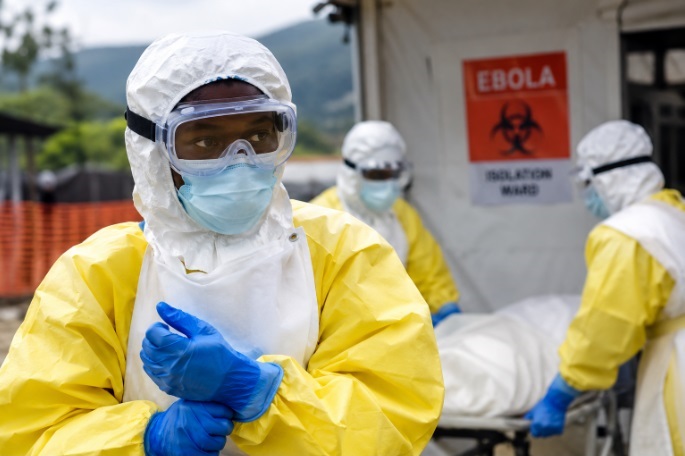
Photo of public health workers in full protective gear fighting the Ebola outbreak in parts of sub-Saharan Africa. Photo Credit: ChatGPT. Click on image to enlarge.
The Nigerian Federal Ministry of Health confirmed its first case of Bundibugyo Ebola virus disease linked to the ongoing regional outbreak on October 20, 2026.
Health Minister Muhammad Ali Pate in a press release posted on X, noted that the patient was a woman who had recently arrived in Nigeria on an international flight from Uganda.
She arrived on October 3, 2026 on Ethiopian Airlines at the Nnamdi Azikiwe International Airport, Abuja. Datelinehealth Africa has not inependently verified this report.
The woman developed symptoms on 7 October, four days after arriving in Nigeria, and sought treatment at a private hospital in Abuja on 11 October. Laboratory tests confirmed the infection on 20 October. She was subsequently placed in isolation and is receiving medical care.
The case comes amid an outbreak of Bundibugyo Ebola virus disease declared in the Democratic Republic of the Congo (DRC) on 15 May 2026. The outbreak has remained concentrated in eastern DRC, while infections have also been reported in Kenya and Uganda.
Kenya confirmed its first imported case on 6 October and reported nine cases by 20 October. Meanwhile, Uganda’s Ministry of Health in a press release on X, denied all claims that the country could be linked to Nigeria’s reported Ebola case, insisting it has no confirmed active infections.
According to a statement issued and signed by the Director-General of Health Services, Prof. Charles Olaro on October 20, "travel through Uganda does not establish that infection occurred there. Additionally, the precise location of exposure remains under investigation, and Nigerian authorities have not publicly confirmed the circumstances of her infection. Uganda, which recorded 20 confirmed cases during its own outbreak earlier in 2026, declared the outbreak over in August after meeting the required conditions. Its health authorities have since reiterated that the Nigerian patient’s transit through the country does not, by itself, indicate that she contracted the virus there”.
Following reports of the Ebola outbreak in DR Congo, the Nigerian health authorities established an Ebola task force in June 2026 to coordinate the government’s response to potential infections. When the task force was announced, Femi Gbajabiamila, Chief of Staff to President Bola Tinubu, noted that the government wants to avoid a repeat of the 2014 Ebola outbreak. At the time, an infected traveler arrived in Nigeria from Liberia, prompting an emergency public health response.
The Nigeria Centre for Disease Control and Prevention (NCDC) has heightened surveillance and reviewed the country’s preparedness measures following reported Ebola cases in Kenya earlier in October. The agency also announced on X that it has activated the incident management system to coordinate response activities. The incident action plan is still being finalized.
On another note, public health teams have begun contact tracing and have so far identified 44 contacts who are being monitored and isolated. They are also working to identify others who may have been exposed, including healthcare workers, patients, caregivers and people who travelled with or encountered the patient.
Authorities are also providing support to the private hospital where the woman was treated to strengthen infection prevention and control. Health Minister Muhammad Ali Pate further has urged Nigerians to remain calm and follow preventive measures, including regular handwashing and avoiding contact with the blood and other bodily fluids of anyone suspected of having Ebola.
In support, the World Health Organization (WHO) and its partners are working with Nigeria health authorities to strengthen outbreak control measures, including case investigation, contact tracing, infection prevention and control as well as the provision of essential supplies such as personal protective equipment for healthcare workers. The WHO has also urged countries across the region to maintain a high level of preparedness as the Ebola outbreak continues to evolve.
Its recommendations include strengthening disease surveillance, investigating alerts promptly, ensuring laboratories can safely test suspected cases, and keeping rapid response and clinical teams ready for deployment.
The WHO has also called for stronger infection prevention and control in public and private healthcare facilities, advance distribution of essential supplies, active community engagement and increased monitoring at points of entry. These measures are intended to support early detection, limit cross-border transmission and protect healthcare workers and communities.
Nigeria’s first confirmed case of Bundibugyo Ebola virus disease linked to the ongoing regional outbreak highlights the growing risk of cross-border transmission as infections spread beyond the Democratic Republic of the Congo (DRC). With the source of the patient’s infection still under investigation, the response has focused on tracing contacts, strengthening surveillance and improving infection prevention measures to limit further spread.
As the outbreak continues to affect countries across the region, early detection, prompt reporting of suspected cases and coordinated action by health authorities remain essential to protecting public health. Although no approved vaccine or specific treatment is currently available for Bundibugyo virus disease, public awareness, timely medical care and strict infection prevention and control measures can help reduce transmission and support efforts to contain the outbreak.
The viral strain causing the recent Ebola outbreak is known as Bundibugyo virus, a species of Ebola virus for which there is currently no approved vaccine or specific treatment. The disease it causes, known as Bundibugyo virus disease (BVD), is a severe illness that can spread from animals to humans and between people. Fruit bats are suspected to be the natural reservoir of the virus.
People can become infected through close contact with the blood or other body fluids of infected wildlife, including bats and non-human primates. Once the virus enters the human population, it can spread through direct contact with the blood, secretions or other body fluids of an infected person. It can also spread through contaminated surfaces and materials.
Transmission can increase in healthcare settings when infection prevention and control (IPC) measures are inadequate. Unsafe burial practices that involve direct contact with the bodies of infected people can also contribute to further spread.
The incubation period for BVD ranges from two to 21 days. People are generally not infectious before symptoms appear. Early symptoms include fever, fatigue, muscle pain, headache and sore throat. Because these symptoms can occur with many other illnesses, they may be difficult to identify at first, which can delay diagnosis. As the disease progresses, patients may develop vomiting, diarrhea, rash and problems affecting the liver and kidneys. In severe cases, the disease can also cause bleeding.
Source:
World Health Organization (WHO) African Region. Nigeria confirms imported case of Ebola Bundibugyo virus disease. [Internet]. 2026 October 20. Geneva. [Cited 2026 October 21]. Available from here.
Published: October 21, 2026
© 2026. Datelinehealth Africa Inc. All rights reserved.
Permission is given to copy, use, and share content freely for non-commercial purposes without alteration or modification, and subject to source attribution.
DATELINEHEALTH AFRICA INC., is a digital publisher for informational and educational purposes and does not offer personal medical care and advice. If you have a medical problem needing routine or emergency attention, call your doctor or local emergency services immediately, or visit the nearest emergency room or the nearest hospital. You should consult your professional healthcare provider before starting any nutrition, diet, exercise, fitness, medical or wellness program mentioned or referenced in the DatelinehealthAfrica website. Click here for more disclaimer notice.