Daily Zinc for Sickle Cell Disease: Does It Prevent Infections in Children?
By Kelechi Nwaowu, RN, RM, BNSc, Freelance Medical and Health Writer. Medically reviewed by: KT Craig, MBBS, MScPH.
October 16, 2026
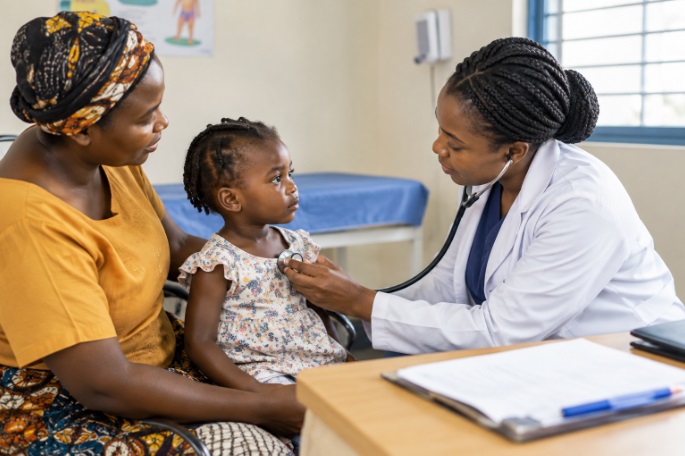
A doctor assessing a young African child with sickle cell disease while her caregiver looks on. Image Credit: ChatGPT. Click on image to enlarge.
If you have ever been close to a child who has sickle cell disease, you probably know that infections are one of the biggest worries. A mild fever can quickly turn serious, and even when the child is following all the right treatments, infections can still land them in hospital, sometimes more than once in a single year.
This relationship between sickle cell disease and increased rates of infections led researchers in Uganda to explore whether an intervention as simple and affordable as a daily zinc tablet could help change that. In August 2026, they published the results of their clinical trial in the Journal of the American Medical Association (JAMA) (1).
This article explains:
Sickle cell disease (SCD) is a genetic blood disorder, caused by a permanent change in the gene which provides instructions for making haemoglobin in the body, leading to the production of abnormal haemoglobin known as haemoglobin S. To develop SCD, a person has to inherit two copies of the haemoglobin S gene (one from each parent), thus having the genotype HbSS (2). This means that a person can only be born with SCD; it cannot be caught or transmitted through contact with another person who has it.
Persons with one normal haemoglobin gene (Haemoglobin A) and one abnormal haemoglobin gene (Haemoglobin S) have the HbAS genotype and are referred to as having the sickle-cell trait (SCT). Usually, they do not show symptoms, but they can pass the abnormal gene to their offspring.
In sickle cell disease, the red blood cells, which are normally round, doughnut-shaped, and flexible, become stiff, sticky, and shaped like a crescent or sickle, hence the name “sickle cell” (2). This abnormal form and shape make the red blood cells clump together, thereby blocking blood flow, causing episodes of severe pain and damaging organs over time.
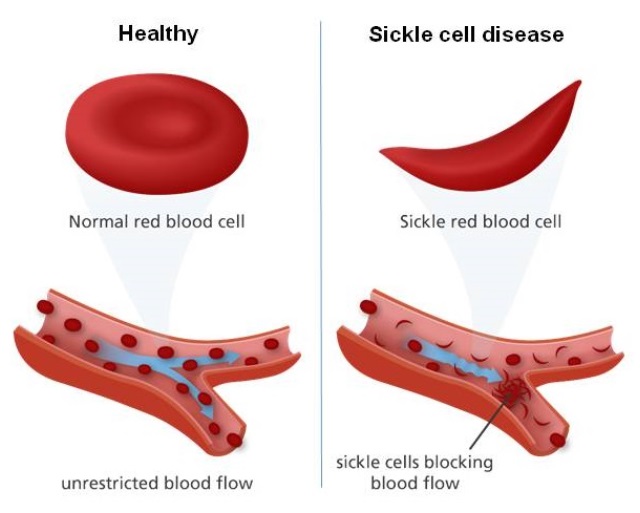
Illustration comparing a healthy red blood cell and a sickle red blood cell. Click on image to enlarge.
One of the most serious consequences of sickle cell disease is a weakened immune system. The immune system is the body's natural defence against infections. In children with SCD, the spleen (an organ that plays a key role in fighting bacteria) is often damaged early in life (2). Without a healthy spleen, the body struggles to clear certain infections from the blood. As a result, children with SCD are more likely to develop serious bacterial infections, like pneumonia, and other illnesses than children without the condition.
The burden of sickle cell disease (SCD) is particularly significant in Sub-Saharan Africa (SSA). For instance, available estimates suggest that 50-90% of children born in Africa with SS disease may die early in life (3), with infections among the leading causes of death.
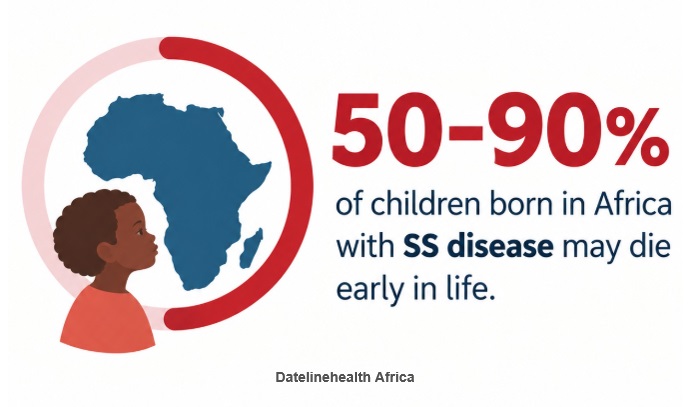
Infographic showing an Africa map and child silhouette alongside the statistic “50–90% of children born in Africa with SS disease may die early in life”. Image created with ChatGPT from data adapted from Grosse et al. Click on image to enlarge.
Zinc, a mineral found in certain foods, including meat, beans, nuts, and seeds, plays a critical role in keeping the immune system functioning properly. Studies have shown that a significant number of children and adults with sickle cell anaemia have low zinc levels in their bodies, and that low zinc is linked to a weaker immune response and a higher risk of infection in them (4, 5).
So, some Ugandan researchers conducted a clinical trial to see the effect of including zinc in the treatment of SCD, as a way of preventing or reducing infection rates in children with this condition.
Related: Why Sickle Cell Burden Remains High in Africa
Given this connection between zinc and immunity, researchers wanted to know whether giving children with SCD a daily zinc supplement could reduce the number of infections they experience.
This particular study was not the first attempt. An earlier study, also conducted in Uganda in 2019, by the same group of researchers, tested a daily zinc dose of 10 mg in children with sickle cell anaemia (5).
However, that study (called ZIPS-1) found no significant benefit (6). In this recent study, called ZIPS-2, the researchers tried a higher dose of zinc (20 mg per day) to test whether it would produce a different result.
This study enrolled 100 children with sickle cell disease between the ages of 1 and just under 5 years (1-4.99) at the Nalufenya Sickle Cell Clinic. This clinic is a part of Jinja Regional Referral Hospital in Jinja, Uganda. Enrolment took place between February and April 2025, and each child was followed up for six months, with follow-up stopping in November 2025.
Of the 100 children who took part:
Hydroxyurea works by increasing production of a type of hemoglobin which keeps the red blood cells round, flexible, and oxygen-rich. All children who were on hydroxyurea before the study continued taking it throughout. Those who were not on hydroxyurea started it and continued taking it throughout the study.
Also note that no child was lost to follow-up. All 100 children completed the full six months of the study.
The study was a randomised, double-blind, placebo-controlled clinical trial. These features strengthen the trial design and help researchers make a fair comparison between the two groups.
The children were split evenly. That is, 50 children received 20 mg of oral zinc sulfate daily for six months, while 50 received the placebo tablet daily for six months.
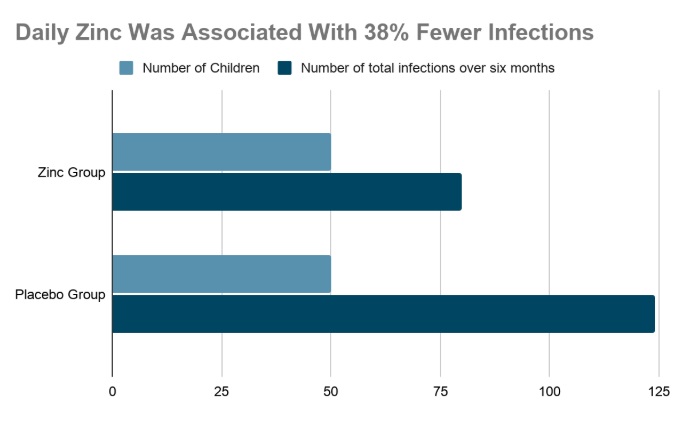
A bar chart showing fewer recorded infections among children receiving zinc than those receiving placebo during the six-month trial. Click on image to enlarge..
The researchers tracked the number of infections in each group over the six months of follow-up, using standardised medical criteria. The results were as follows:
After adjusting for differences in age, sex, and hydroxyurea use between the two groups, the researchers calculated an incidence rate ratio of 0.62. This means that for every 100 infections that occurred in children not taking zinc, only roughly 62 occurred in children who were taking it.
In a simple sentence, the result of the study showed that children who received zinc had about 38% fewer infections than children who received the placebo.
The safety findings of this study were reassuring. For instance, no child in either group experienced an unexpected harmful reaction serious enough to require stopping the zinc or placebo tablet. Zinc was well tolerated throughout the six months.
For families and healthcare workers in sub-Saharan Africa, these findings are potentially relevant because children with sickle cell disease face a high risk of serious infections. However, the trial was conducted at a single sickle cell clinic in Uganda and involved only 100 children, so the results should be interpreted cautiously.
If larger, more distributed studies confirm these findings, zinc supplementation could become an additional strategy for reducing infections in young children with sickle cell disease. This could be particularly relevant in settings where families face challenges reaching healthcare facilities or accessing timely treatment when a child develops an infection. However, the ZIPS-2 trial does not establish that zinc will have the same effect in children living in other countries or healthcare settings.
The study also evaluated zinc alongside existing sickle cell care rather than as a replacement for it. At enrolment, 45% of the children were already receiving hydroxyurea, and all children continued or started hydroxyurea during the trial. The findings therefore suggest that the reduction in infections observed with zinc occurred within a broader treatment programme that included standard sickle cell care, rather than zinc as a stand-alone
Most importantly, these findings do not mean that parents should start giving zinc to a child with sickle cell anaemia on their own. The trial was small and conducted at a single centre, and the researchers called for larger, multisite studies before the findings can support wider recommendations.
For now, zinc should be discussed with the child's doctor or sickle cell specialist rather than added to treatment based on this study alone.
The researchers were open about several important limitations of ZIPS-2 that are worthy of note:
A recent randomised trial has found that among Ugandan children aged 1 to 4.99 years with sickle cell anaemia (SCA), 20 mg of daily zinc sulfate reduced all-cause infections by about 38% over six months. Children with sickle cell disease (SCD) are at high risk of infections, which remain a leading cause of death in African children with the condition. The administered zinc was well tolerated and safe. No child had to stop the supplement due to a harmful reaction. However, the study is still preliminary and do not give zinc to any child on the basis of this study without talking with your provider.
1. Namazzi R, Mellencamp KA, Bagala I, Kato C, Birungi I, Kasembo P, et al. Daily zinc supplementation for infection prevention in children with sickle cell anemia: the ZIPS-2 randomized clinical trial [Internet]. JAMA. 2026 Aug 19 [cited 2026 Sep 21];336(11):e2614190. Available from here
2. World Health Organization. Sickle cell disease [Internet]. Geneva: World Health Organization; 2023 Oct 2 [cited 2026 Sep 21]. Available from here
3. Grosse SD, Odame I, Atrash HK, Amendah DD, Piel FB, Williams TN. Sickle cell disease in Africa: a neglected cause of early childhood mortality. American journal of preventive medicine. 2011 Dec 1;41(6):S398-405. Available from here
4. Youssry I, El-Ghamrawy M, Youness ER, Mohamed NA, Selim YMM. Zinc level and its impact on the phenotype of sickle cell disease. Ann Hematol [Internet]. 2025 Jun [cited 2026 Sep 23];104(6):3213–21. Available from here
5. Namazzi R, Mellencamp KA, Opoka RO, Birungi I, Kasembo P, Kato C, et al. Zinc for Infection Prevention in Sickle Cell Anemia (ZIPS): study protocol for a randomized placebo-controlled trial in Ugandan children with sickle cell anemia. Trials [Internet]. 2019 Jul 16 [cited 2026 Sep 23];20(1):460. Available from here
6. Namazzi R, Opoka RO, Conroy AL, Datta D, Tagoola A, Bond C, et al. Zinc for infection prevention in children with sickle cell anemia: a randomized double-blind placebo-controlled trial. Blood Adv [Internet]. 2023 Jul 11 [cited 2026 Sep 23];7(13):3023–31. Available from here
Related:
\Why Sickle Cell Disease Burden Remains High In Africa
Sickle Cell Disease: Essential Information for Africans
Published: October 16, 2026
© 2026. Datelinehealth Africa Inc. All rights reserved.
Permission is given to copy, use, and share content freely for non-commercial purposes without alteration or modification and subject to source attribution.
DATELINEHEALTH AFRICA INC., is a digital publisher for informational and educational purposes and does not offer personal medical care and advice. If you have a medical problem needing routine or emergency attention, call your doctor or local emergency services immediately, or visit the nearest emergency room or the nearest hospital. You should consult your professional healthcare provider before starting any nutrition, diet, exercise, fitness, medical or wellness program mentioned or referenced in the DatelinehealthAfrica website. Click here for more disclaimer notice.