Investing in Care: Closing Sub-Saharan Africa’s Healthcare Workforce Gap
By Chinenye Abel, B.Tech, Information Systems. Datelinehealth Africa Volunteer and Akin Odutola, MBBS, PhD.
October 21, 2026
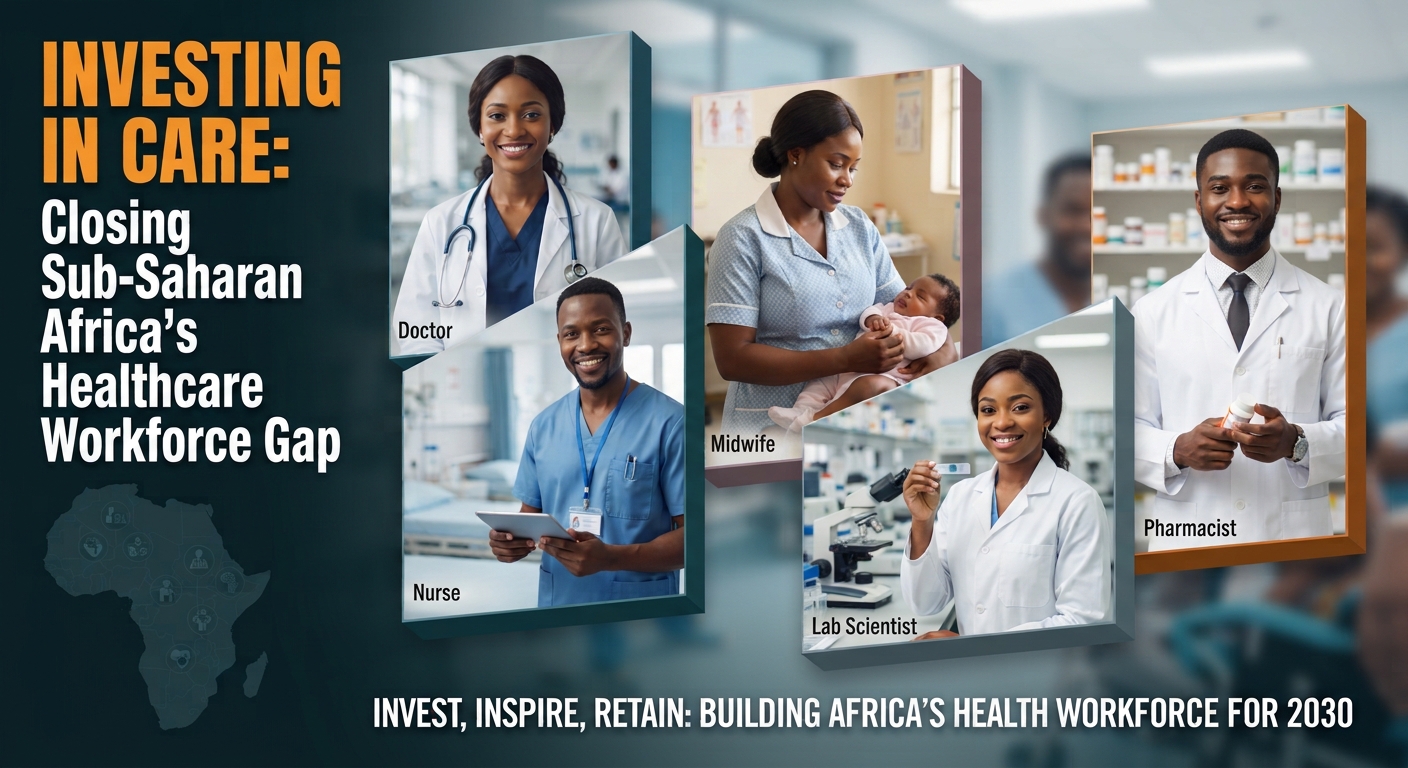 .
Image showing a collage of different categories of African healthcare workers captioned "Investing in Care: Closing Sub-Saharan Africa’s Healthcare Workforce Gap." The byline reads: "Invest. Inspire. Retain. Build Africa's Health Workforce for 2030!" Image credit: Gemini AI. Click image to enlarge.
Imagine walking into a crowded health center where patients line the hallways and spill out into the courtyard. Inside, a handful of exhausted healthcare workers rush to keep up. A single nurse juggles multiple critical patients, while a doctor briefly assesses one person before racing to the next.
This is the daily reality across public facilities in many sub-Saharan African countries. While patient volumes continue to rise, the healthcare workforce remains dangerously stagnant. Across the region, millions of people depend on a system that simply lacks the personnel to care for them. When a small fraction of professionals is forced to shoulder the needs of an entire community, the pressure on both the workers and the infrastructure becomes unsustainable.
Ultimately, this deficit dilutes the quality of care. Stretched far beyond their capacity, workers have less time to monitor conditions, attend to individual needs, or provide critical patient support. This makes the shortage far more than a logistical staffing problem—it is a direct threat to patient well-being across the continent.
This article explores how healthcare workforce shortages compromise patient care, examines the systemic factors driving the crisis, and highlights potential solutions.
In 2024, approximately 5.72 million healthcare workers served a population of 800 million across the WHO African Region. While this workforce has expanded, it satisfies only 46% of the region’s actual healthcare needs [1].
This deficit becomes glaring when measured against the World Health Organization (WHO) benchmark of 44.5 doctors, nurses, and midwives per 10,000 people—the minimum ratio required to achieve median coverage for critical health development indicators. Currently, the region averages just 3.1 doctors and 13.3 nurses and midwives per 10,000 people. This combined ratio of 16.4 falls drastically short of the global standard [2].
When a healthcare system faces such acute shortages, the burden falls heavily on the remaining workforce. Fewer doctors, nurses, midwives, pharmacists, and laboratory professionals mean that available staff are severely overextended. This strain directly compromises their ability to diagnose illnesses, provide preventive care, support maternal and child health, and help patients manage chronic conditions.
Furthermore, this crisis is deeply unequal in its distribution. While cities and urban centers retain a higher concentration of professionals, rural and remote communities are left critically underserved. Where a patient lives heavily dictates the level of medical support they can access.
Without decisive intervention, the gap will continue to widen. The WHO projects that Africa’s healthcare workforce deficit could spiral to 5.85 million workers by 2030, underscoring a systemic challenge that threatens the core of the continent’s healthcare stability [1].
The acute shortage of healthcare workers across most sub-Saharan African countries stems from two primary, compounding factors: supply constraints driven by training and recruitment shortfalls, and workforce attrition accelerated by international migration.
At the center of this crisis is an inability to scale the domestic healthcare workforce. Due to severe fiscal and budgetary limitations, national governments consistently underfund medical education and public sector employment. Consequently, the pipeline of newly trained professionals cannot keep pace with rapidly growing demographic and epidemiological demands. This chronic under-recruitment leaves existing facilities understaffed, placing immense workload pressure on the remaining workforce and accelerating burnout.
This systemic underfunding persists despite high-level regional political commitments:
Despite these frameworks, actual investments remain critically low. World Health Organization (WHO) data indicates that public health spending across the African Region averaged just 7.1% of total government expenditure—less than half of the Abuja target [1].
The baseline deficit created by training and recruitment failures is further exacerbated by the significant departure of qualified professionals. Driven by a complex mix of domestic "push" factors and international "pull" factors, a significant portion of sub-Saharan Africa's limited medical workforce continues to migrate toward better-resourced healthcare systems in Western nations. This brain drain effectively subsidises wealthier health systems at the expense of local African populations [3].
Nigeria, Ghana, and Kenya have all recorded massive outward movements of healthcare professionals seeking opportunities abroad, severely exacerbating regional staffing shortages. Data from the World Health Organization (WHO) and national regulatory bodies highlight the accelerating scale of this migration [4]:
While these metrics track different stages of the migration pipeline—ranging from initial verification requests to actual relocation—they collectively underscore an unprecedented level of international mobility. When highly skilled workers exit far faster than domestic health systems can recruit, train, and retain replacements, chronic staffing shortages transition from systemic challenges into deep-seated institutional crises.
A complex matrix of push-pull factors accelerates healthcare worker mobility across sub-Saharan Africa, deepening regional shortages. While certain systemic deficiencies drive professionals out of the workforce, others actively hinder recruitment and long-term retention [3].
A robust healthcare workforce is essential not only for treating acute conditions but also for ensuring patients receive safe, dignified, and comprehensive attention throughout their treatment. Within sub-Saharan Africa, acute staffing shortages directly undermine healthcare delivery, eroding clinical quality across these six non-exclusive primary areas:
Resolving healthcare worker shortages in sub-Saharan Africa requires a strategy that goes beyond mere recruitment. Governments and health authorities must simultaneously invest in the workforce, develop data-driven strategies, and demonstrate the political will to enforce them. These three pillars—funding, policy, and leadership—are deeply interconnected; progress on one depends entirely on the stability of the others.
Adequate and sustainable funding is the foundation of any health system expansion. Increased public investment is critical to:
Without targeted, well-managed financial commitments, even the most comprehensive workforce plans will remain unimplemented.
Effective healthcare policies must be anchored in reliable data regarding workforce gaps, population demographics, geographical distribution, and migration trends. Data-driven policies enable governments to:
Strong leadership is indispensable to prioritise healthcare within national budgets, implement evidence-based policies, and guarantee that allocated funds are utilised efficiently.
Governments and health authorities must establish robust accountability mechanisms to monitor progress and systematically address structural gaps in recruitment, staff distribution, working conditions, and service delivery.
Concurrently, they must structure and implement sustainable retention strategies while respecting healthcare workers' rights to professional mobility and global migration. Ultimately, without sustained political commitment, even the most well-funded and meticulously designed health workforce policies will fail to yield meaningful, long-term improvements.
Finance, policy, and political will are fundamentally interdependent. Funding secures the vital resources needed to strengthen the health workforce, evidence-based policies strategically dictate how those resources are distributed, and political leadership ensures that these commitments are actively executed and monitored. If any single pillar is weak, systemic progress is undermined.
Furthermore, addressing healthcare workforce shortages requires a paradigm shift beyond mere recruitment. Governments and health authorities must proactively cultivate professional environments that attract and retain talent, ensuring that rural and underserved communities with the greatest clinical needs are no longer left behind.
Achieving a resilient, equitable, and sustainable health system in sub-Saharan Africa ultimately depends on well-coordinated cross-sectoral action across all three foundational pillars.
The severe shortage of healthcare professionals across sub-Saharan Africa is more than a systemic failure—it is a direct threat to human lives. When doctors, nurses and other frontline health professional workers are absent or limited, patients endure prolonged wait times, compromised treatment quality, and delayed care. The burden falls heaviest on those already pushed to the margins: rural villages, low-income families, expectant mothers, and the chronically ill. A healthcare system can only be as strong as its workforce. Until governments, regional and national partners actively deploy scalable solutions—such as improving national funding for health, incentivising rural healthcare, integrating digital health systems, and scaling robust localised training—millions will continue to be denied the care they deserve. The path forward is clear; the tools are available; what remains is the political will to invest in the people who keep Africa healthy.
1. World Health Organization Regional Office for Africa. Africa’s health workforce expands but shortages, unemployment and migration intensify: WHO report [Internet]. 2026 May 6 [Cited October 15, 2026]. Available from here.
2. World Health Organization Regional Office for Africa. Universal health & well-being [Internet]. 2026. [Cited October 15, 2026]. Available from here.
3. African Health Observatory Platform on Health Systems and Policies. New AHOP policy brief examines health workforce migration in Africa [Internet]. 2025 Nov 6 [Cited October 15, 2026]. Available from here.
4. World Health Organization Regional Office for Africa. The state of health workforce in Africa 2026: Plan, train and retain. [Internet]. Brazzaville 2026. [Cited October 15, 2026]. Available from here. PDF required.
5. World Health Organization Regional Office for Africa. African countries commit to train and retain 3 million more health workers by 2035. [Internet]. 2026 August 26. [Cited October 15, 2026]. Available from here.
Published: October 21, 2026
© 2026. Datelinehealth Africa Inc. All rights reserved.
Permission is given to copy, use, and share content freely for non-commercial purposes without alteration or modification, and subject to source attribution.
DATELINEHEALTH AFRICA INC., is a digital publisher for informational and educational purposes and does not offer personal medical care and advice. If you have a medical problem needing routine or emergency attention, call your doctor or local emergency services immediately, or visit the nearest emergency room or the nearest hospital. You should consult your professional healthcare provider before starting any nutrition, diet, exercise, fitness, medical or wellness program mentioned or referenced in the DatelinehealthAfrica website. Click here for more disclaimer notice.