Is Play-Based Preschool Right for Your Child? (Pros & Cons)
By Victory Onyenekwe. B.Sc. Ed Physical and Health Education. Freelance Health Writer. Medically reviewed by the DLHA Team.
10.26.2026
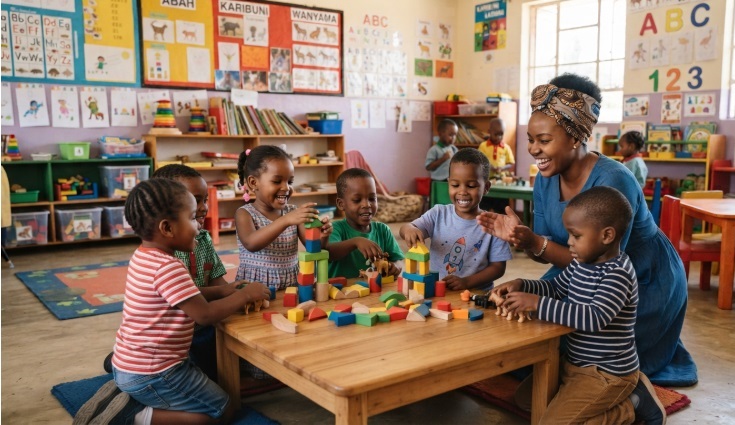
An African teacher teaches a group of preschoolers using building blocks. Image generated by Google Gemini. Click on image to enlarge.
.
Highlights
- Early childhood education goes far beyond rote memorization and direct instruction. Integrating play-based learning ensures a well-rounded foundation for young learners.
- Play-based learning is a strategic learning experience where children are taught through play.
- Misconceptions regarding classroom play, academic performance anxiety and the desire for visible traditional metrics make many parents hesitant to embrace play-based early childhood learning.
- Play-based learning directly supports young African children by building social skills, improving cognitive processes and encouraging lifelong academic curiosity.
Introduction
There are a lot of misconceptions around using play as a tool for learning in schools. For most parents children can only learn through worksheets and not toys or games. Teachers agree that play supports learning but most families in urban families do not actually believe that play can be a tool for learning, literacy and mathematics in young children. In this article we learn why parents are sceptical about play-based preschool learning and how it benefits African preschoolers.
What is Play-based Preschool?
A play-based preschool is an early childhood educational program where children choose many of their own activities based on their interests, while teachers gently guide learning. It uses self-directed play, exploration, and hands-on activities as the primary way for children to learn and grow
The learning experiences in play-based preschool help children explore literacy, science, maths, creativity and social understanding in ways that feel natural and enjoyable.
Categories of Play-based Learning
- Child-led Learning: In this form of play-based learning, the child makes the choice of what, when and how to play with little to no guidance from the teacher. The teacher only observes to ensure the activity being carried out is safe. An example would be letting a child play with toys or roleplay.
- Mutually Directed Learning: Here the teacher creates activities based on the interests of the child. Providing materials and asking questions that direct the play. The child still decides the direction of play while exploring interests and organising materials that have been provided. An example would be transforming the classroom into a real life scenario e.g. hospital and providing the props for the activities to be carried out.
- Teacher Guided Learning: The teacher decides the learning activity which often comes with learning objectives. An example of this would be providing props or toys to teach a maths, science or arts class.
Types of Play-based Learning
- Sensory play: using sand, water, paint or playdough to make different items.
- Roleplay: Playing real life scenarios, characters or community with props e.g. imitating a doctor, lawyer or artisan, simulating a scene from a shop, school or hospital.
- Constructive play: using building blocks or puzzles to improve fine skills and spatial awareness.
- Physical play: running, dancing, climbing to improve gross motor skills and physical health.
- Structured games: board games and card games that teach basic math concepts, turn-taking and patience.
- Exploratory: simple science experiments, arts and crafts that are age-friendly and conducted under the teacher’s supervision.
Pros: Benefits of Play-based Preschool
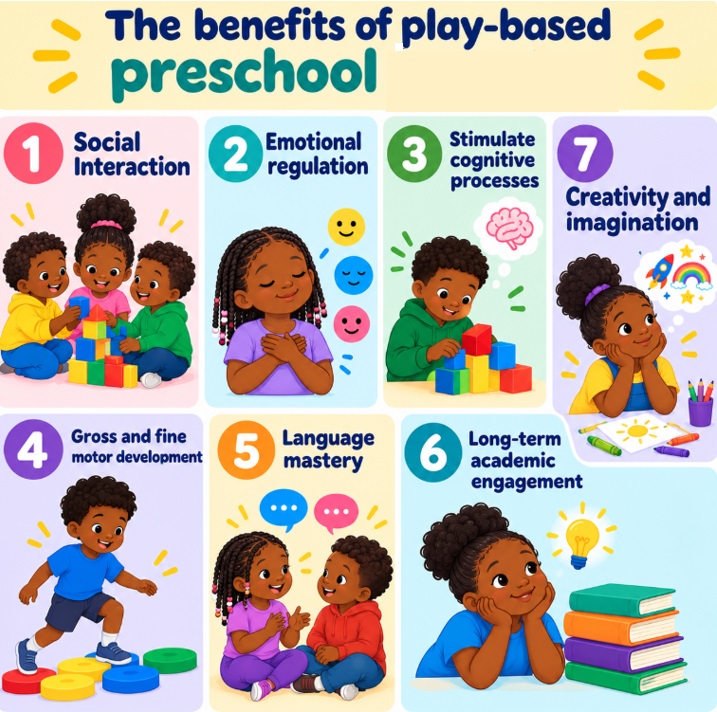
Infographics displaying the benefits of play-based preschool for early child development. Image generated by Google Gemini. Click o image to enlarge.
Far from being a form of aimless distraction or a waste of time, play-based learning is an intentional, structured form of learning that provides preschoolers with access to a diverse range of learning tools through simple, engaging experiences. Highlighting its benefits can transform parental attitudes towards play-based learning for African preschoolers:
- Social Interaction: Through play-based school, children interact with peers and develop social skills. They learn how to share, take turns, negotiate and communicate effectively.
- Emotional regulation: Children learn to self-regulate, manage their emotions, solve everyday problems and develop task persistence. Key factors that predict long-term academic success far better than early rote memorization.
- Stimulate cognitive process: Simple games like building with blocks or sorting shapes stimulate cognitive developments including memory and attention without causing early cognitive stress.
- Gross and fine motor developments: Many play activities require physical movement that require both fine and gross motor skills.
- Language Mastery: Playing with other children teaches kids how to speak clearly, expand their vocabulary, accelerate language acquisition and build social intelligence.
- Long term academic engagement: Early direct instruction can lead to burnout and disinterest in academics, whereas play-based learning fosters curiosity and a positive association with school environments.
- Creativity and imagination: Play-based learning fosters a conducive environment for creativity and imagination to flourish, giving children the freedom to explore different ideas and scenarios.
Cons: Why Some Parents Are Sceptical
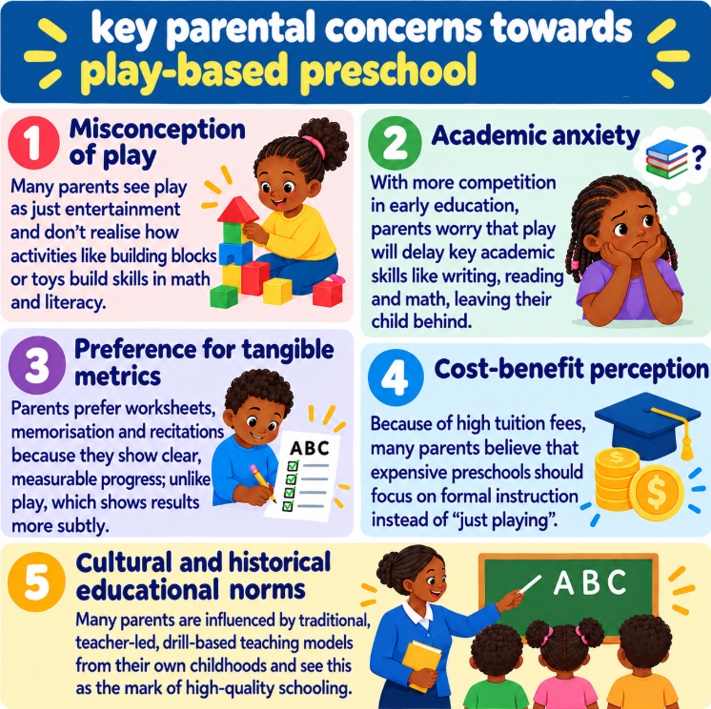
Infographics displaying some reasons for parental skepticism towards play-based learning. Image generated by Google Gemini. Click o image to enlarge.
The reasons for parental concerns about play-based preschool vary but key factors include:
- Misconception of play: Parents may view play as entertainment or recreation rather than an active tool for learning. From the outside, play-based preschool activities can look unguided or chaotic, which gives the appearance of being fundamentally different from structured academic learning. Many parents do not see how building blocks, or playing with toys can translate to math and literacy skills.
- Academic anxiety: Increasing competition in early primary education leads parents to believe that play can delay structured academic preparation such as writing, reading, or math. As a result, they assume the time a child spends playing will leave the child falling behind in core academic skills.
- Preference for tangible metrics: Worksheets, memorizations and recitations offer direct measurable output that make academic progress visible to many parents, compared to play which displays results more subtly.
- Cost-Benefit Perception: Considering the amount spent on preschools, parents often believe that paying high tuition fees means that the child should be engaged in formal instruction rather than “just playing”.
- Cultural and historical educational norms: Many parents measure high-quality schooling against the traditional, teacher-led, drill-based instruction models they experienced when they were young.
Conclusion
Early childhood education goes far beyond rote memorization and direct instruction. Integrating play-based preschool ensures a well-rounded foundation for young learners.
While parents are encouraged to look beyond the games and toys to see the cognitive benefits of play-based learning, schools and teachers must clearly communicate the purpose behind play. By bridging this understanding, educators and parents can work together to promote high-quality early learning for children across sub-Saharan Africa
RELATED SOURCES
Pretend Play Boosts Child Development, Study Says
How Play Builds Stronger and Smarter Kids
Published: October 26, 2026
© 2026. Datelinehealth Africa Inc. All rights reserved.
Permission is given to copy, use and share content for non-commercial purpose without alteration or modification and subject to source attribution.