The Hidden Toll of Advanced Prostate Cancer in Sub-Saharan Africa
By: Faith Hawi Ouma, MD. Medically reviewed by: A. Odutola, MBBS, PhD, FRCSEd.
October 16, 2026
A captioned image of the portrait of an older African in blue danshiki posing outdoor against a city landscape in the background. The image is captioned, "The Hidden Toll of Advanced Prostate Cancer in sub-Saharan Africa". Image credit: ChatGPT. Click on image to enlarge.
Prostate cancer is the commonest cancer affecting African men, and having access to clear but basic information of how the condition occurs, and how it progresses from a local growth to advanced stages is vital for improving prostate cancer awareness and treatment options across the region.
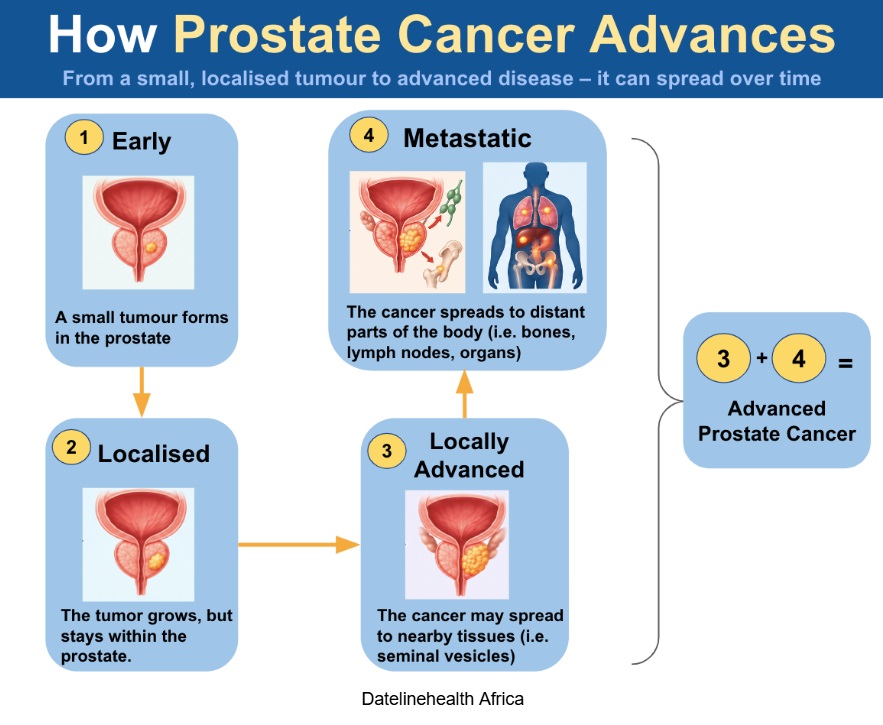
Infographic: How Prostate Cancer Advances.Created by the Faith Hawi Ouma for Datelinehealth Africa. Click on image to enlarge.
Advanced prostate cancer occurs when the tumour has extended beyond the prostate or cancer that has returned after initial treatment. There are different stages of advanced prostate cancer, based on how far the cancer has travelled from its original source and how it responds to hormone therapy:
Prostate cancer becomes locally advanced when the cancer cells break from the prostate to grow outside at nearby structures within the pelvis, such as the bladder, rectum, seminal vesicles (glands that help produce semen), or pelvic muscles [1].
At the metastatic stage, cancerous cells from the prostate have circulated the body, through the blood stream or lymphatic system, reaching sites outside the pelvis, such as lymph nodes, bones, the liver, or lungs [2].
This occurs when prostate-specific antigen (PSA), a marker used to track prostate cancer progression, rises despite initial treatment such as radiotherapy or surgery. While scans may not show the presence of a tumour and the patient may not report any symptoms, the increased levels of PSA suggest the risk of microscopic prostate cancer cells growing somewhere in the body [3].
Advanced prostate cancer is also classified based on the response to hormonal therapy, particularly in lowering testosterone. The two main distinctions are castration-sensitive or castration-resistant. Although these traits influence treatment selection and disease management, their detailed classification is beyond the scope of the article [4].
The majority of tumours are silent at the early stages, meaning that most men might not notice or report any symptoms. However, as the cancer develops into the advanced stages, more symptoms are experienced [1, 5, 6].
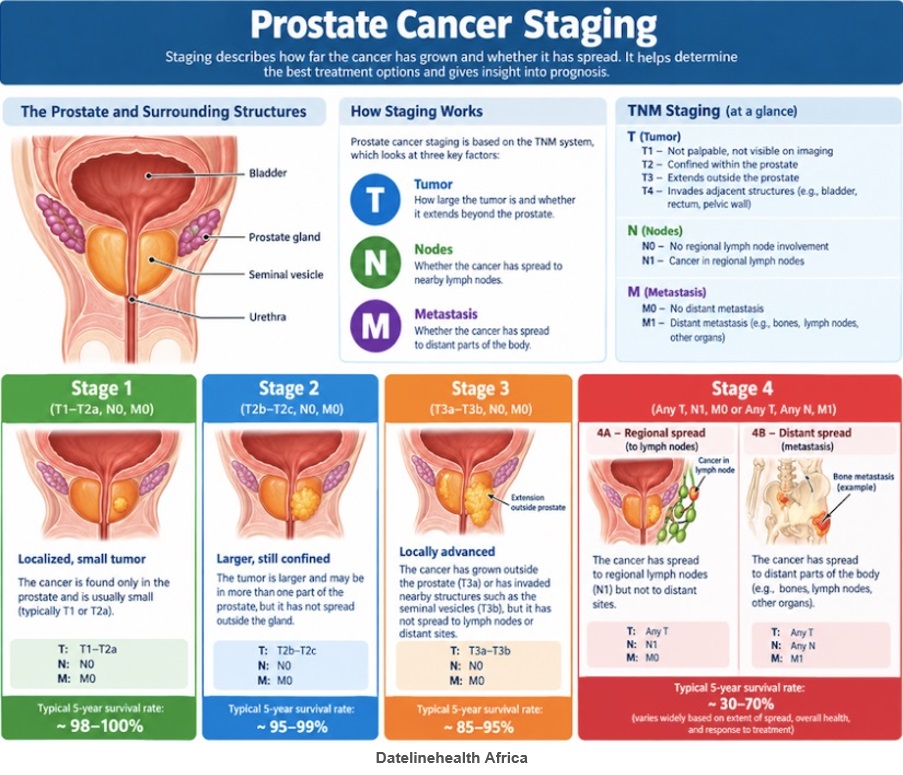
Fact Sheet: Prostate Cancer Staging. Image Credit: ChatGPT. Click on image to enlarge
Prostate cancer is diagnosed through a combination of:
History: During history taking, your doctor will ask several general and specific questions, including how you pass urine, how often you do so during the day and at night, whether it is difficult and or painful, whether you dribble urine after passage, etc.
Physical Examination: A key initial component of the physical examination is the digital rectal examination (DRE), where your doctor examines your prostate by inserting a finger through the anus (back body) to feel it for enlargement or irregularities through the rectal wall.
Blood tests: Among various blood tests that your doctor may order during your evaluation, is one called Prostate Specific Antigen (PSA) test. This measures the level of PSA, a protein produced by normal and cancerous cells in the prostate gland. When your prostate is enlarged, PSA increases. Also, when PSA is higher than normal, it could be a sign of prostate cancer.
Imaging tests. Imaging is fundamental to confirming the extent of spread of the disease. Tests such as Ultrasound, CT, MRI, PET, as well as bone scans may be ordered by your doctor to help determine whether the cancer has spread beyond the prostate to the lymph nodes, bones, or other distant sites [1]. These imaging results help clinicians evaluate tumour burden and the patterns of spread.
Your doctor will consider all the information from your asessments to determine the stage of the cancer, i.e., whether it is a locally advanced prostate cancer (Stage III) or metastatic prostate cancer (Stage IV). Staging helps doctors advise on the best treatment option and the likely outcome.
Why is Prostate Cancer Commonly Diagnosed at Advanced Stages in Sub-Saharan Africa?
.jpg)
A concerning issue in sub-Saharan Africa is that doctors commonly observe patients presenting with advanced prostate cancer at their first visit or during what is supposed to be a preventive checkup.
A 2021 study published in The Lancet Global Health revealed that 76.4% of men in sub-Saharan Africa are already in the advanced stages, Stage III or IV, of prostate cancer by the time they receive their diagnosis [7]. This statistic is mostly likely attributed to genetic and biological factors, demographics and lifestyle changes, lack of awareness, and cultural stigma around male reproductive health.
Men with African ancestry are more likely to develop prostate cancer at a younger age and more likely to be diagnosed with aggressive forms of the disease. [8].
Research suggests that genetics play a role in this increased risk. In 2022, researchers compared genetic profiles of prostate cancer in men of sub-Saharan African ancestry with those in men of European ancestry. Men of sub-Saharan African ancestry were found to have more genetic changes linked to aggressive prostate cancer, including genes that promote tumour growth and progression [9].
Another study found that African men have a greater number and diversity of genetic changes, which can interact and work together in ways that may make the cancer more aggressive [10].
These findings suggest that genetic factors may contribute to the higher burden of advanced prostate cancer seen in African men, although genetics alone does not fully account for the differences in outcomes.
Lifestyle and demographic changes also play a role in the growing burden of prostate cancer in Africa. As many African countries adopt western dietary and lifestyle habits, cancer rates may continue to rise.
Diet. A 2016 review of 12 studies found that men who followed a Western-style diet rich in processed foods, red meat, refined carbohydrates, and unhealthy fats had a higher risk of developing prostate cancer compared with those who consumed healthier diets [11].
Physical activities. Limited physical activity may also play a role. YuPeng Liu et al. reported that men who engaged in higher levels of physical activity had a lower risk of developing prostate cancer compared with less active men [12].
Together, these findings suggest that a healthy diet and regular physical activity may potentially reduce prostate cancer risk.
Ageing population. In addition, an aging population is another driving factor in the increased reports of advanced prostate cancer in Africa. WHO states that improvement in healthcare and life expectancy results in more men living into an older age, which is the strongest risk factor for prostate cancer [13].
The presence of prostate cancer awareness campaigns are inconsistent in sub-Saharan Africa resulting in a severe lack of understanding regarding the disease. Although there are public initiatives on healthy living and safe sex, not many show the relation of how these can reduce prostate cancer risk.
There are countries that have foundations, such as South Africa’s ‘Prostate Cancer Foundation of South Africa’, Kenya’s ‘Faraja Cancer Support’, and Nigeria’s ‘Men on Blue’ [14, 15, 16]. These organisations are popular, respective to their nations, and set out to educate men on prostate cancer risk factors, screening methods, and management. Unfortunately, other countries are still behind. Consequently, a severe lack of knowledge concerning prostate cancer among men, which has been reported in multiple studies, remains a significant public health concern [7, 17, 18, 19, 20, 21].
There is also a deficit in cultural inclusion when educating the public. According to a 2023 study, tribal groups in rural South Africa lack a translation for the word prostate, as the term does not exist in their vocabulary [22]. A most recent review also highlights communication barriers in prostate cancer care across sub-Saharan Africa, reinforcing the importance of culturally grounded health education [23]. Failure to account for these differences in awareness campaigns excludes a large population of African men, further contributing to late diagnosis.
The cultural mindset and common myth of prostate cancer in some countries of sub-Saharan Africa, is that it is a fatalistic end believed to be divine punishment, metaphysical causation, or a natural process of aging, creating a sense of inevitable doom on an individual level [17]. This misconception often leads to the conclusion that prostate cancer is an incurable sickness or curse, resulting in avoidance of biomedical screening.
In addition, there is the negative connotation associated with prostate screening, mainly the process of the DRE. Feelings towards this procedure are mainly those of humiliation, sense of bodily violation, and an offense on a man’s dignity. A 2026 study done in Nigeria reported that in Yoruba culture going through with preventative inspections could be viewed as a sign of weakness conflicting the masculine standards, such as strength and stoicism [24]. This creates a preconceived notion among many men to only seek medical attention when experiencing severe symptoms, which is often too late for curative interventions.
These cultural beliefs influence how men respond to illness within the family setting. Culturally taboo topics, such as adult-aged children bathing their parents or providing intimate care within the family, come up when faced with the possibility of having prostate cancer [18]. This challenges the African perceived notion to be the head of the household, to provide and protect the family, further contributing to poor help-seeking behavior and failure to adopt the ‘sick role’ [25].
There are multiple management approaches for treating advanced prostate cancer. Several options may be used depending on the extent the cancer has spread and the patient’s overall health.
The general therapeutic options include [2]:
Hormonal therapy. This is commonly the first line treatment, especially for advanced prostate cancer. The National Comprehensive Cancer Network Guidelines strongly recommends Androgen Deprivation Therapy (ADT). Details of ADT protocols are beyond the scope of this article.
Simply put, androgens, such as testosterone, promote cancerous cells to multiply and spread. Therefore ADT is crucial, causing programmed cell death in both normal and diseased prostate cells. Many men respond well initially, although the cancer can become resistant over time [19].
Chemotherapy. This is used in combination with hormonal therapy or when hormonal therapy is no longer effective. Drugs such as docetaxel or cabazitaxel aid in controlling widespread disease, reducing symptoms, and improving survival rate [1].
Radiotherapy. This plays a key role in treatment, used across multiple stages of prostate cancer. It targets areas of spread, relieves bone pain and helps control local tumour growth. Commonly, radiotherapy is combined with hormonal therapy for optimized results [26].
Immunotherapy & Bone-Targeted Care: This employs immune-boosting treatments or bone-strengthening drugs (like zoledronic acid or denosumab) alongside radiation and ADT to manage painful bone metastases and reduce skeletal complications [2].
Surgery. This may be used in limited ways in locally advanced prostate cancer to relieve urinary obstruction or manage spread and complications, with or without hormone therapy [26]. Surgical removal of the testicles (orchidectomy) has been substituted with hormone therapy as a preferred method to lower testosterone levels.
Watchful Waiting. This is an approach where treatment is delayed and the cancer is monitored over time, protecting day-to-day quality of life. Healthcare professionals direct this management style for slow growing cancers, especially in older patients or those with additional health problems. Rather than starting treatment, which may be associated with harsh side effects, doctors monitor symptoms and how the patient is feeling. The main goal is managing symptoms for comfort rather than a curative purpose. This is typically used when life expectancy is limited [27].
Palliative care. This is a core pillar in advanced and metastatic prostate cancer treatment. WHO defines palliative care as “an approach that improves the quality of life of patients and their families who are facing problems associated with life-threatening illness” [28]. This therapy encompasses pain relief, symptom management, emotional and mental healthcare, as well as caregiver support.
Treatment for advanced prostate cancer is limited in the African region due to financial burdens, inadequate infrastructure and equipment, lack of standardised national/regional treatment guidelines, limited skilled and qualified healthcare workers as well as medication shortages.
State of the art cancer treatment and care is expensive, and most sub-Saharan African countries are developing nations that face financial challenges in obtaining such resources. Makau-Barasa et al. analyzed prostate treatment cost in sub-Saharan Africa and found that out of the respondents from Ethiopia, Ghana, Nigeria and Zimbabwe, 80% of patients treated pay for services out-of-pocket [29]. It was also found that in these same countries, in addition to Kenya, Senegal, and Tanzania, the average cost for:
When currency conversion rate is factored in, these treatment prices are unaffordable to the majority of the population of sub-Saharan Africa.
In addition to treatment costs, most patients are located in rural areas and have to travel long distances to access health facilities, which adds to the expenses that they may be struggling with. The current international treatment guidelines for prostate cancer may not be the most financially fitting plan for African countries. The financial barrier to treatment draws attention to the need for health insurance schemes that cover the entire cancer care. As of 2022, there have only been reports on free prostate cancer treatment being provided by the governments in Botswana, Zambia, and Tanzania [29].
Lack of essential medicines, shortages in specialists personnel and functional treatment facilities place further constraints on access to advanced prostate cancer treatment.
The shortage of specialised urologists and oncologists, as well as functional treatment facilities, severely limits access to care, specifically in rural regions.
Cassell et al. reported that there is evidence of 22 chemotherapy drugs on the WHO Essential Medicine list in Africa, however, they remain inaccessible for most patients due to high costs and lack of trained oncology professionals for proper administration [20].
Likewise, radiotherapy is limited mainly due to the scarce nature of the facilities. Countries such as Burundi, Guinea Bissau, Liberia and the Central African Republic are reported to not have radiotherapy centers [21].
Medication shortages are also seen in pain management. Those suffering with advanced prostate cancer experience excruciating pain due to sensitive nerves and weak skeletal structures. While mild pain relievers, such as paracetamol, are available, stronger pain medication, such as codeine and morphine, are hard to acquire for most patients [18]. The ongoing opioid epidemic in Africa makes such treatment hard to obtain, even for cancer care patients. In 2020, it was reported that an estimated 20 million people, in low income countries, die each year with severe pain that could have been managed with stronger relievers [18].
Although some level of treatment is technically available for advanced prostate cancer, unique challenges faced in sub-Saharan Africa create an environment of both inaccessible and inadequate care. These contribute to the poor treatment outcomes and high burden of advanced prostate cancer across the continent.
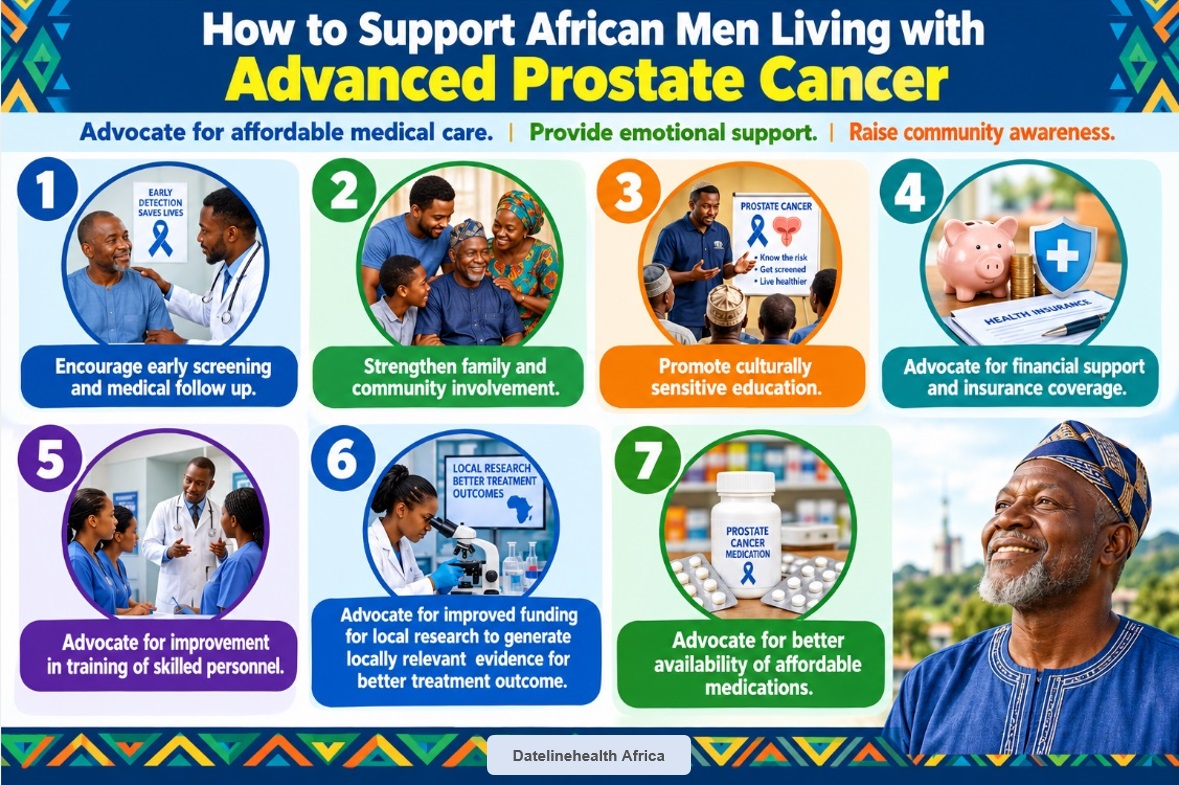
Infographic listing ways to support African men living with advanced prostate cancer. AI-generated with ChatGPT. Click on image to enlarge.
Supporting men living with advanced or metastatic prostate cancer encompasses medical care, emotional support and increased community awareness.
While early stage prostate cancer is often treatable and potentially curable, most African men are diagnosed at advanced stages, resulting in lowered survival rates and poorer clinical outcomes. Given this disparity, it is essential to encourage men over the age of 45, and younger men with family history, to speak with a healthcare provider about prostate cancer screening. Early detection saves lives, reduces suffering, and increases effective treatment options before prostate cancer becomes advanced and incurable.
1. Prostate Cancer UK. Advanced prostate cancer [Internet]. April 2023 [Accessed 15 Sept 2026]. Available from here.
2. Thomas TS, Pachynski RK. Treatment of Advanced Prostate Cancer. Missouri Medicine 2018;115(2):156–161. Available from here.
3. Care Partner Corner. About Advanced Prostate Cancer [Internet]. Care Partner Corner. 2025 [Accessed 29 Sept 2026]. Available from here.
4. Fizazi K, Attard G, Azad AA, Baciarello G, Beltran H, Bjartell A, et al. Advanced and metastatic prostate cancer: ESMO Clinical Practice Guideline for diagnosis, treatment and follow-up. Annals of Oncology [Internet]. 2026 Feb [Accessed 1 Oct 2026];. Available from here.
5. Adeniyi IA, Shehu UU, Ikumola EO, Mohammed SMA, Archibong V, Usman IM. Exploration of the Challenges in the Management of Prostate Cancer in East Africa. Clinical Genitourinary Cancer. 2026;24(5):102572. Available from here.
6. Chisti MM. Metastatic and advanced prostate cancer: [Internet]. Updated: 26 August, 2026. Medscape. [Accessed 15 Sept 2026] . Available from here.
7. Seraphin TP, Joko-Fru WY, Manraj SS, Chokunonga E, Somdayala NIM, et al. Prostate cancer survival in sub-saharan Africa by age, stage at diagnosis, and human development index: A population-based registry study. Cancer Causes & Control. 2021;32(9):1001–1019. Available from here.
8. Vapiwala N, Miller D, Laventure B, Woodhouse K, Kelly S, Avelis J, et al. Stigma, beliefs and perceptions regarding prostate cancer among Black and Latino men and women. BMC Public Health. 2021 Apr 20;21(1). Available from here.
9. Jaratlerdsiri W, Jiang J, Gong T, Patrick SM, Willet C, Chew T, et al. African-specific molecular taxonomy of prostate cancer. Nature. 2022 Sep;609(7927):552-559. doi: 10.1038/s41586-022-05154-6. Available from here.
10. Craddock J, Hayes VM. Epigenetic modulation of prostate cancer disparities in men with African ancestry. Nat. Rev. Urol. Nat Rev Urol (2026). doi: 10.1038/s41585-026-01157-4 2026 June 5 Abstract available from here.
11. Fabiani R, Minelli L, Bertarelli G, Bacci S. A Western Dietary Pattern Increases Prostate Cancer Risk: A Systematic Review and Meta-Analysis. Nutrients. 2016 Oct 12;8(10):626. Available from here.
12. Liu Y, Hu F, Li D, Wang F, Zhu L, Chen W, et al. Does Physical Activity Reduce the Risk of Prostate Cancer? A Systematic Review and Meta-analysis. European Urology. 2011 Nov;60(5):1029–44. Available from here.
13. World Health Organization (WHO) Regional Office for Africa. Understanding Africa’s prostate cancer prevalence, risks and prevention mechanisms [Internet]. 3 November 2025. [Accessed 17 Sept 2026]. Available from here.
14. Prostate Cancer Foundation of South Africa. Who We Are [Internet, n.d.]. [Accessed 15 Sept 2026] Available from here.
15. Faraja Cancer Support Trust. Information and Education. [Internet, n.d.]. [Accessed 15 Sept 2026] Available from here.
16. Nigerian NGO. Project Pink Blue and ACT Foundation help to raise awareness in the fight against prostate cancer. 30 July 2016. [Accessed 15 Sept 2026] Available from here. l
17. Benedict MO, Steinberg WJ, Claassen FM, Mofolor N. Enhancing public awareness and practice of prostate cancer screening among African men: A scoping review. South African Family Practice: 2023;65(1): a5621. e1–e11. Available from here..
18. van der Plas WY, Benjamens S, Kruijff S. The increased need for palliative cancer care in Sub-Saharan Africa. European Journal of Surgical Oncology. 2020; 46, 1373-1376. Available from here.
19. Schaeffer EM, Srinivas S, Adra N, An Y, Barocas D, Bitting R, et al. Prostate cancer, version 4.2023, NCCN clinical practice guidelines in oncology. Journal of the National Comprehensive Cancer Network. 2023;21(10): 1067–1096 Available from here.
20. Cassell A, Yunusa B, Jalloh M, Ndoye M, Mbodji MM, Diallo A, et. al. Management of advanced and metastatic prostate cancer: A need for a sub-saharan guideline. Journal of Oncology, 2019:1785428, 9 pages. Available from here.
21. Biyouma MDC, Gebreselassie, KH, Nedjim SA, Ziba OJD, Makon ASN, Kifle AT, et. al. Prostate cancer diagnosis and management: Current practices in Africa a consultant-based survey. Frontiers in Urology. 2025;5:1496951 Available from here.
22. Benedict MOA, Steinberg WJ, Claassen FM, Mofolo N, Rooyen CV. Knowledge, attitude and practice on screening and early diagnosis of prostate cancer of primary health care providers in the free state. African Journal of Primary Health Care & Family Medicine. 2023;15(1):e1–e12. Available from here.
23. Ofori B, Fosu Kwadwo, Aikins AR, Sarpong KAN. The intersection of culture and prostate cancer care in Sub-Saharan Africa: a systematic review. African Journal of Urology. 2025;31(41). Available from here.
24. Aluko-Arowolo S, Oyafunke-Omoniyi C, Tamuno-opubo AT, Tobi AA, Nwaobilor OS. Cultural factors influencing prostate cancer screening uptake in Urban Ogun State, Nigeria: A review of evidence. Nigerian Medical Journal. 2026;67(1):1–14. Available from here.
25. Malika N, Ogundimu O, Roberts L, Alemi Qais, Casiano C, Montgomery S. African Immigrant Health: Prostate Cancer Attitudes, Perceptions, and Barriers. American Journal of Men’s Health. 2020;14(4):1557988320945465. Available from here.
26. National Cancer Institute. Prostate cancer treatment - Health Professional Version. [Internet]. Updated 20 May 2025. [Accessed 18 Sept 2026]. Available from here. .
27. Vrooman, L Watchful waiting. [Internet] Ebisco. 2014. [Accessed 29 Sept 2026] Available from here.
28. World Health Organization. Palliative care [Internet]. 5 August, 2020. [Accessed 22 Sept 2026] Available from here.
29. Makau-Barasa LK, Manirakiza A, Carvalho AL. Rebbeck TR. Prostate cancer screening, diagnostic, treatment procedures and costs in sub-saharan Africa: A situational analysis. Cancer Control: Journal of the Moffitt Cancer Center 2022;29, 10732748221084932. Available from here.
Related:
Published: October 16, 2026
© 2026. Datelinehealth Africa Inc. All rights reserved.
Permission is given to copy, use and share content for non-commercial purposes without alteration or modification and subject to source attribution.
DATELINEHEALTH AFRICA INC., is a digital publisher for informational and educational purposes and does not offer personal medical care and advice. If you have a medical problem needing routine or emergency attention, call your doctor or local emergency services immediately, or visit the nearest emergency room or the nearest hospital. You should consult your professional healthcare provider before starting any nutrition, diet, exercise, fitness, medical or wellness program mentioned or referenced in the DatelinehealthAfrica website. Click here for more disclaimer notice.