Can Prolonged Sitting Cause Low Back Pain? What Research Says
By: Zikra Akram, Final Year Medical Student, Freelance Health Writer and DLHA Volunteer. Medically reviewed by A. Odutola, MBBS, PhD, FRCSEd.
August 26, 2026

Image showing an African office worker experiencing low back pain after prolonged sitting at a desk. Image Credit: Chat GPT. Click on image to enlarge.
Picture this: You sit down to work in the morning and hardly notice the hours passing. You might be busy replying to emails, having online meetings, or preparing for your exam. Hours later you finally get up and your back hurts.
If this sounds like you, you might have wondered: Can sitting for too long cause low back pain?
Low back pain is already a major health issue worldwide. The World Health Organization (WHO) estimates that nearly 619 million people experienced it in 2020 and the numbers keep on rising, particularly in regions such as Asia and Africa. By 2050, it could hit 843 million.
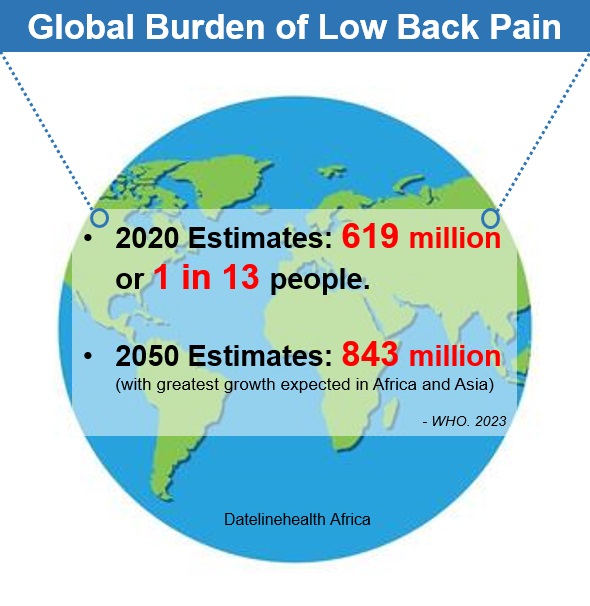
Infographic showing estimates of the global burden of low back pain in 2020 and 2050 created on a transparent background on a blue globe with lemon green maps of the world. Adapted from WHO, 2023. Click on image to enlarge.
So, what causes all this pain? Researchers have been investigating if there is any relationship between sedentary behaviour and low back pain, but the answer isn't as straightforward as “sitting causes back pain.”
To better understand this relationship, researchers conducted a systematic review and meta-analysis. Instead of doing a new experiment, the researchers looked at existing studies to see what they could collectively tell us about sedentary behaviour and low back pain. They identified 49 relevant studies and combined the results from 27 studies that had suitable data for meta-analysis.
The studies looked at different kinds of sedentary behaviour such as watching TV, using computers or mobile devices while working, playing video games and driving. They also investigated the relationship between sedentary behaviour and low back pain in different groups, including adults, children and office workers.
This gave them a chance to look beyond sitting alone and see how prolonged sitting fits into the bigger picture of low back pain.
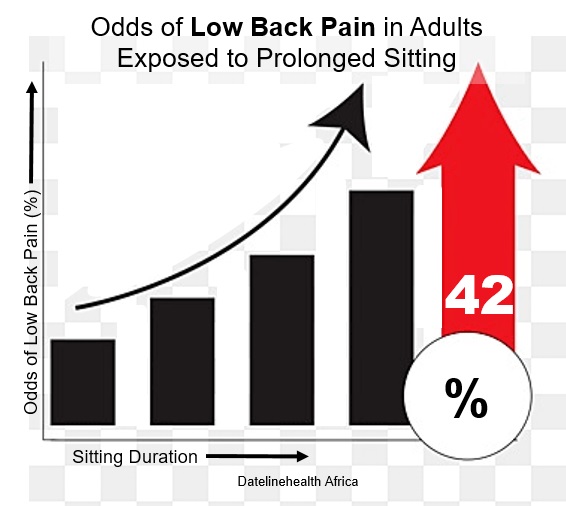
Histogram chart illustrates the odds (in percentage) of low back pain in adults exposed to prolonged sitting. Click on image to enlarge.
Researchers found that adults exposed to prolonged sitting had 42% higher odds of low back pain than those who were not exposed to prolonged sitting. However, this does not mean that sitting itself caused the pain.
The majority of studies included in the review were observational, meaning that researchers observed people's existing behaviours and health outcomes rather than assigning them to sit for a specific amount of time. Thus, the finding shows association, rather than causation.
Interestingly, not all studies were pointing in the same direction. One study involving 665 blue-collar workers found that longer periods of sitting at work were actually helpful for low back pain.
This suggests that the association between sitting and back pain might differ in different work environments. It may also be affected by the methodology and population of the different studies.
Other factors such as body weight and posture, type of work, and physical activity may also impact a person’s risk of low back pain.
This means that sitting is only one piece of the puzzle. Prolonged sitting may be one factor associated with low back pain, but it’s not able to explain every case.
Just like any research, this review has its limitations too.
First, many of the studies included were observational. Such studies can help identify the relationships between behaviours and health outcomes, but they cannot establish whether one caused the other.
Second, the studies varied in terms of participants, occupations and the methods used to measure sedentary behavior and low back pain. This makes it difficult to compare all of the findings directly.
Moreover, some studies relied on self-reported questionnaires which may cause recall bias. People may not be able to accurately recall or estimate the amount of time they spend sitting or how often they experience pain.
Another issue is that low back pain can have a variety of contributing factors. Physical activity, occupational demands, body weight and other individual characteristics may influence the relationship between sitting and pain.
.jpg)
Infographic illustrating the pooled lifetime prevalence of low back pain in Africa. Click on image to enlarge.
The findings are particularly relevant in Africa, where low back pain is already a significant health concern. Research suggests that the average lifetime prevalence of low back pain in Africa is about 47%, highlighting how widespread the problem is.
At the same time, sedentary lifestyles are becoming more common in modern African environments. As office workers and students, in particular, are spending more time sitting in front of their computers, the problem is not getting any smaller.
A recent systematic review of computer-using office workers across sub-Saharan Africa also highlights the relevance of the issue, as it revealed that low back pain was listed as one of the major complaints reported by office workers.
This makes prolonged sitting a relevant issue for people whose daily routines involve little movement, even though it is only one of several factors that may contribute to low back pain.
Researchers have proposed several possible mechanisms that could help explain the relationship between sitting and low back pain.
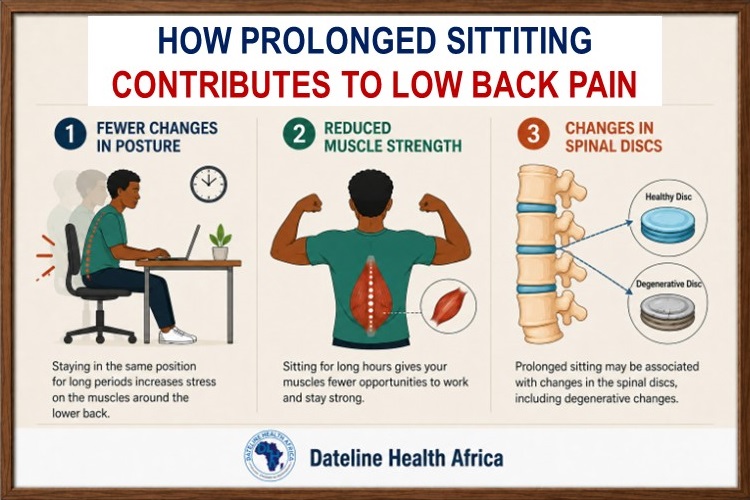
Infographic showing how prolonged sitting may contribute to low back pain through reduced posture changes, weaker muscles, and spinal disc changes. Image Credit: Nano Banana
Prolonged sitting may lead to decrease in postural changes throughout the day. Staying in the same position for too long means more stress on muscles near your lower back.
Another possibility is that spending too much time sitting gives your muscles lesser opportunities to work and stay conditioned. So they lose some of their power and aren’t as good at supporting you.
The discs between your vertebrae (bones of your spine) help cushion and distribute load through your spine, and they need movement to stay healthy. Researchers have proposed that prolonged sedentary behaviour may be associated with changes in their structures, including degenerative changes.
However, these mechanisms are proposed explanations rather than established causes. Low back pain is complicated and can involve a lot of factors. That is why more research is needed to understand exactly how prolonged sedentary behaviour may contribute to pain in different people.
Even if you are stuck behind a desk for hours, it doesn't mean you have to accept back discomfort as part of your routine. Making a few simple adjustments can ease the discomfort that comes with long hours of sitting.
The Canadian Centre for Occupational Health and Safety (CCOHS) says changing your sitting position regularly, rather than staying in one posture for too long, helps. Make sure your feet are flat on the floor, your back feels supported and upright, and your screen is positioned at a comfortable height that doesn't require you to constantly bend or tilt your neck.
The CCOHS recommends taking a 5–10-minute break after every hour spent at your desk. The purpose of the break is to stand up and move your body around a bit. You can also vary your tasks and include gentle stretches. A little movement goes a long way when it comes to keeping your back happy.
So, can prolonged sitting cause low back pain?
Research suggests that prolonged sitting is associated with low back pain, but it has not established that sitting alone causes it. The relationship appears to depend on a combination of factors, including physical activity, occupation and individual characteristics.
For people who spend much of their day sitting, the message isn't to avoid chairs altogether. The key is to pay attention to how long you are sitting and give your body regular opportunities to move. Adjusting your sitting position, taking movement breaks and staying physically active can all support better back health.
But if your back pain persists, keeps returning or interferes with your daily activities, it might be a good idea to speak with a healthcare professional to identify possible underlying causes.
Source:
Baradaran Mahdavi S, Riahi R, Vahdatpour B, Kelishadi R. Association between sedentary behavior and low back pain; A systematic review and meta-analysis. Health Promot Perspect. 2021 Dec 19;11(4):393-410. doi: 10.34172/hpp.2021.50. Available from here.
Related:
Low back pain: Causes, Symptoms, Diagnosis, Treatment and Prevention
Telehealth Solutions for Low Back Pain Care in Sub-Saharan Africa
Published: August 26, 2026
© 2026. Datelinehealth Africa Inc. All rights reserved.
Permission is given to copy, use and share content for non-commercial purposes without alteration or modification and subject to source attribution.
DATELINEHEALTH AFRICA INC., is a digital publisher for informational and educational purposes and does not offer personal medical care and advice. If you have a medical problem needing routine or emergency attention, call your doctor or local emergency services immediately, or visit the nearest emergency room or the nearest hospital. You should consult your professional healthcare provider before starting any nutrition, diet, exercise, fitness, medical or wellness program mentioned or referenced in the DatelinehealthAfrica website. Click here for more disclaimer notice.