DR Congo Bundibugyo Ebola Virus Outbreak, October 2026 Update
Tamunobelema Bamson. B.Sc. Microbiology. Health & News Reporter and DLHA Volunteer. Medically reviewed by the DLHA Editorial Team
October 15, 2026
.jpg)
Health workers in full protective gear fighting the Ebola outbreak in DR Congo. Photo Credit: WHO
The Democratic Republic of the Congo (DRC) is facing its largest Ebola outbreak on record, with thousands of confirmed infections and deaths. The outbreak which is caused by the Bundibugyo virus disease has also crossed borders, with Kenya reporting its first imported case that resulted in the patient's death. The developments have raised fresh concerns about cross-border transmission as health authorities continue efforts to identify infections, trace contacts and improve access to early treatment
In fact, the outbreak has been declared a Public Health Emergency of International Concern (PHEIC) by the World Health Organization (WHO), highlighting the need for countries to work together to contain the virus. Although some affected areas are reporting fewer new infections due to response from public health authorities, others continue to record cases. The response is further complicated by the lack of an approved vaccine or a specific treatment for the Bundibugyo virus disease.
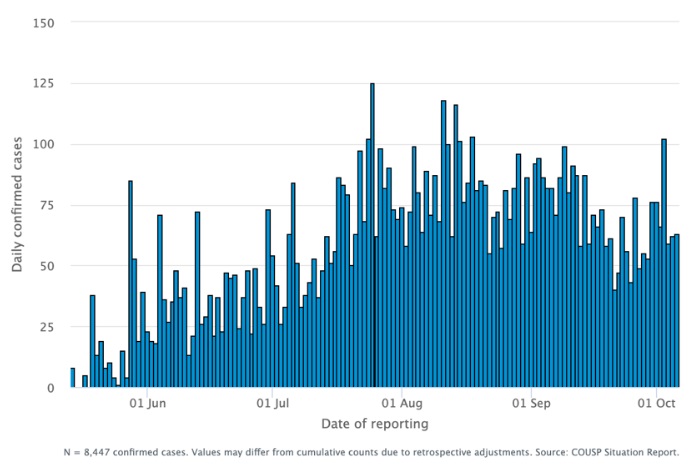
Number of confirmed Bundibugyo cases in the Democratic Republic of Congo from June 1 to October 1, 2026. Image credit: WHO. Click image to enlarge.
According to the World Health Organization (WHO), the Democratic Republic of the Congo (DRC) had recorded 8,728 confirmed cases, 4,205 deaths and 2,269 recoveries of the Bundibugyo virus as of October 6. This represents an increase of 775 confirmed cases and 379 deaths since WHO published its previous Disease Outbreak News on September 25. Overall, the figures translate to a crude case fatality ratio (CFR) of 48.2%, meaning that nearly one in two confirmed cases had resulted in death. Although this figure is a slight decline from the previously reported 48.3%, the continued rise in infections and deaths highlights the severity of the outbreak.
Beyond the growing death toll, the virus has also continued to spread into more areas of the country. By October 6, cases had been reported in 64 health zones, up from 61 previously. Among the newly affected areas, Alimbongo in North Kivu became the latest health zone to report infections, recording four confirmed cases, including two deaths. Meanwhile, Ituri remains the most extensively affected province, with cases reported in 28 of its 36 health zones. North Kivu follows, with 17 of its 34 zones affected, while Haut-Uélé and Tshopo have reported cases in seven of their 13 and 23 health zones, respectively. In addition, cases have been recorded in three of Bas-Uélé’s 11 health zones, one of South Kivu’s 34 zones and one of Sud-Ubangi’s 16 zones.
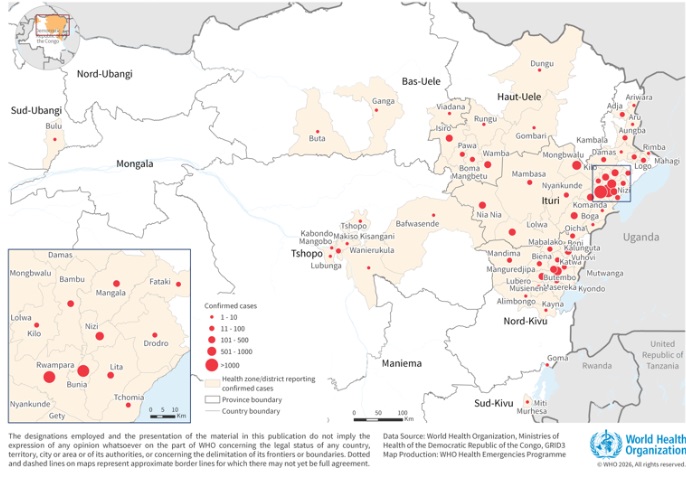
DR Congo map showing provinces within the eastern region with an intensifying Ebola virus outbreak. Image credit: WHO. Click on image to enlarge.
In terms of the provincial burden, Ituri has recorded 6,480 confirmed cases and 2,989 deaths. North Kivu, by comparison, has reported 1,755 confirmed cases and 1,013 deaths, giving it a CFR of 57.7%, the highest among the affected provinces. Haut-Uélé has recorded 364 cases and 153 deaths, while Tshopo has reported 51 cases and 17 deaths. Although the number of infections varies considerably between provinces, the continued spread across multiple locations shows that the outbreak remains geographically widespread.
Meanwhile, WHO reported 62 new confirmed cases in its latest 24-hour reporting period as of October 6. Its provincial breakdown listed 33 cases in Ituri and 30 in North Kivu, while no new cases were reported in Bas-Uélé, South Kivu or Sud-Ubangi. Across the preceding seven days, the average number of new cases had risen to 72 per day. Furthermore, 48 of the 64 affected health zones reported at least one new case in the preceding 21 days, while the remaining 16 recorded no recent cases.
The outbreak has also crossed international borders, with Kenya reporting its first imported BVD case in an infected Kenyan national with close association with the DRC.
According to the Kenya Ministry of Health, the first laboratory-confirmed imported case was reported on October 6, 2026. The patient, an adult who had been living in the DRC, reportedly fell ill about a month earlier and received treatment at several hospitals in the country before travelling by road to Kampala, Uganda, and then flying to Nairobi, Kenya, on October 3.
Although it remains unclear whether the patient was symptomatic during the journey, the individual was reportedly taken directly to Nairobi Hospital by a relative upon arrival and isolated at the facility. Samples were collected from the patient on October 5 and subsequently tested positive for Bundibugyo virus at both Kenya’s National Virology Reference Laboratory and the Kenya Medical Research Institute laboratory. Despite receiving supportive treatment, the patient later died.
Following confirmation, Kenyan authorities arranged a safe and dignified burial and launched public health response measures, including contact tracing among individuals who may have been exposed. Investigations also cover the international flight the patient took to Nairobi. However, the timeline of the illness has raised questions about when the infection occurred.
Given the approximately one-month interval between the reported onset of illness and death, the World Health Organization (WHO) has indicated that the patient may initially have been suffering from another condition before acquiring Bundibugyo virus in a healthcare facility or community setting while seeking treatment. The development has raised fresh concerns about cross-border transmission as health authorities work to identify and monitor people who may have been exposed.
Meanwhile, the outbreak has also involved the medical evacuation of an infected healthcare worker to the Netherlands.
On October 1, 2026, Dutch authorities reported that the worker had tested positive for BDBV by polymerase chain reaction (PCR) while working on the Ebola outbreak response in the DRC.
The individual was subsequently evacuated to the Netherlands under strict medical and infection-prevention procedures, in coordination with health authorities in both countries. Although the evacuation brought another infected person outside the DRC, WHO has stated that it will not count the case as a locally acquired infection in the Netherlands. Instead, it remains associated with the outbreak in the DRC.
Health authorities in the Democratic Republic of Congo (DRC), Uganda and Kenya, in collaboration with the World Health Organization (WHO) and other partners, are continuing to implement extensive public health measures to contain the outbreak and limit further transmission of the virus. Click here to learn more.
Conclusion
The Ebola outbreak caused by Bundibugyo virus remains a serious public health concern for the DRC and the wider African region. Although health authorities and their partners are working to detect cases, trace contacts, provide treatment and prevent further transmission, conflict, weak infrastructure, limited funding and unknown chains of transmission continue to make the response difficult.
With no approved vaccine or specific treatment for Bundibugyo virus disease, early detection and strong infection prevention remain especially important, staying informed, practicing preventative measures, and supporting public health efforts, communities can play a vital role in controlling the spread. Ebola is deadly, but with awareness, early action, and collective responsibility, it can be contained.
World Health Organization (WHO). Ebola disease caused by Bundibugyo virus - Democratic Republic of the Congo. [Internet] 2026 October 8. Geneva. [Cited 2026 October 15]. Available from here.
Related:
WHO Warns of Intensifying Spread of New Ebola Virus Strain in DR Congo
New Ebola Outbreak in DR Congo and Uganda, 2026
Published: October 15, 2026
© 2026. Datelinehealth Africa Inc. All rights reserved.
Permission is given to copy, use and share content for non-commercial purposes without alteration or modification and subject to source attribution.
DATELINEHEALTH AFRICA INC., is a digital publisher for informational and educational purposes and does not offer personal medical care and advice. If you have a medical problem needing routine or emergency attention, call your doctor or local emergency services immediately, or visit the nearest emergency room or the nearest hospital. You should consult your professional healthcare provider before starting any nutrition, diet, exercise, fitness, medical or wellness program mentioned or referenced in the DatelinehealthAfrica website. Click here for more disclaimer notice.