The Double Threat: How Super El Niño Threatens Sub-Saharan Africa’s Food and Health
November 5, 2026.
By: Chinenye Abel. B.Tech, Information Systems. Dateline Health Africa Volunteer. Medically reviewed by the DLHA Editorial Team.
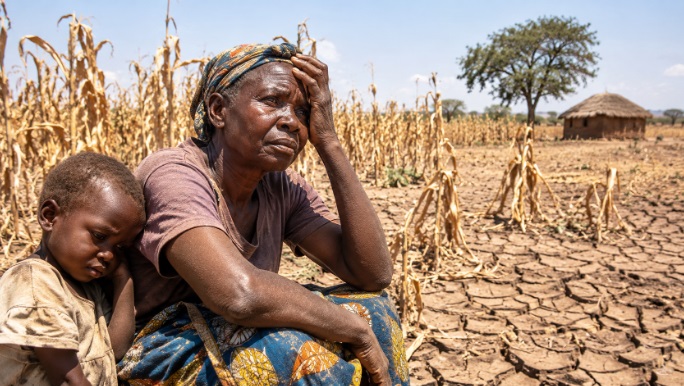
A South Sudanese mother and child sit in a dry, cracked field surrounded by withered crops, reflecting the devastating impact of drought on farming communities. Image credit: ChatGPT. Click image to enlarge.
Imagine a mother seated with her four young and hungry children inside a dimly lit thatched hut somewhere in South Sudan. Drought has devastated her community, and she also struggles to provide for her family. Outside the hut lies a once-productive field of maize and sorghum, now dry and brittle, while shrinking water sources force women and girls to travel long distances in search of water.
Her experience reflects the devastating consequences of extreme weather on vulnerable communities. In September 2026, the US National Oceanic and Atmospheric Administration (NOAA) forecast a 75% chance that the developing El Niño would exceed the strength of previous events since 1950 during October–December 2026. By mid-October, the weekly Niño 3.4 index had reached +3.3°C, indicating exceptionally warm sea-surface temperatures in the central and eastern Pacific.
Across sub-Saharan Africa, the effects could extend beyond agriculture. For farmers, herders and food markets, the question is not whether rainfall will change but where, and how ready governments and communities are for the impacts. This article examines what El Niño is, how it threatens food security and public health across Sub-Saharan Africa and why early action matters.
El Niño is a climate pattern that occurs when surface waters in the central and eastern Pacific Ocean become unusually warm. This warming affects atmospheric circulation, changing rainfall patterns and temperatures in different parts of the world.
Under normal conditions, trade winds push warm surface water towards the western Pacific. During El Niño, these winds weaken, allowing warm water to spread eastwards. This changes where clouds form and rainfall occurs, influencing weather patterns far beyond the Pacific Ocean.
Across sub-Saharan Africa, the 2026-2027 El Nino is projected to produce different effects depending on the region:
These patterns are not guaranteed. Other climate systems and local conditions also influence rainfall. Rising global temperatures can further intensify drought impacts by increasing evaporation and drying out soils.
Southern Africa faces a heightened risk of drought during the 2026/27 rainy season as El Niño strengthens. The Southern African Development Community (SADC) forecast below-normal rainfall across much of the region, including Zimbabwe, southern Zambia, Mozambique and parts of South Africa. Drier conditions are also expected to persist in several areas between January and March 2027. However, the severity of the drought will depend on local rainfall patterns and other climate influences.
Maize is a major staple across Southern Africa, and much of the region's production depends on rainfall. When rains arrive late, dry spells last longer or temperatures rise, crops may struggle to germinate and grow. Insufficient water during critical growth stages can reduce yields, while drought also limits pasture and water supplies for livestock. These effects can reduce both household food supplies and farmers' earnings.
The region has already experienced the consequences of a severe El Niño-related drought. During the 2023/24 season, poor rainfall damaged crops across several countries, including Malawi, Zambia and Zimbabwe. South Africa's maize production fell by approximately 15% compared with the previous season. This matter beyond South Africa itself: the country accounted for about 70% of Southern Africa's maize production in that season and is a major regional supplier.
When harvests fall, the amount of maize available for households, traders and neighbouring countries may decline. Countries that produce less maize than they need may have to increase imports, sometimes from outside the region. If supplies tighten while transport and other costs remain high, maize prices can rise, making food harder for low-income households to afford.
The risk is therefore not limited to crop losses. Reduced harvests, lower farm incomes and rising food costs can combine to worsen food insecurity, particularly for households that already struggle to afford enough nutritious food.
El Niño is expected to increase the likelihood of heavy rainfall across parts of East Africa during the October–December 2026 rainy season. The regional forecast indicates a high probability of above-average rainfall in southern Ethiopia, central and southern Somalia, and parts of Kenya. Excessive rainfall can trigger flooding, landslides and damage to infrastructure.
Heavy rainfall can cause rivers to overflow and overwhelm drainage systems, flooding homes, roads and farmland. Communities living near rivers and in low-lying urban areas are particularly vulnerable. Flooding can also damage bridges and isolate communities, making it harder for people to access food, clean water and essential services.
The 2023 El Niño season demonstrated the scale of this threat. Floods associated with El Niño and a positive Indian Ocean Dipole affected approximately 3.5 million people and displaced more than 1.8 million across the East and Horn of Africa between July and November 2023.
Floodwater can destroy crops, wash away fertile topsoil and damage stored food. Excessive rainfall can also waterlog fields, delaying planting and reducing crop yields. For households already struggling with food shortages, another poor harvest can mean less food at home and greater dependence on markets or humanitarian assistance.
Flooding can also kill livestock and damage grazing areas, threatening the income and food supplies of pastoralist communities. These losses are particularly concerning where families have not fully recovered from previous droughts.
Flooding can contaminate drinking-water sources with sewage and other pollutants, increasing the risk of waterborne diseases such as cholera. Flood-related environmental changes can also increase the risk of diseases such as malaria in some locations. Following the 2023 floods, health authorities reported increased cases of cholera, malaria and dengue fever in affected parts of the Greater Horn of Africa.
With severe food insecurity already affecting vulnerable communities, the forecast heavy rains could compound existing problems. The extent of the damage will depend on where and how it rains heavily, local flood preparedness and the ability of communities and governments to respond.
El Niño's influence on West African rainfall is less consistent than its effects in Southern and East Africa. However, changes in rainfall and rising temperatures can create challenges for farming communities, particularly when dry spells or excessive heat occur during important growing periods.
Changes in rainfall can affect planting seasons, soil moisture and crop development across West Africa. When rainfall is insufficient, crops such as maize, rice and millet may struggle to grow, reducing harvests and farmers' income. High temperatures can increase water loss from soil and crops, making dry conditions more damaging.
The effects are not the same everywhere. Some areas may experience rainfall shortages, while others may receive heavy rainfall that causes flooding, soil erosion and damage to farmland. These contrasting conditions can make agricultural planning difficult, especially for farmers who depend on rain-fed production.
Higher temperatures can increase the risk of heat-related illness, particularly among farmers and other outdoor workers who spend long hours in the sun. Extreme heat can also affect children, older people and individuals with existing health vulnerabilities.
Changes in rainfall create additional health concerns. Heavy rainfall and flooding can contaminate drinking-water sources and increase the risk of diseases such as cholera. In some locations, changing environmental conditions may also influence mosquito populations and malaria transmission. Meanwhile, poor harvests can worsen food insecurity and increase the risk of malnutrition among vulnerable households.
Cocoa is particularly important to West Africa's agricultural economy. Côte d'Ivoire and Ghana together produce more than half of the world's cocoa, making their harvests important to farmers, national export earnings and global markets.
Cocoa trees are sensitive to changes in temperature and rainfall. Prolonged dry conditions can reduce soil moisture and place stress on trees, affecting pod development and production. On the other hand, excessive rainfall and persistent damp conditions can encourage black pod disease, which damages cocoa pods and reduces the quantity of cocoa farmers can harvest.
These pressures can reduce farmers' earnings and affect the supply of cocoa to international markets. However, cocoa production is also influenced by pests, ageing trees, farming practices and other environmental conditions, so production losses should not be attributed to El Niño alone.
At a glance
The three regions experience different climate-related risks at different times of the year, making region-specific preparation essential.
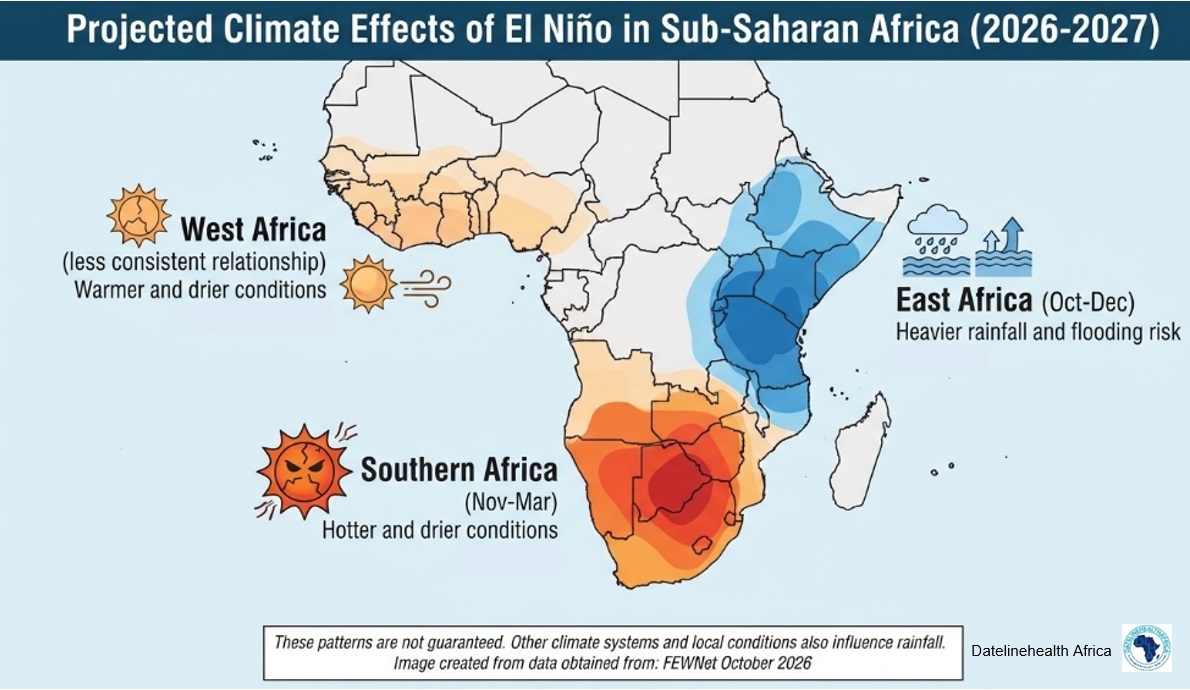
Infographic showing projected impact of El Niño on different regions of sub-Saharan Africa. Image Credit: Gemini AI. Click on image to enlarge.
Forecasts can give governments and institutions time to prepare for El Niño, but predicting a climate event does not automatically prevent its consequences. Early warnings must trigger timely funding, coordinated planning and practical interventions before communities experience the worst impacts.
Past events show why this matters. In June 2023, the World Meteorological Organization highlighted gaps in operational multi-hazard early-warning systems across countries participating in the CREWS East Africa initiative. This demonstrated the challenge of ensuring that weather information reaches vulnerable communities and leads to effective action.
The 2023/24 drought in Malawi provides another example. Government agencies and researchers recommended measures such as drought-tolerant crops, early-maturing varieties and improved water management. However, prolonged dry spells still caused significant agricultural losses. This shows that recommendations alone are insufficient without the resources and infrastructure needed to implement them.
Effective preparation requires region-specific interventions:
Early action also requires cooperation between governments, humanitarian organisations, agricultural agencies and healthcare institutions. Funding must be available before disasters occur, rather than only after communities have suffered major losses.
The central lesson is that early warnings must lead to early action. Governments and institutions have an opportunity to reduce the impact of El Niño, but that opportunity depends on preparation, adequate resources and coordinated responses.
Households can also take practical steps to reduce their exposure to extreme weather.
In flood-prone areas:
Across all regions:
The 2026 El Niño will test Sub-Saharan Africa's ability to turn climate forecasts into timely action. Southern Africa faces increased drought risks that could threaten staple crops and food supplies. East Africa faces the possibility of destructive flooding, disease outbreaks and further pressure on communities already experiencing food insecurity. In West Africa, changing rainfall patterns and higher temperatures could place additional stress on agriculture, health and cocoa production.
These threats extend beyond the environment. They affect people's health, livelihoods, access to food and ability to recover from climate-related disasters. Governments, humanitarian organisations, healthcare institutions and communities must therefore work together to reduce the risks.
With the event expected to persist through March–May 2027, the opportunity to prepare should not be wasted. Early action today could help protect lives, livelihoods and food security across the region.
1. Abbas A, Birungi M, Dingamdoum A, Girón A, Rarivoson V, Tosta H. As a mighty El Niño deepens global hunger, early action pays off [Internet]. World Food Programme; 2026 Sep 11 [Cited 2026 Nov 5]. Available from here.
2. Columbia University Center for Climate Systems Research; International Research Institute for Climate and Society.CCSR/IRI ENSO forecast: October 2026 quick look [Internet]. 2026 Oct 19 [Cited 2026 Nov 5]. Available from here.
3. World Meteorological Organization (WMO). CREWS East Africa Project Launch [internet]. 2023 Jun 10 [Cited 2026 Nov 5].Available from here.
4. Famine Early Warning Systems Network (FEWS NET). Humanitarian assistance likely to improve food security conditions in south [Internet]. 2024 Oct [Cited 2026 Nov 5]. Available from here.
Related: Dual Crises: How Flooding and Water-Borne Diseases Drain Sub-Saharan Economies
Published: November 5, 2026
© 2026. Datelinehealth Africa Inc. All rights reserved
Permission is given to copy, use and share content freely for non-commercial purposes without alteration or modification and subject to source attribution.
DATELINEHEALTH AFRICA INC., is a digital publisher for informational and educational purposes and does not offer personal medical care and advice. If you have a medical problem needing routine or emergency attention, call your doctor or local emergency services immediately, or visit the nearest emergency room or the nearest hospital. You should consult your professional healthcare provider before starting any nutrition, diet, exercise, fitness, medical or wellness program mentioned or referenced in the DatelinehealthAfrica website. Click here for more disclaimer notice.