No Prescription Required: Why Exercise is the Best Preventive Medicine
By: Oluwasola Samuel, freelance health writer. Medically reviewed by: A. Odutola, MBBS, PhD, FRCSEd.
November 6, 2026.
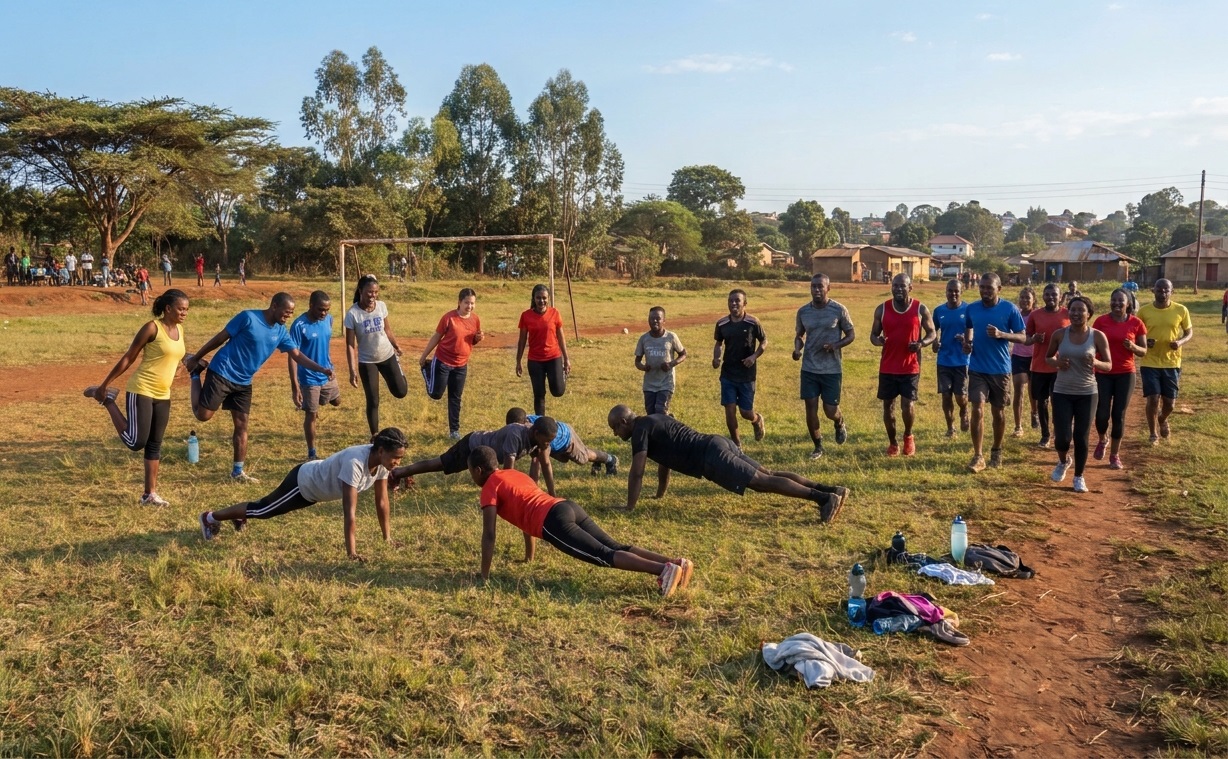
Image of African community members engaging in various exercises In an open field. Some are jogging, others are doing bench presses and some more are doing stretch exercises while standing on one leg. Image credit: Gemini AI. Click on image to enlarge.
Most of us only think about our health when something goes wrong. Maybe your blood pressure reading came back high, or your clinic visit ended with a new tablet due to your present health condition.
If that sounds familiar, you are not alone. Life can be busy, and exercise is easy to push aside. The good news is you don't have to wait for a warning sign before you act.
Regular exercise is one of the most powerful ways to protect your health. The World Health Organization (WHO) says staying active can lower your risk of early death, heart disease, high blood pressure, type 2 diabetes and some cancers. (1) Yet in 2022, more than 3 in 10 adults worldwide did not get enough physical activity.
Exercise is not magic, and it does not replace your medications or doctor. In this blog, you will learn why exercise is important, how much you need, and how to start safely.
Preventive medicine means stopping illness before it starts, or catching it early. Vaccines, blood pressure checks, and healthy daily habits all count as preventive medicine.
Think about the generator at home. You service it before it breaks down, because when it breaks down unexpectedly, it costs you more money and stress. Your body works the same way.
The CDC says regular physical activity lowers the risk of many chronic diseases, including heart disease, cancer and type 2 diabetes. (2)
So what happens inside your body when you move?
Exercise does not do this alone. It works best with a balanced diet, enough sleep, regular check-ups and any medication your doctor gives you.
If you have a family history of heart disease, diabetes or stroke, you may be worried about how it can affect you. The truth is that exercise can't erase your family history, but it can lower your risk.
Here is how exercise can help with each condition.
Your heart pumps blood to every part of your body every second. Over time, a fatty build-up inside your blood vessels can make pumping blood harder. High blood pressure and high cholesterol (fat in your blood) make it worse.
Regular activity eases the load. This helps your heart pump more blood with each beat, so it doesn't have to work as hard. Your blood vessels stay more flexible, and your cholesterol improves.
A brisk walk counts. You don't need a gym.
A stroke happens when blood flow to part of the brain is blocked, or when a blood vessel in the brain bursts. High blood pressure increases your risk of stroke.
Exercise works on the things that lead to a stroke. It lowers blood pressure, keeps blood vessels flexible, and helps with cholesterol, blood sugar and weight. The CDC lists a lower risk of stroke among the benefits of regular activity.
Blood pressure is the force of blood pushing against the walls of your blood vessels. When it is constantly high, it strains your heart and weakens or damages the walls.
Regular exercise brings that force down. Your heart pumps more blood with less effort, so there is less pressure on your blood vessels. It can take 1 to 3 months to see the change, and it lasts only while you keep exercising.
High blood pressure often has no symptoms, so many people don't know they have it until it becomes worse.
Get your blood pressure checked, even if you feel fine. If you already take blood pressure medicine, ask your doctor before any change.
Your body uses a hormone called insulin (a protein hormone produced by an organ in the body called pancreas) to move sugar from your blood into your cells for energy.
In type 2 diabetes, your cells stop responding to insulin well. Sugar then builds up in your blood.
When you move, your muscles use sugar for energy, so your blood sugar drops. Regular activity helps your cells respond to insulin better. And it builds muscle, which uses sugar as fuel even when you rest.
Doctors don't fully know how exercise lowers cancer risk, but the National Cancer Institute points to several reasons:
Keep your screenings up to date, even when you are active.
Not everyone starts exercising to avoid a disease. Many people just want to feel better in their daily life. Exercise helps with that and some other benefits like:
You don't have to wait months to feel a change. A single session of moderate to vigorous activity gives you immediate health benefits. So even on a tiring day, you can take a short walk.
think of exercise as more than a tool against disease. It is also a way to sleep better, feel steadier and stay independent for longer.
The WHO says adults should do 150 to 300 minutes of moderate activity a week, or 75 to 150 minutes of vigorous activity. For at least 2 days, add exercises that strengthen your muscles.
This can sound like a lot if you are new to exercise. The truth is that it is smaller than it looks. The minimum of 150 minutes is 30 minutes a day for 5 days.
Moderate activity includes brisk walking, cycling, dancing and heavy housework. Vigorous activity includes running, fast cycling and sports.
How to start with no gym:
Three 10-minute walks in a day add up because some activities are always better than none.
pick one thing you can do tomorrow, and keep it small. If you have a health condition, or you have not been active for years, you may need to see your doctor for advice before you start.
Exercise is powerful, but it has limits, and it helps to know them. Exercise does not replace your medicine, vaccines, or screening, like blood pressure checks, blood sugar tests or cancer screening. The truth is that active people can still get sick.
If you take medicine for a condition, never stop it on your own. If exercise improves your health, your doctor can decide whether your treatment should change.
You need to see a doctor before you start exercising if you:
You need to stop and get medical help if you feel:
Stop right away, rest, and call for help if the signs are strong or don't ease.
Most people can exercise safely. The risk goes up when you suddenly do much more than you are used to.
So start slow and build up gradually.
You don't need a perfect plan to protect your health. You need a first step.
Regular exercise lowers your risk of many health conditions. It also helps you sleep, think and feel better.
Aim for at least 150 minutes a week, build up slowly, and keep your check-ups and medicines in place. A short walk or jog today counts.
Exercise helps your heart and blood vessels work better, helps your body control blood sugar, lowers inflammation and helps prevent unhealthy weight gain. Together, these lower your risk of heart disease, stroke, type 2 diabetes and some cancers.
Yes. Regular, moderate exercise appears to support your immune system and may lower your risk of infections like colds. Very hard or very long sessions can briefly lower your defences, but don't overdo it. However, exercise alone can't guarantee you won't get sick. Quality sleep, a balanced diet, and managing stress levels matter too.
No. Exercise is not a cure. But a 2024 review of 218 trials in the BMJ found that exercise can reduce depression symptoms. (4) The authors say it could be considered alongside therapy and antidepressants. They also note that confidence in the evidence was low, so more research is needed.
No. Never stop a prescribed medicine on your own. Exercise can improve your health, and for some people it lowers the need for medicine over time. Only your doctor can decide whether your treatment should change.
1. Bull FC, Al-Ansari SS, Biddle S, Borodulin K, Buman MP, Cardon G, et al. World Health Organization 2020 guidelines on physical activity and sedentary behaviour. Br J Sports Med. 2020;54(24):1451-62. doi:10.1136/bjsports-2020-102955. Available from here.
2. Centers for Disease Control and Prevention. Benefits of physical activity [Internet]. Atlanta (GA): CDC; 2025 Dec 4 [Cited 2026 Nov 6]. Available from here.
3. FSH Staff. WHO updates physical activity guidelines [Internet]. Family Safety and Health Magazine; 2020 Dec 28. [Cited 2026 Nov 6]. Available from here.
4. Noetel M, Sanders T, Gallardo-Gómez D, Taylor P, del Pozo Cruz B, van den Hoek D, et al. Effect of exercise for depression: systematic review and network meta-analysis of randomised controlled trials. BMJ. 2024;384:e075847. doi:10.1136/bmj-2023-075847. Available from here.
Related:
Does exercise promote general health?
Best physical exercise for stroke patients
10 reasons Africans should exercise
Best exercise for healthy ageing in Africans (Tips)
Best exercise for blood pressure control] shows what works
Beyond Meditation: 5 Creative Habits for Daily Calm
Published: November 6, 2026.
© 2026. Datelinehealth Africa Inc. All rights reserved.
Permission is given to copy, use and share content for non-commercial purposes without alterations or modifications and subject to source attribution.
DATELINEHEALTH AFRICA INC., is a digital publisher for informational and educational purposes and does not offer personal medical care and advice. If you have a medical problem needing routine or emergency attention, call your doctor or local emergency services immediately, or visit the nearest emergency room or the nearest hospital. You should consult your professional healthcare provider before starting any nutrition, diet, exercise, fitness, medical or wellness program mentioned or referenced in the DatelinehealthAfrica website. Click here for more disclaimer notice.