Moving Past Cancer: How Exercise Powers Recovery and Longevity
By: Oluwasola Samuel, freelance health writer. Medically reviewed by: A. Odutola, MBBS, PhD, FRCSEd.
October 28, 2026
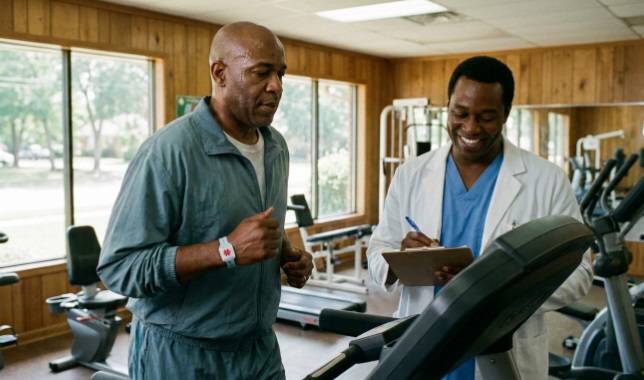
An African man with cancer exercising while his doctor watches and takes notes. Image Credit: Magnific AI, Click on image to enlarge.
When someone you love is told they have cancer, people begin to advise things like:
"You need to rest so you don't tire yourself.”
"Please stay in bed today."
"Don't carry anything heavy."
"Sit down, we will cook and clean for you."
In many African homes, these statements come from deep love. But is rest always the best answer for cancer? What if exercise helps people with cancer recover better and live longer?
While previous studies already recommend mild to moderate exercise to ease tiredness and improve quality of life, a recent study has found new and exciting benefits of exercise in people living with cancer.
In this article, we will break down what the new research says about exercise and cancer recovery and longevity, why exercise helps, what it could mean for Africans living with cancer, and the practical steps you can take to stay active safely.
In the new study, researchers wanted to know if structured exercise could help people with cancer live longer. To do so, they gathered results from 21 earlier clinical trials. Together, these trials included 8,449 people with cancer.
All 21 trials were randomised controlled trials. This means participants were randomly assigned to one of two groups. One group followed a supervised exercise programme. The other group did not. Because the groups were chosen by chance, the comparison between them is fairer.
The exercise programmes included aerobic exercise, strength training, or both. Aerobic exercise raises your heart rate, such as brisk walking or cycling. Strength training uses resistance to build muscle. On average, people were followed for about five years.
The study was led by researchers at the National Taiwan University and it was published in 2026 in the British Journal of Sports Medicine.
The results suggest exercise may help people living with cancer live longer. According to findings in this study, people who followed a structured exercise programme had a lower risk of dying and a lower risk of their cancer coming back. The benefits looked strongest in some groups more than others.
Compared to cancer patients in the non-exercise group, those in the exercise group showed the following benefits:
The study also found that people who exercised had a lower risk of their cancer returning. But exercise is not a guarantee. It works alongside your treatment and not a direct replacement.
Researchers rated the strength of this evidence as moderate. That means the results are encouraging, but should not be treated as final.
Exercise was not linked to better progression-free survival. It was also not linked to a better response to treatment. Also, exercise did not appear to shrink tumours in these trials.
However, researchers say exercise may help the immune system fight cancer. It may also improve blood flow inside tumours, which could help cancer treatments work better.
First, you need to know the trials underlying the study were conducted in countries like Canada, Germany, the US, the Netherlands, Australia, Japan, India, and not in any African country.
So it should not be assumed that the research findings apply directly African cancer patients.
Cancer is a big burden in most sub-Saharan African countries. In Nigeria alone, the International Agency for Research on Cancer estimates about 152,261 new cases, 90,795 deaths and 292,934 five-year existing cases.
Breast cancer is the most common cancer in Nigerian women, and it was also the most studied cancer in this research. About three in four people in the study had breast cancer.
The study found the benefit of exercise stronger in early-stage cancer. But many Nigerians are diagnosed late. A 2026 review of 125 studies, covering 42,689 patients with breast cancer across sub-Saharan Africa from 2014 to 2025, found that 63.1% were diagnosed at a late stage. In West Africa, the region where Nigeria sits, the figure was higher, at 71%. This does not mean exercise cannot help later-stage patients. It means that early checks matter, and your oncologist (cancer doctor) is the right person to say what is safe for your stage.
No. Exercise is not a cure. It is a support that works alongside your treatment. Never stop or delay treatment because you are exercising.
You may not have a supervised exercise programme nearby. That is common. Ask your cancer doctor or a physiotherapist what is safe for you. A caring family can help too. A relative who walks with you each evening, or a church or mosque group that checks in on you, can make it easier to keep going.
No study is perfect. Here are some of the limitations in this study:
However, the authors say doctors can reasonably recommend structured exercise as part of cancer care.
Research has shown that it is usually safe for most people to do some physical activity before, during or after cancer treatment. But what is safe for you depends on your cancer, your treatment plan and progress.
As the study did not suggest best exercise plans for people living with cancer, existing and well-known cancer guidelines give a safe place to start.
Here are four steps to begin exercise if you have cancer:
1. Talk to your doctor and ask what is safe for your stage and treatment.
2. Start small with 10 minutes of gentle walking. If you feel worse, stop and try later.
3. Build up intensity slowly. Guidelines from the American College of Sports Medicine suggest working towards 150 minutes of moderate activity a week, plus muscle-strengthening. Many people with cancer cannot reach this, moderate exercise is better than none.
4. Do it with someone. Walk with a relative or friend. It is safer and easier to keep going.
When to stop and call your doctor
Stop right away if you find it hard to breathe, or you have chest pain, new or worsening pain, sudden nausea, chills or shaking. Do not exercise if you have a fever or feel unwell.
This research suggests exercise can help people with cancer live longer. In 21 trials with 8,449 people, those who followed a structured exercise programme had a lower risk of dying and a lower risk of their cancer coming back.
Understand that exercise is not a cure, but it helps you to manage cancer. Most of the evidence came from breast cancer trials, none of the trials studied in the paper was conducted in any sub-Saharan African country, and the best type and amount of exercise are still unknown.
What is clear is that rest is important, but staying moderately active may help too. Speak to your doctor, start small, and exercise at your own pace.
Source: Tzang CC, Luo CA, Kuo VF, Huang ES, Kang YF, Su WY, et al. Structured exercise interventions and survival outcomes in patients with cancer: systematic review and meta-analysis of randomised controlled trials. Br J Sports Med. 2026;60(18):1434-42. doi:10.1136/bjsports-2026-111664. Available here.
Related:
Does exercise promote good health?
Short Bursts of Exercise Can Lower Risk of Major Diseases, Study Finds
10 Reasons African Should Exercise
Best Exercise for Healthy Ageing in Africans (Tips)
Health Effects of Exercise in African Females: Myths, Facts and Benefits
Exercise Is Vital to Men’s Mental and Sexual Wellbeing: Lessons for Africans
Published: October 28, 2026.
© 2026. Datelinehealth Africa Inc. All rights reserved.
Permission is given to copy, use and share content for non-commercial purposes without alterations or modifications and subject to source attribution.
DATELINEHEALTH AFRICA INC., is a digital publisher for informational and educational purposes and does not offer personal medical care and advice. If you have a medical problem needing routine or emergency attention, call your doctor or local emergency services immediately, or visit the nearest emergency room or the nearest hospital. You should consult your professional healthcare provider before starting any nutrition, diet, exercise, fitness, medical or wellness program mentioned or referenced in the DatelinehealthAfrica website. Click here for more disclaimer notice.