More Than Just Fun: How Play Builds Smarter, Stronger Kids
By: Rukhsar Jabbar. M.Sc. Physiotherapy. Freelance Health Writer. Medically reviewed by: Victory Onyenekwe. B.Sc. Ed Physical and Health Education.
July 29, 2026
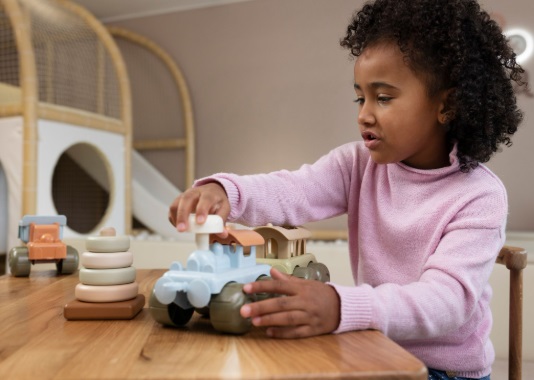
Side view of a girl kid playing with eco-toys on a table. Image credit Magnific
For kids, play may look like simple fun, but while they play the child's brain is growing in ways that are not visible. Play has a very important role in your child’s life and helps build skills like thinking, moving, relating to others, managing emotions, and using language. Play also has a role in raising self-confident, creative, and happy children.
When kids play games, they learn to handle challenges, show respect for each other, and share ideas. Simultaneously, their brain and motor development are enhanced during the years of early development
In this article, we explore how a child's brain develops while playing and recommend play-based activities that can help promote a child’s development (1, 2).
When kids play, their brain is always making new links and strengthening old ones. It's almost like making new pathways between different parts of the brain. Let us take an example to understand this. When your child runs, climbs, constructs with blocks, or engages in pretend play, the following changes are taking place:
Think of it like a path through a field of grass:
Play, especially in the early years, is essential for brain connections to develop and strengthen (1, 3, 4, 5).
Gross motor skills are big movements such as running, jumping, climbing, crawling, and throwing, while fine motor skills are small, precise movements such as pinching, gripping, and eye-hand coordination. Every time a child plays, they are strengthening both muscles and the brain-body link that govern these movements. For instance:
Because children have fun during play, they gladly repeat actions numerous times without feeling like they are "practicing." This makes play particularly successful.
Consider motor skills such as learning to ride a bicycle:
Every jump, throw, climb, and block stack teaches and develops their bodies, brains, and emotional intelligence (1, 5, 6).
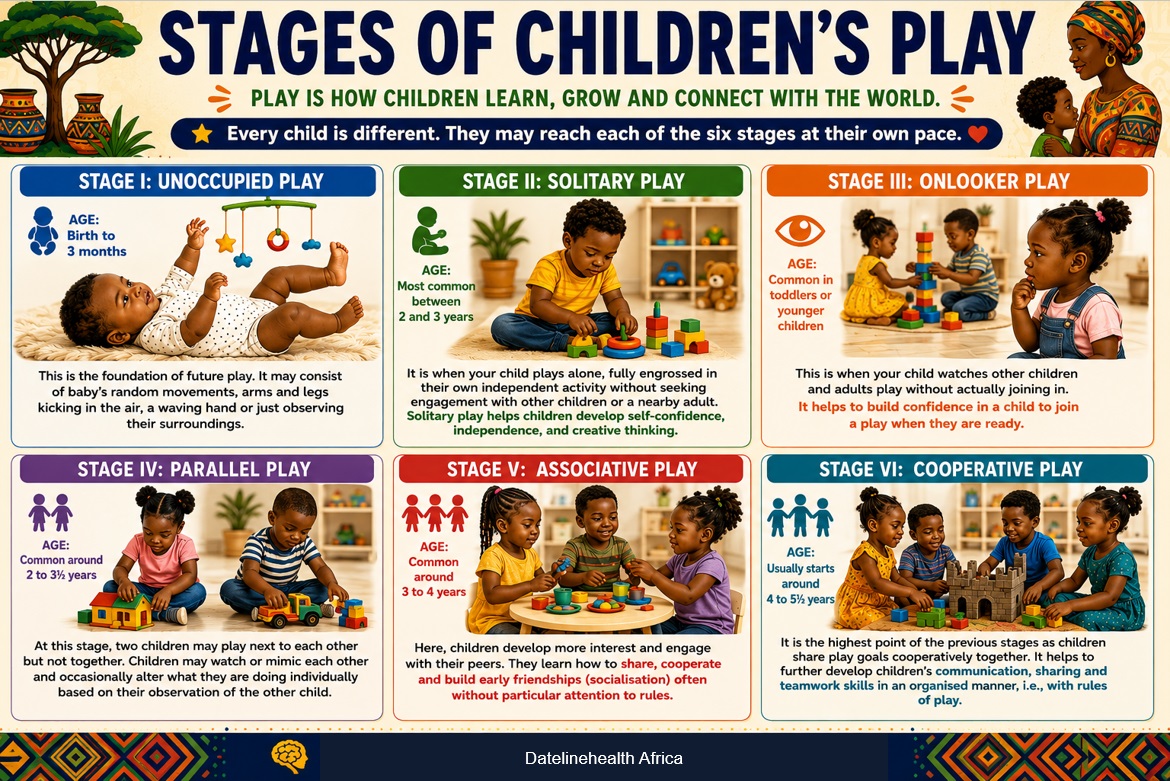
Info-poster showing the six stages of children’s play by age. Image credit: ChatGPT based on prompts defined by Datelinehealth Africa. Click on image to enlarge.
Play in children develops along six stages, with each stage building on the next your child grows and develops. Every child is different and may reach each of the six stages at their own pace.
Stage I: Unoccupied Play - This is the foundation of future play. It starts from birth to three months of age and babies do it automatically, while parents just watch. It may consist of your baby’s random movements, arms and legs kicking in the air, a waving hand or your baby just observing their surroundings.
Stage II: Solitary Play - This may start at any age but is most common between the ages of 2 and 3 years. It is when your child plays alone, fully engrossed in their own independent activity without seeking engagement with other children or a nearby adult. Solitary play helps children develop self-confidence, independence, and creative thinking
Stage III: Onlooker Play - This is when your child watches other children and adults play without actually joining in. It’s common in toddlers or younger children who are still developing language skills. Onlooker play helps to build confidence in a child to join a play when they are ready.
Stage IV: Parallel Play - This is common around 2 to 3 ½ years of age as two children play next to each other but not together. Children may watch or mimic each other and occasionally alter what they are doing individually based on their observations of the other child. Children in parallel play do not seek to influence what another child is doing as they will do if they are playing together
Stage V: Associative Play - This is common around ages 3 to 4 years as children start to develop more interest and engage with their peers. At this stage, children learn how to share, cooperate and build early friendships (socialisation) often without particular attention to structure.
Stage VI: Cooperative Play - This usually starts around 4 to 5 ½ years of age as children share play goals together cooperatively with others. It is the highest point of the previous stages. It helps to further develop children's communication, sharing and teamwork skills in an organised manner, i.e., with known rules of play.
Within these stages of play are also different types of play and children may engage in more than one type at a time.
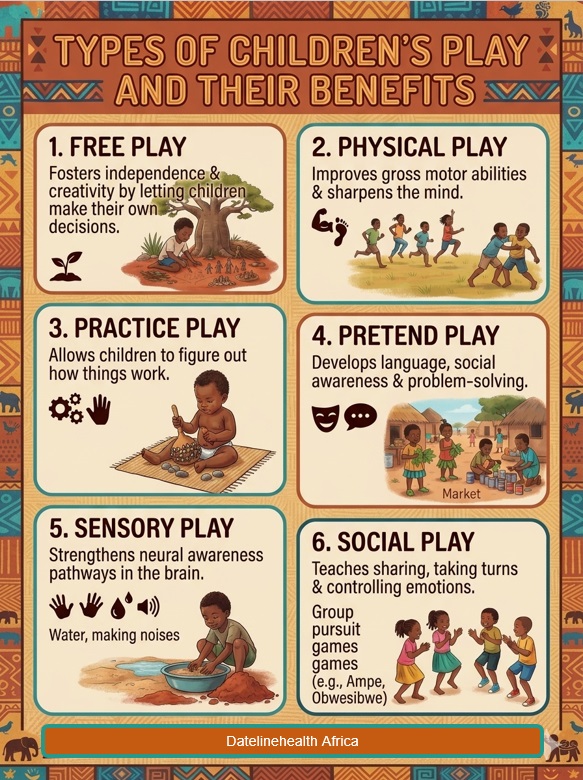
Info-poster illustrating the six types of children’s play and their benefits. Image credit: ChatGPT based on prompts defined by Datelinehealth Africa. Click on image to enlarge.
Play comes in different forms. The following are examples of different types of basic play that you may be familiar with from your own childhood.
These and other activities are all worthwhile. While your child may not require all categories every day, a combination of them over the week might have a significant impact.
It is, however, important to remember that there isn't just one "right" way to play. Children learn vital skills that support their learning, health, and well-being while they are playing with friends, pretending to be a teacher, running outside, or building with natural materials (2, 3, 6).
Which Play Activities Best Support Your Child’s Development?
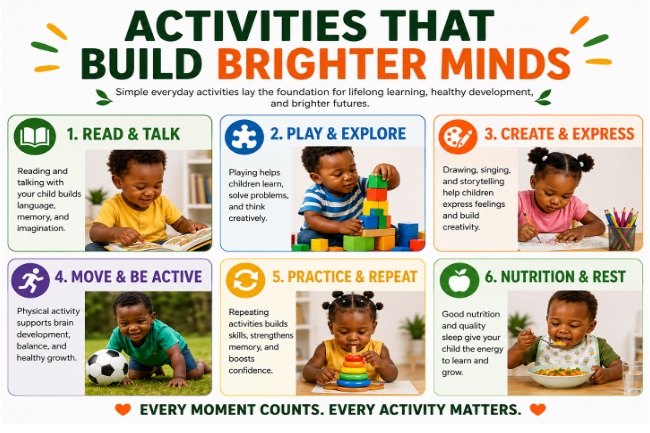
An infographic showcasing simple, fun activities that promote healthy brain development and learning in toddlers. Generated by ChatGPT. Click on image to enlarge.
Expensive toys are not necessary to support your child's development. Children can enjoy themselves while learning valuable skills through a variety of commonplace activities.
Remember that play doesn't have to be difficult. Even assisting in the kitchen—stirring, pouring, sorting, or picking things up—can be an enjoyable way to teach your child valuable life skills. (1, 2, 5).
It's important to schedule playtime each day. The good news is that play doesn't need to be organized or structured; it can occur at home, outside, or during regular activities.
As a general rule:
To move, explore, and engage with caretakers, babies require a lot of floor time.
Remember that quality is just as important as quantity. When given the chance to move, explore, imagine, and play with others, children gain the most. A combination of peaceful, creative, and vigorous play promotes learning, emotional stability, motor skills, and healthy brain development (7).
There is no need to strive for flawless results because each child learns at his or her own speed. The advantages of play frequently manifest in subtle, ordinary moments that are simple to overlook.
When your child tries new things, uses their imagination creatively, or comes up with novel solutions to issues while playing, they are growing self-assured. They might become more adept at handling small things, and they might feel more at ease dealing with adults and other kids. All of these indicate that they are growing and learning via play (1, 4, 8).
Above all, a child who is interested, inquisitive, and ready to explore is frequently learning vital skills, even if they appear to be “just playing.”
Play is crucial to children’s learning, development, and understanding of the world around them; it goes beyond simple amusement. Children gain confidence in their abilities, develop social and emotional skills, improve their balance and coordination, and grow their brains via play. Every playful moment offers a chance to learn. You can help your child’s healthy development in straightforward and significant ways by scheduling playtime each day.
Remember that when kids play, they are creating the groundwork for a lifetime of learning, development, and wellbeing rather than merely passing the time.
Right from infancy when they see faces, reach for things, listen to sounds, and investigate their environment, they learn through play.
Children’s play becomes more imaginative and active as they become older, assisting them in learning new abilities at every level.
Not at all. Children frequently pick up just as much knowledge from commonplace items and events as they do from toys.
Sand, water, sticks, boxes, containers, art supplies, and everyday objects can all stimulate imaginative and significant play. The chance to explore is more important than the toy’s price.
Indeed. Children can gain independence, creativity, self-assurance, and problem-solving abilities by playing by themselves. Playing with others is beneficial for kids as well, therefore it’s best to mix social and independent play.
For kids, learning and play are often simultaneous (concurrent) activities rather than distinct ones. Children learn about their bodies, their surroundings, other people, and themselves via play. A youngster frequently learns some of the most crucial life skills through what may appear to be “just playing.”
1. Yogman M, Garner A, Hutchinson J, Hirsh-Pasek K, Golinkoff RM; Committee on Psychosocial Aspects of Child and Family Health; Council on Communications and Media. The power of play: a pediatric role in enhancing development in young children. Pediatrics. 2018;142(3):e20182058. doi:10.1542/peds.2018-2058. Available from here.
2. UNICEF, The LEGO Foundation. Learning through play: strengthening learning through play in early childhood education programmes. New York: UNICEF; 2018. Available from here.
3' Hirsh-Pasek K, Golinkoff RM, Berk LE, Singer DG, editors. A mandate for playful learning in preschool: presenting the evidence. New York: Oxford University Press; 2009. Available from here.
4. Shonkoff JP, Phillips DA, editors. From neurons to neighbourhoods: the science of early childhood development. Washington (DC): National Academies Press; 2000. Available from here.
5. Brown S, Vaughan C. Play: how it shapes the brain, opens the imagination, and invigorates the soul. New York: Avery; 2009. Available from here.
6. Ginsburg KR; Committee on Communications; Committee on Psychosocial Aspects of Child and Family Health. The importance of play in promoting healthy child development and maintaining strong parent-child bonds. Pediatrics. 2007;119(1):182-91. doi:10.1542/peds.2006-2697. Available from here.
7. World Health Organization. Guidelines on physical activity, sedentary behaviour and sleep for children under 5 years of age. Geneva: World Health Organization; 2019. Available from here.
8. Centers for Disease Control and Prevention. Developmental milestones. Atlanta (GA): CDC; 2024. Available from here.
Related: Pretend Play Boosts Child Development, Study Says
Published: July 29, 2026.
© 2026. Datelinehealth Africa Inc. All rights reserved.
Permission is given to copy, use and share content for non-commercial purposes without alteration or modification and subject to attribution as to source.
DATELINEHEALTH AFRICA INC., is a digital publisher for informational and educational purposes and does not offer personal medical care and advice. If you have a medical problem needing routine or emergency attention, call your doctor or local emergency services immediately, or visit the nearest emergency room or the nearest hospital. You should consult your professional healthcare provider before starting any nutrition, diet, exercise, fitness, medical or wellness program mentioned or referenced in the DatelinehealthAfrica website. Click here for more disclaimer notice.