Recognising Cerebral Palsy Early: 10 Signs to Watch For in Babies
By: Rukhsar Jabbar. M.Sc. Physiotherapy. Freelance Health Writer. Medically reviewed by: A. Odutola, MBBS, PhD, FRCSEd
November 23, 2026
The Centers for Disease Control and Prevention (CDC) identifies Cerebral palsy (CP) as a group of brain disorders that affect a child’s ability to move and maintain balance and posture, making it challenging to perform everyday tasks.
It is the most common movement disability in children globally including in Africa. 2 to 3 children in every 1,000 births are affected by cerebral palsy.
Awareness of and resources for managing the condition in most sub-Saharan African countries remain low.
This slideshow provides simple, factual and visually illustrated information on how to recognise the early signs of cerebral palsy for purposes of seeking medical attention promptly for a better outcome.
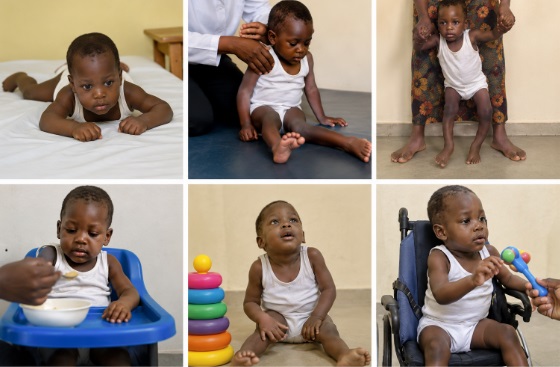
Image of a baby with cerebral palsy at different delayed neurodevelopmental states—from top left to bottom right: lying on tummy, being helped to sit, standing while held, self-feeding, sitting independently with toys, and sitting in a supportive wheelchair Image credit: ChatGPT
As a baby's brain, nerves, and muscles grow, they develop a predictable series of movement skills known as motor milestones. Milestones in CP occur late, out of order, or not at all because the brain injury or anomaly interferes with the impulses that drive this development.
The child is slow to reach milestones such as rolling over, sitting, crawling, and walking. (1)

An African female physiotherapist providing support to a baby during assessment, demonstrating rigid posture and muscle stiffness often seen in cerebral palsy. Image credit: Google Gemini. Click on image to enlarge.
This is one of the hallmark signs of cerebral palsy. Muscles are unusually stiff (hypertonia) or floppy (hypotonia) when a limb is held or picked up. (2, 3). This is because electrical signals are sent wrongly pr poorly from the brain regions that control muscle movements due usually to birth-related injury or abnormally. The muscles get either too little or a disorganised signal, which causes them to be floppy or fluctuating, or too much signal, brain development.

An African father supports a baby whose head falls backward while being pulled to sit, illustrating head lag. This is an early sign of cerebral palsy. Image credit: Google Gemini. Click on image to enlarge.
This is best observed as baby shows difficulty holding the head up by around 3–4 months of age.
Head lag when a baby is picked up from a lying position is one of the earliest and most observable signs of cerebral palsy – the head flops backward instead of the baby engaging their neck muscles (4).
It's an important indication since head control is the basis for all other motor skills. A baby cannot sit, reach, feed, or visually explore the world without a steady head.

A close-up photograph of the lower legs and feet of a young child supported while standing outdoors by a carer. The child has one leg rigidly crossed over the other in an X-feature, suggestive of a scissors gait. This is an unusual posture associated with cerebral palsy. Image credit: Google Gemini. Click on image to enlarge.
Legs crossing ("scissoring"), clenched fists, or abnormal positioning of the arms or legs are postural signs to look out for..
Overextending the back and neck can also be seen. In this posture, the baby overextends their neck and back while being held, giving the impression that they are trying to pull away (2).
Scissoring or stiffening legs – When the baby is picked up, the legs get stiff or cross/scissor in an X pattern (1).
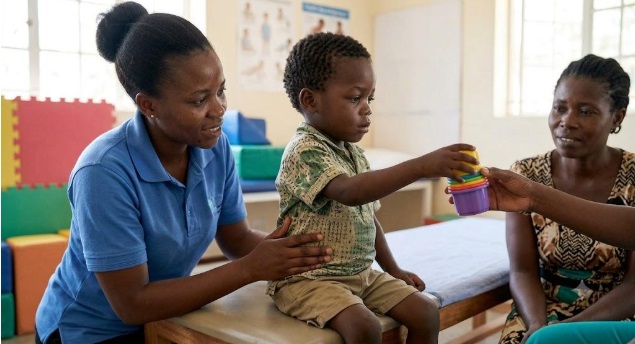
Toddler reaching for stacking toy cups using only one hand while a caregiver and therapist look on, This illustrates early one-sided hand preference associated with cerebral palsy. Image credit Google Gemini. Click on image to enlarge.
Reaching with only one hand before 12 months or dragging one side while crawling are significant signs to note..
Asymmetric movement / early "handedness" — When reaching, crawling, or changing positions, a baby may constantly favour one side of their body over the other (1).
This one-sided preference, especially when persistent, is a notable warning sign (5).
Strong hand preference before roughly 12–18 months is unusual (4).
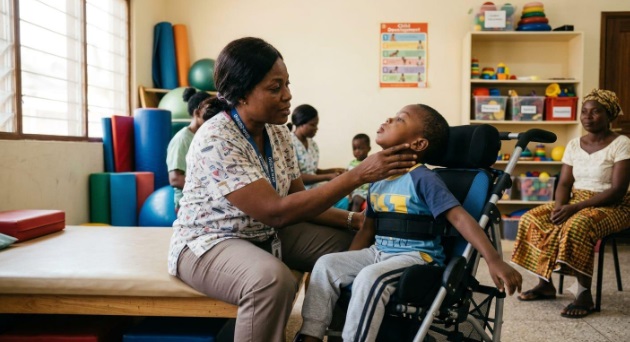
An African female physiotherapist gently turning a child's head to one side during a clinical assessment, demonstrating the symmetrical tonic neck reflex (STNR) retained beyond infancy. Image credit: Google Gemini. Click on image to enlafrge.
In support of early survival and protection against danger, newborns develop automatic, involuntary movements known as "primitive reflexes". These include, instinctively grasping your finger, startle reflex, i.e., reacting to sudden changes, loud noise and loss of support, etc. As the brain develops over the first year of life, these primitive reflexes usually disappear, creating space for deliberate, controlled motions.
When early brain injury occurs as in cerebral palsy, these automatic and involuntar reflexes do not fade off, but are indeed "retained."
Consider a retained reflex as a background "glitch" in a child with cerebral palsy. It unintentionally activates, causing the child's body to become rigid or uncomfortable and making everyday tasks like reaching, sitting, or rolling feel like a never-ending struggle.
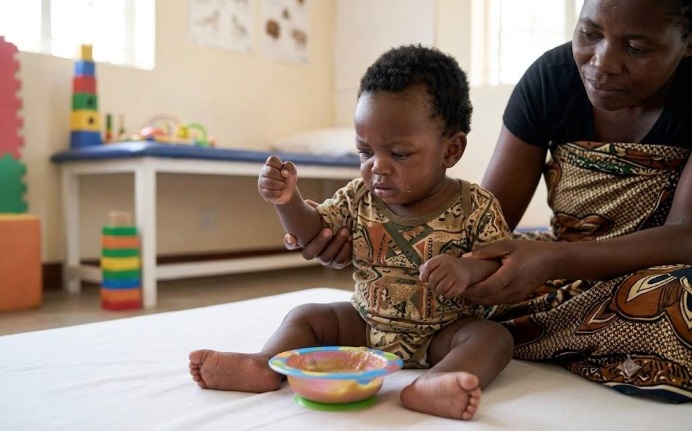
An African mother assisting a baby in bringing a spoon to their mouth during feeding, illustrating difficulty with hand-to-mouth coordination.. Image credit: Google Gemini. Click on image to enlarge.
One of the first indications of purposeful, coordinated movement is bringing hands to the mouth and midline (the body's center) (4).
Babies older than six months have difficulty bringing their hands together or bringing them to their mouth. This milestone is usually reached at month four (2).
It provides crucial information regarding how the brain is coordinating the two sides of the body, but it is frequently disregarded since it doesn't appear as dramatic as head lag or stiffness.
These are how the hand-mouth coordination difficulty may look like in a child with cerebral palsy:
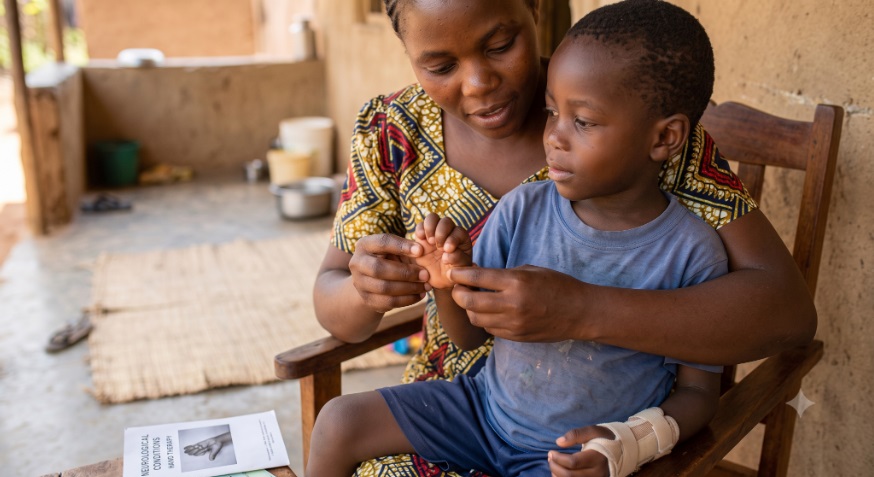
An image showing a carer's hand displaying a cortical thumb, where the thumb is flexed and tucked inside the palm, indicating abnormal muscle tone often associated with cerebral palsy. Image credit: Google Gemini. Click on image to enlarge.
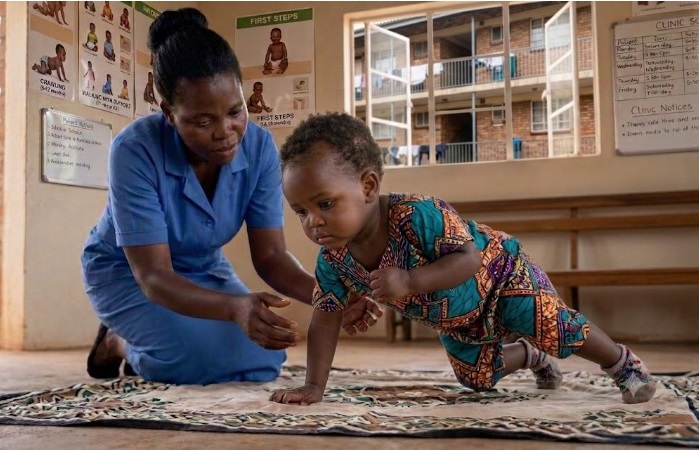
An African therapist guiding a toddler through an uneven, asymmetrical crawl on a clinic mat, illustrating commando or lopsided crawling.. Image credit: Google Gemini. Click on image to enlarge.
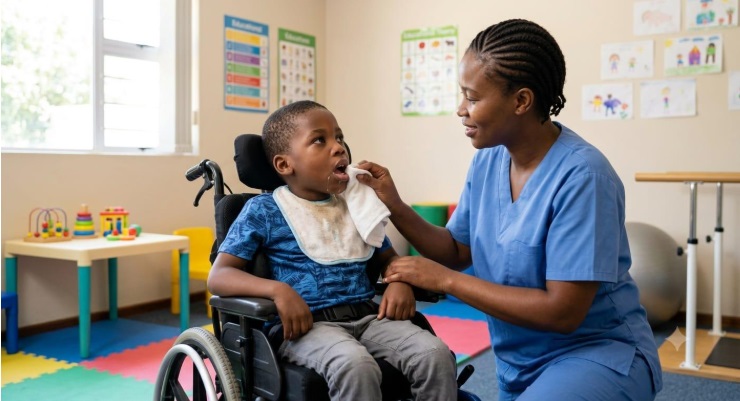
An African female caregiver wiping a young child's mouth while the child sits in a supportive wheelchair, illustrating drooling related to oral-motor difficulties in cerebral palsy. Image created by Google Gemini. Click on image to enlarge.
Since cerebral aplsy can affect the muscles of the mouth and tongue, baby can also present one or more of the following early signs:
The ability to recognise some or all of the 10 early signs of cerebral palsy in a child places a parent or caregiver in a good position to seek help early for the child. These signs include muscle sitffness or floppiness, poor neck control, predominant and preferential use of one limb in the presence of weakness and stiffness of the opposite side of the body, reappearance or retention of primitive reflexes, poor hand to mouth coordination and much more.
Stay aware and informed about cerebral palsy!
1.National Institute of Neurological Disorders and Stroke. Cerebral Palsy. [Internet]. Last reviewed March 13, 2026. [Cited July 18, 2026]. Available grom here.
2. US Centers for Disease Prevention and Control (CDC_. About Cerebral Palsy. [Internet]. June 12, 2026. [Cited July 18, 2026].Available from here.
3.Ajayi T. Cerebral Palsy in Africa: Symptoms, Causes and Care. [Internet]. Updated June 21, 2026. Datelinehealth Africa. [ [Cited July 18, 2026]. Available from here
5. US National Library of Medicine. Cerebral Palsy. [Internet, n.d.]. MedlinePlus. [Cited July 18, 2026]. Available from here.
6.Polisano R, Schreiber J. Campbell’s Physical Therapy for Children. Published Nov. 8, 2022. Available from here
7. Arvedson, J. Feeding children with cerebral palsy and swallowing difficulties. Eur J Clin Nutr. 2013; 67 (Suppl 2), S9–S12 doi: 10.1038/ejcn.2013.224. Available from here.
Related: Cerebral Palsy in Africa: Symptoms, Causes and Care
Published: November 23, 2026.
© 2026. Datelinehealth Africa Inc. All rights reserved.
Permission is given to copy, use, and share content freely for non-commercial purposes without alteration or modification and subject to source attribution.
DATELINEHEALTH AFRICA INC., is a digital publisher for informational and educational purposes and does not offer personal medical care and advice. If you have a medical problem needing routine or emergency attention, call your doctor or local emergency services immediately, or visit the nearest emergency room or the nearest hospital. You should consult your professional healthcare provider before starting any nutrition, diet, exercise, fitness, medical or wellness program mentioned or referenced in the DatelinehealthAfrica website. Click here for more disclaimer notice.