The 2.5-Hour Tipping Point: How Social Media Screen Time May Predict Depression Risk
By: Foluke Akinwalere, Health & Medical Writer. DLHA Fellow. Medically reviewed by the DLHA Team.
November 18, 2026
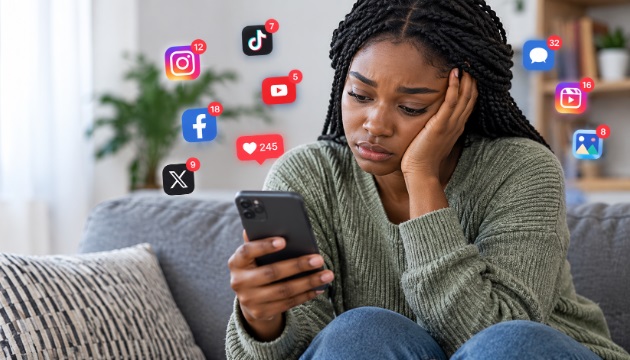
Image of a sad-looking young African woman looking at her smartphone surrounded by social media notifications. Image created from ChatGPT
Social media has become part of everyday life. We use it to connect with friends, follow trends, grow businesses, and keep up with the world. But what if the time we spend scrolling is affecting our mental health in ways we rarely notice? A new study spanning more than a decade has uncovered a troubling pattern that raises important questions about how much time adults spend online.
The study, published in the Nature Portfolio journal npj Mental Health Research, has followed over 180,000 American adults across 11 years and found something that should make anyone, including Africans, who owns a smartphone pause before opening Instagram, Facebook, TikTok, or X (formerly Twitter) one more time.
Social media use, the researchers say, predicts depression more strongly than a person’s job, their education, or even how much time they spend watching TV or browsing the web.
For readers across the African continent, where social media is becoming commonplace, this is not a story to scroll past. This blog breaks down what the study found, why it matters, and what it means for how we use social media at home, in the office, and in our communities.
The study was conducted by a team from the University of Cincinnati and Northwestern University in Ohio, USA, and led by Professors Hans Breiter and Martin Block. It was published on 22 August 2026 in npj Mental Health Research.
Unlike most studies on social media and mental health, which tend to focus narrowly on teenagers or rely on a single year of data, this one took a much wider view.
The team analysed 183,300 anonymised surveys collected every year between 2014 and 2024 as part of the long-running Media Behaviour and Influence Study, conducted by Prosper Insights & Analytics. Respondents were adults aged 18 to 70, and each survey covered an enormous range of ground: 1,318 questions in total, including 31 separate health measures, one of which was whether the person had ever reported experiencing depression.
To make sense of such a huge and detailed dataset, the researchers trained a machine learning model to look for patterns linking social media habits to self-reported depression, while also weighing in other everyday factors like income, education, job types, and how people spent time on activities such as video games, television, and general web browsing. The model’s accuracy was tested carefully using standard statistical checks, and it performed consistently well across every single year studied; not just once, but 11 times in a row.
The research produced several findings that may help explain why excessive social media use deserves attention.
The most important finding was that higher social media use was associated with self-reported depression across the 11 annual surveys.
Although the participants surveyed changed from year to year, the relationship appeared repeatedly between 2014 and 2024.
This consistency strengthens the evidence that social media use and depression are related. However, it does not prove that the relationship is causal or that everyone who spends considerable time online will experience depression.
For example, two people might spend three hours on social media daily but have very different experiences. One might use the time to learn a skill, maintain friendships, and promote a small business. Another might spend much of that time comparing their appearance, income, or achievements with carefully selected images of other people’s lives.
The amount of time spent online matters, but the context and purpose of that use may also be important.
One of the study’s widely discussed findings was that the contribution of social media use to the model’s classification of self-reported depression shifted from neutral to positive at approximately 150 minutes per day, equivalent to two and a half hours
This means that higher daily social media use became a more notable predictor of self-reported depression in the researchers’ statistical analysis.
However, this figure should not be interpreted as a scientifically established danger threshold.
Spending 149 minutes on social media does not guarantee good mental health, just as spending 151 minutes does not mean someone will develop depression. The finding identifies a pattern in the data, not a universal limit for every individual.
Nevertheless, if you regularly spend several hours scrolling through social media and notice it affects your sleep, mood, concentration, or relationships, it may be worth reviewing your habits.
The researchers found that social media use continued to contribute to the models even when other demographic and media-use factors were considered.
This suggests that the association was not limited to a single year or dataset. It also highlights the importance of studying social media separately rather than treating all screen time the same way.
However, the researchers did not establish that social media was the most important cause of depression. Their analysis assessed predictive relationships, not the causes of an individual’s mental health condition.
The researchers point to how the nature of social media itself has shifted over the years, and that shift may hold the key to why it affects mood so strongly.
Nicole Vike, one of the study’s co-authors, explained that social media used to function mainly as a way to stay in touch with people you already knew: classmates, cousins, old colleagues. Today, much of what people consume comes from strangers: influencers, content creators, and algorithm-recommended posts designed to keep eyes on the screen for as long as possible.
She pointed to the phenomenon of full-time content creators who sometimes need to take months-long breaks from being online just to protect their own mental health; a sign, she suggested, of just how demanding constant online performance and consumption can be.
Martin Brock offered a memorable comparison. Social media, he said, has become a defining feature of our era, much like the automobile was more than a century ago; bringing real benefits, but also carrying a serious, well-documented downside, in this case, its link to depression.
The study identified a statistical relationship, but it did not directly establish the psychological or biological mechanisms behind it. Several possible explanations are worth considering.
Social media often presents carefully selected versions of people’s lives.
You may see someone announcing a promotion, buying a house, travelling abroad, or celebrating a wedding or launching a successful business. What you may not see are their financial difficulties, family disagreements, disappointments, or personal struggles.
Repeatedly comparing your everyday experiences with these selected moments can leave you feeling unsuccessful or inadequate.
Likes, comments, shares, and follower counts can become measures of personal worth when people rely heavily on online approval.
A post that receives little engagement may cause disappointment, while negative comments or cyberbullying can contribute to emotional distress.
In professional spaces such as LinkedIn, where people showcase career achievements and business milestones, this pressure can also affect working adults.
There is nothing inherently wrong with celebrating achievements online. The concern arises when online reactions begin to determine how someone feels about themselves.
Using social media late at night can delay bedtime, particularly when videos automatically play, or notifications encourage users to keep checking their phones.
Insufficient or irregular sleep can affect concentration, emotional regulation, and daily functioning. Sleep difficulties are also associated with depression, although the relationship can operate in both directions.
Someone who stays awake scrolling until 2 a.m. may struggle to concentrate at work the next morning and feel emotionally exhausted throughout the day. Over time, this pattern can become difficult to break.
Long periods online can displace activities that support well-being, such as physical exercise, hobbies, family conversations, and face-to-face friendships.
In African communities, where family connections, religious gatherings, neighbourhood relationships, and community events may play important roles in daily life, losing time for meaningful offline interactions can be particularly noticeable.
However, online connections can also provide valuable emotional support, especially for people living far from loved ones or those who feel isolated in their immediate surroundings.
The goal is not to reject digital communication but to maintain a healthy balance between online and offline life.
The relationship may also work in the opposite direction.
Someone who already feels lonely, anxious, or depressed may turn to social media for distraction, reassurance, or companionship. If they subsequently spend more time online, it could appear that social media use is contributing to their depression when existing difficulties may also be influencing their behaviour.
These possible explanations illustrate why researchers need more studies to understand the direction of the relationship.
Although the findings are important, several limitations should be considered before concluding.
First, the research shows an association, not proof of cause and effect. It cannot say for certain that social media causes depression rather than, for instance, people who are already struggling emotionally turn to social media more often as a coping habit.
Second, depression in this study was self-reported by participants rather than clinically diagnosed by a mental health professional, so it reflects how people described their own experience rather than a formal medical assessment.
Third, the data comes entirely from adults living in the United States, so the exact patterns, thresholds, and cultural context may not transfer identically to other countries or regions.
Fourth, the study did not distinguish between different types of social media activity. Scrolling passively through content, communicating with family, participating in a support group, and promoting a business are different experiences. The analysis did not establish which activities were most strongly associated with depression.
Finally, even the researchers themselves acknowledge that more work is needed: longer-term studies and controlled experiments to establish whether crossing that 150-minute mark represents a genuine clinical risk or simply a strong statistical signal.
These limitations do not make the study unimportant. Instead, they explain why the result should be interpreted carefully and why further research is needed.
Social media is deeply integrated into everyday life, especially across urban communities in sub-Saharan Africa. People use WhatsApp to communicate with relatives, Facebook to maintain community connections, TikTok for entertainment, Instagram to promote businesses, and LinkedIn to pursue professional opportunities.
For many people, particularly entrepreneurs, freelancers, job seekers, and remote workers, spending time online is part of earning a living.
Therefore, the answer to concerns about social media and mental health in Africa cannot simply be to stop using social media.
Instead, the findings encourage individuals, families, employers, and policymakers to consider how digital habits affect emotional well-being.
Pay attention to how you feel before, during, and after using social media.
Do you feel informed, connected, or encouraged? Or do you regularly feel anxious, inadequate, angry, or emotionally drained?
These observations can help you identify patterns in your own experience.
If you spend several hours on social media each day, consider reviewing your screen-time report and identifying activities that consume time without providing much value.
You might choose specific periods for checking notifications, reduce unnecessary scrolling, or keep your phone away during meals and before bedtime.
If your work requires regular social media use, separate essential professional tasks from recreational browsing where possible.
Unfollow, mute, or limit accounts that repeatedly encourage unhealthy comparisons or expose you to distressing content.
Instead, follow accounts that provide reliable information, practical learning opportunities, positive community connections, and useful professional resources.
You do not need to maintain access to every account simply because you know the person or once enjoyed their content.
Establish a bedtime routine that allows you to disconnect from social media before sleeping.
Make time for activities that support your well-being, including walking, exercise, reading, hobbies, and conversations with people you trust.
These habits are not a guaranteed way to prevent depression, but they can help create a healthier relationship with technology.
If you experience persistent sadness, loss of interest, hopelessness, significant changes in sleep or appetite, or difficulty managing everyday responsibilities, consider speaking with a qualified healthcare professional.
Do not assume that reducing screen time alone will resolve depression. Mental health conditions can have multiple contributing factors and may require professional assessment and treatment.
Equally, avoid labelling someone as depressed simply because they spend a lot of time online.
The appropriate response is curiosity, compassion, and support rather than judgement.
Social media has transformed how people communicate, work, learn, and maintain relationships. It offers real benefits, but its relationship with mental health deserves attention.
The findings from this 11-year study add to the evidence linking heavier social media use with depression among adults. At the same time, the study’s limitations remind us that a statistical association does not establish cause and effect.
For Africans navigating increasingly connected lives, the practical lesson is to make digital well-being part of everyday self-care.
Notice how social media makes you feel. Set boundaries that fit your personal and professional needs. Protect your sleep, maintain meaningful relationships, and seek support when emotional difficulties persist.
Ultimately, the aim is not to spend as little time online as possible. It is to ensure that technology supports your life rather than consistently interfering with your well-being.
Your mental health matters more than your screen-time statistics.
Sources:
Block, M.L., Suresh, V., Avant, J. et al. Social media use and depression across 11 years of U.S. adult data. npj Mental Health Res (2026). https://doi.org/10.1038/s44184-026-00237-y Available from here.
Related
The Influence of Social Media on the Health of African Youths
New Study Links Social Media Use With Mental Health Risks in Children
Healthy Scrolling: How to Spot and Filter Social Media Misinformation
Published: November 18, 2026
© 2026. Datelinehealth Africa Inc. All rights reserved.
Permission is given to copy, use, and share content freely for non-commercial purposes without alteration or modification and subject to source attribution.
DATELINEHEALTH AFRICA INC., is a digital publisher for informational and educational purposes and does not offer personal medical care and advice. If you have a medical problem needing routine or emergency attention, call your doctor or local emergency services immediately, or visit the nearest emergency room or the nearest hospital. You should consult your professional healthcare provider before starting any nutrition, diet, exercise, fitness, medical or wellness program mentioned or referenced in the DatelinehealthAfrica website. Click here for more disclaimer notice.