How Late-Night Phone Habits After 10 PM Are Costing Teens Their Sleep
By Adebowale Bello. B.Tech Microbiology. Freelance Health Writer. Medically reviewed by the DLHA Team.
November 15, 2026.
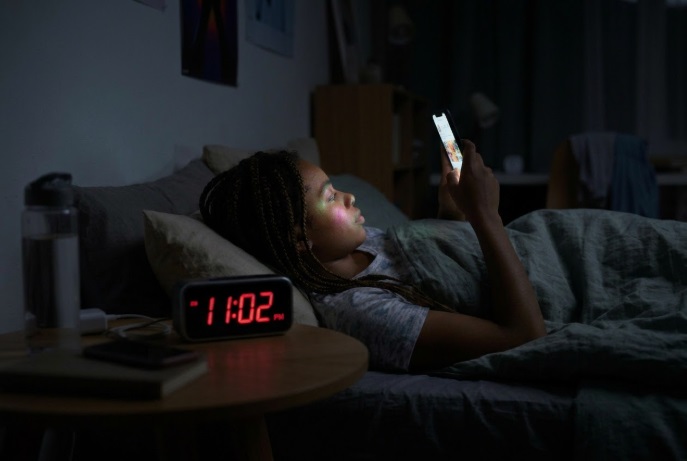
An African teenager lying in bed and using her phone past 10 p.m. in a darkened room. Image Credit: Gemini AI
Phone use after 10 pm are costing Teens their sleep through later sleep onset, later sleep offset (i.e., wakeup time), shorter total sleep time and more wakefulness within 30 minutes of falling asleep.
Many teenagers have a habit of checking their phones before going to bed. Some spend time chatting with friends, scrolling through social media, watching videos or playing games and what may begin as a few minutes of screen time can easily extend into an hour or more, especially when there is no fixed bedtime routine.
For parents, this raises an important question: could using a smartphone late at night affect how well teenagers sleep?
A new study has found that smartphone use after 10 pm is associated with adolescents sleeping late and for shorter periods. Understanding this relationship is important because adequate sleep plays a vital role in the physical, mental and emotional development of teenagers.
The researchers wanted to investigate whether smartphone use in the evening was associated with changes in adolescents' sleep patterns. Unlike many previous studies that relied on participants estimating their screen time and reporting how well they slept, this research used data collected directly from smartphones and Fitbit devices.
They analysed data from 425 adolescents with an average age of 14.8 years and approximately 51% of the participants were female. The data were collected between November 2020 and February 2024 and the scientists examined 7,591 nights of smartphone use and sleep records.
They focused on two patterns of phone use, with the first being the amount of time adolescents spent using their phones after different evening cut-off times, particularly after 10 pm while the second was phone usage within the 5 to 30 minutes window before falling asleep.
To assess sleep, Fitbit measurements were used to estimate when participants fell asleep, when they woke up and how long they slept. They also examined how much time participants spent awake after initially falling asleep. This approach allowed the researchers to examine whether changes in an adolescent's usual evening phone habits were associated with changes in their sleep on different nights.
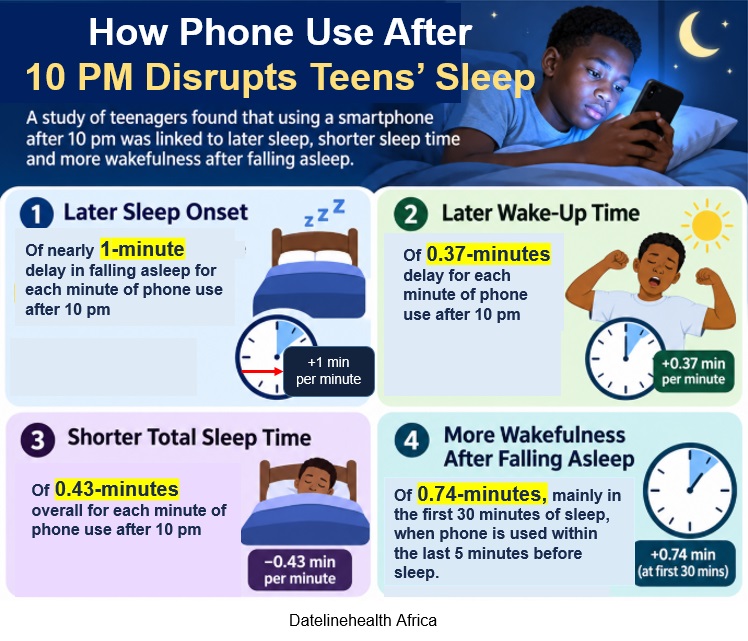
Infographic showing how phone use after 10 pm are costing Teens their sleep through later sleep onset, later sleep offset (i.e., wakeup time), shorter total sleep time and more wakefulness within 30 minutes of falling asleep. Image credit: ChatGPT. Click on image to enlarge.
The findings revealed that evening smartphone use was associated with different aspects of adolescent sleep. Four points stood out.
The researchers found that teenagers who spent more time on their phones after 10 pm tended to fall asleep later than usual. Every additional minute of phone use after 10 pm was associated with a 0.87-minute delay in falling asleep. The researchers also found that teenagers fell asleep approximately 65 minutes later on nights when they used their phones more than usual after 10 pm.
This suggests that spending more time on a phone late at night may delay sleep onset and reduce the time available for rest.
Sleep offset, which refers to the time a person wakes up and gets out of bed for the day, was also affected by late-night phone use. The researchers found that every additional minute teenagers spent on their phones after 10 pm was associated with waking up approximately 0.37 minutes later than usual.
However, this delay was smaller than the delay in falling asleep (0.87 minutes). This means that although teenagers who used their phones longer at night also woke up later, they did not make up for all the sleep time they had lost.
3. Using a phone after 10 pm was associated with shorter total sleep duration
The researchers found that teenagers who spent more time on their phones after 10 pm slept for about 20 minutes less than they usually did.
This suggests that spending too much time on a phone at night, especially after 10 pm reduces the time available for sleep. However, the researchers could not establish that phone use was the only reason these teenagers slept later.
4. Using a phone immediately before sleep was associated with more sleep interruptions after falling asleep
The scientists also wanted to know whether using a phone just before falling asleep could affect what happens after a person has fallen asleep.
They found that teenagers who used their phones within the last five minutes before falling asleep had longer duration in sleep interruptions shortly after falling asleep. On average, this difference was less than one minute. This period of wakefulness is called wake after sleep onset and simply refers to the duration that a person's sleep is interrupted after they have fallen asleep.
Although the difference was small, the finding suggests that phone use may be linked to more than just going to bed late. However, the scientists did not establish that using a phone before bed directly causes sleep interruptions.
Perhaps the most important finding from the research is that different patterns of evening smartphone use were associated with different sleep outcomes.
Compared to time spent on a smartphone before 8 pm, spending time at 10 pm or later was associated with later sleep onset, later wake time, shorter sleep duration and longer wakefulness shortly after sleep begins.
Put in perspective for example, two teenagers may each spend four hours on their phones daily. However, one may use the phone mostly during the late afternoon/early evenings (say before 8 pm), while the other spends a significant part of the late evening (say 10 pm) scrolling through social media. Their sleep patterns may differ even though their total daily screen time is similar.
This suggests that looking at total daily screen time alone may not provide a complete picture of how smartphone use affects sleep timing and quality.
Smartphone ownership and internet access have become increasingly common across households in urban communities in sub-Saharan Africa. Many teenagers in urban homes use their phones for schoolwork, entertainment, communication and social media.
While these activities have benefits, using smartphones late at night may interfere with the time available for sleep.
This is particularly relevant for African households where teenagers may have early morning school schedules, household responsibilities or long journeys to school. Staying awake late because of phone use may leave them with insufficient time to rest before the following day's activities.
Adolescence is also an important period of physical and mental development. Sleep supports several processes, including memory, learning, emotional regulation and physical growth. Consistently getting insufficient sleep may make it harder for teenagers to concentrate in class, retain information and manage their emotions.
However, it is important not to interpret the findings as proof that African teenagers experience the same effects observed in their American participants. Differences in household routines, school schedules, phone use and other social factors may influence how these findings apply to young people in sub-Saharan Africa.
Nevertheless, the research provides a useful reason for parents, teachers and caregivers to pay closer attention to teenagers' evening phone habits.
The study provides an opportunity for families to establish routines that allow teenagers to enjoy their phones without allowing screen use to interfere with sleep.
Some practical steps include:
Parents can encourage teenagers to stop or reduce phone use after 10 pm, particularly when they have school or other activities early the following morning. The aim should be to protect sufficient time for sleep rather than impose restrictions without explanation.
Charging phones away from the bed can reduce the temptation to check notifications, reply to messages or continue scrolling after going to bed.
Teenagers should be encouraged to follow a regular sleep schedule, including going to bed and waking up at roughly the same times each day. Activities such as reading, taking a bath or listening to calming music can help them prepare for sleep.
Rather than simply taking phones away, parents should explain why excessive late-night use may affect sleep. Teenagers are more likely to understand and participate in healthy habits when they know the reasons behind them.
It is also important to recognise that smartphones are useful tools for learning and communication. The goal is not necessarily to eliminate their use but to encourage habits that support healthy sleep.
First, the study was observational. This means the researchers examined the relationship between smartphone use and sleep without assigning participants to use their phones for specific periods. Therefore, the findings cannot establish that late-night phone use directly causes shorter sleep or sleep interruptions.
It is also possible that other factors, such as stress, anxiety, academic pressure or existing sleep difficulties, influenced both phone use and sleep patterns.
Second, the study involved only 425 adolescents who used Android smartphones and had sufficient smartphone and Fitbit data available. Although the researchers analysed 7,591 nights of data, these observations came from the same 425 participants. They should not be mistaken for 7,591 different adolescents.
Third, the study relied on Fitbit devices to measure sleep. Although these devices can estimate sleep duration and patterns, they are not as accurate as polysomnography, which is the standard clinical method for assessing sleep. Therefore, the findings should not be interpreted as proof that smartphone use causes a sleep disorder.
Finally, all participants were from the United States. The findings may not apply equally to teenagers in other parts of the world, including sub-Sharan Africa. More research involving teens in the region would help establish whether similar patterns occur in different social and cultural settings.
Smartphones have become an important part of teenagers' daily lives, but when they are used may have implications for sleep. Although the study does not establish that smartphone use causes poor sleep, it highlights the importance of developing healthier evening phone habits.
Parents and caregivers need to help their adolescents sleep healthily by encouraging consistent bedtimes, reducing late-night screen use and keeping phones away from the bed. Ultimately, smartphones are not the enemy and the aim is ensuring that their use does not take priority over the sleep which teenagers need for their health and development.
Source: Zhao Y, Hale L, Christakis DA. Evening Phone Use and Sleep Outcomes Among Youth. JAMA Pediatr. Published online October 19, 2026. Available from here
Related:
Early Age Smartphone Use Harms Kids Mental Health in Adulthood. Study Finds
New Study Links Social Media Use With Mental Health Risks in Children
7 Ways Screen Time Affects Motor Skills Development in African Children
Published: November 15, 2026.
© 2026. Datelinehealth Africa Inc. All rights reserved.
Permission is given to copy, use and share content for non-commercial purposes without alteration or modification and subject to source attribution.
DATELINEHEALTH AFRICA INC., is a digital publisher for informational and educational purposes and does not offer personal medical care and advice. If you have a medical problem needing routine or emergency attention, call your doctor or local emergency services immediately, or visit the nearest emergency room or the nearest hospital. You should consult your professional healthcare provider before starting any nutrition, diet, exercise, fitness, medical or wellness program mentioned or referenced in the DatelinehealthAfrica website. Click here for more disclaimer notice.