Rising Diphtheria Cases in Nigeria Spark Health Warnings: How to Stay Safe
Tamunobelema Bamson. B.Sc. Microbiology. Health & News Reporter and DLHA Volunteer. Medically reviewed by a DLHA Editorial Team member.
.jpg)
A healthcare worker in protective gear holds a diphtheria vaccine vial and syringe. Photo credit: ChatGPT. Click on image to enlarge.
23 September 2026, Port Harcourt. Nigeria is facing a renewed rise in diphtheria cases as the vaccine-preventable bacterial disease continues to affect communities across the country. Notably, more than 10,000 confirmed cases have been recorded in 2026, according to the Nigeria Centre for Disease Control and Prevention (NCDC), with eight northern states accounting for 98% of confirmed infections. The current surge is part of the wider diphtheria outbreak that began in Nigeria in 2022 and has continued despite vaccination campaigns and other response measures.
According to NCDC Director-General Dr Gidado Idris, Nigeria has recorded about 10,402 confirmed diphtheria cases and 395 deaths by epidemiological week 31 of 2026, giving a case-fatality rate of 3.1%. The rate was lower than the approximately 7% recorded during the corresponding period in 2025. Notably, the northern states of Nigeria were hit hardest by the outbreak, with Kano, Kaduna, Katsina, Borno, Bauchi, Plateau, Sokoto and Zamfara accounting for about 98% of the confirmed cases.
.jpg)
A map of Nigeria highlighting eight states affected by the 2026 diphtheria outbreak. Photo credit: ChatGPT
In Katsina alone, diphtheria has spread to 29 of the state's 34 local government areas, while health authorities have reported about 150 admissions and 29 deaths. Meanwhile, Kano has remained one of the northern states most affected by diphtheria since the outbreak intensified in 2023. According to reports by Médecins sans Frontières (MSF), the Kano State Ministry of Health (MoH), the state has recorded more than 31,000 suspected cases and more than 1,500 deaths, mostly among children, between March 2022 and March 22, 2026. Plateau State is also experiencing a sharp increase in suspected cases.
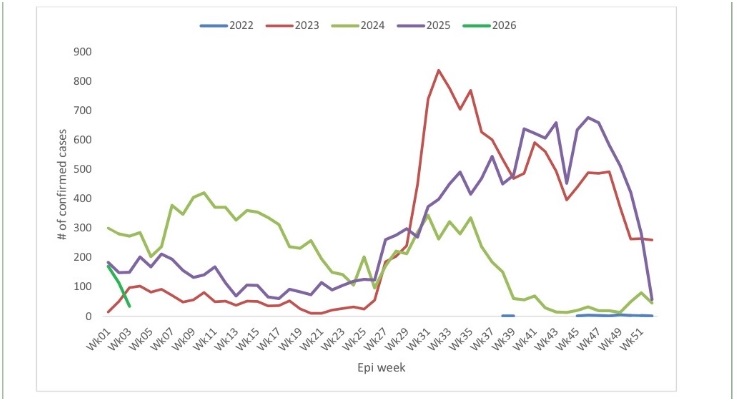
Trend of confirmed cases by epidemiological week, from 2022-2026 in Nigeria. Photo credit: NCDC. Click on image to enlarge.
Authorities initially reported 143 suspected cases and 23 deaths in late August and early September 2026. By September 10 2026, suspected cases had risen to 303, up from 149 in the earlier report, while the death toll reached 27. Most of the deaths were recorded in Jos North Local Government Area. Although the eight northern states account for the vast majority of confirmed cases nationally, diphtheria has also been reported in other parts of the country. Lagos recorded six laboratory-confirmed cases in 2026, while Enugu State has also reported a confirmed case that resulted in a death.
1. Vaccination Gaps. Low vaccination coverage remains a major factor behind Nigeria's ongoing diphtheria burden. In an interview with Channels TV Nigeria on September 5, Michael Okali, Principal Health Communication Officer in the Department of Disease Prevention and Health Promotion at the NCDC, disclosed that about 68% of confirmed diphtheria cases involved people who had not been vaccinated, while 28% had an unknown vaccination status. Okali also indicated that most of the deaths occurred among unvaccinated people."
Okali, who also heads the Risk Communication, Community Engagement and Infodemic Management Pillar of the National Diphtheria Incident Management System, said everyone remains at risk of infection. At the same time, people who are not adequately vaccinated face a higher risk of contracting and transmitting the disease. He urged parents and guardians to ensure that eligible children are fully vaccinated.
2. Insecurity and Mass Displacement: However, vaccination gaps are not the only challenge facing the response. Insecurity and population displacement can make it difficult for health workers to reach some communities, particularly in remote and underserved areas.
3. Systemic Factors and Funding Gaps. Delayed healthcare-seeking, gaps in disease surveillance, limited laboratory capacity and inadequate access to essential medicines can also delay the detection and treatment of cases. These challenges are further complicated by weaknesses in health-sector financing.
According to reports from the Guardian Newspaper, Nigeria, the Honourable Minister of Health and Social Welfare, Professor Ali Pate, said during the Federal Ministry of Health's 2026 budget defense before the National Assembly, that only N36 million had been released from the N218 billion appropriated for the ministry's 2025 capital expenditure.
He said the limited release made it practically impossible to implement the ministry's planned capital projects and also affected access to some counterpart funding. The funding gap comes as Nigeria continues to respond to recurring infectious disease outbreaks, investing in laboratories, healthcare facilities, vaccination programmes and disease surveillance, which are important to the country's ability to detect and contain outbreaks early.
The response by Nigerian health authorities including the Nigeria Centre for Disease Control and Prevention (NCDC), National Primary Health Care Development Agency (NPHCDA), Federal Ministry of Health and their state counterparts to contain the spread of diphtheria, is focused on four main areas:
Health authorities have intensified surveillance in affected and at-risk communities to detect suspected cases early and limit further transmission. In Lagos, for instance, health officials increased disease surveillance after recording about 53 suspected diphtheria cases in 2026, including six laboratory-confirmed cases. Commissioner for Health Professor Akin Abayomi said all six confirmed patients were managed, while their contacts were traced and monitored throughout the incubation period.
The surveillance effort has also been stepped up in Plateau State following a sharp rise in suspected cases. Authorities have intensified contact tracing and community sensitisation while monitoring affected communities. The state has also temporarily closed public and private primary and secondary schools after suspected infections were reported in Jos North, Jos South, Bassa and Wase local government areas.
Health officials are also using public awareness campaigns to help residents recognise symptoms early and reduce the risk of transmission. In Lagos, Abayomi said the state had "kick-started a public awareness campaign" to educate residents about diphtheria and prevention. As part of the awareness campaign, he urged people to maintain respiratory hygiene by covering their mouths and noses when coughing or sneezing, washing their hands regularly and avoiding close contact with people experiencing respiratory symptoms. Abayomi also advised people who develop symptoms associated with diphtheria to seek medical attention promptly rather than self-medicate.
Vaccination remains a major part of the response because diphtheria is vaccine-preventable. Health officials have identified immunization as the most effective way to prevent the disease. The NCDC has therefore urged citizens, parents and guardians to ensure their children receive the recommended three-dose pentavalent vaccination schedule at six, 10 and 14 weeks. In fact, in states like Lagos, more than 1,000 healthcare facilities offer routine immunization services across the public and private sectors, with vaccines available free of charge at government health facilities.
Vaccination efforts are also being expanded in the northern states. In Kano, the Federal Government has supplied 650,000 doses of the diphtheria vaccine, although state health officials have said substantially more doses are needed to reach communities across all 44 local government areas. Meanwhile, the humanitarian medical organisation Médecins sans Frontières (MSF)/Doctors Without Borders just recently concluded its diphtheria emergency intervention in Kano State with a mass vaccination campaign.
Health authorities are also strengthening facilities and services for people with suspected or confirmed diphtheria. In Lagos, four facilities have been designated to manage suspected cases: Mainland Hospital, formerly Infectious Disease Hospital, Yaba; Massey Street Children's Hospital, Lagos Island; Lagos University Teaching Hospital (LUTH); and Lagos State University Teaching Hospital (LASUTH). Plateau State has also established isolation facilities at Jos University Teaching Hospital and Plateau State Specialist Hospital for suspected patients as part of its response to the rise in cases.
Click on the video below to learn more about official Nigerian national response to the diphtheria outbreak.
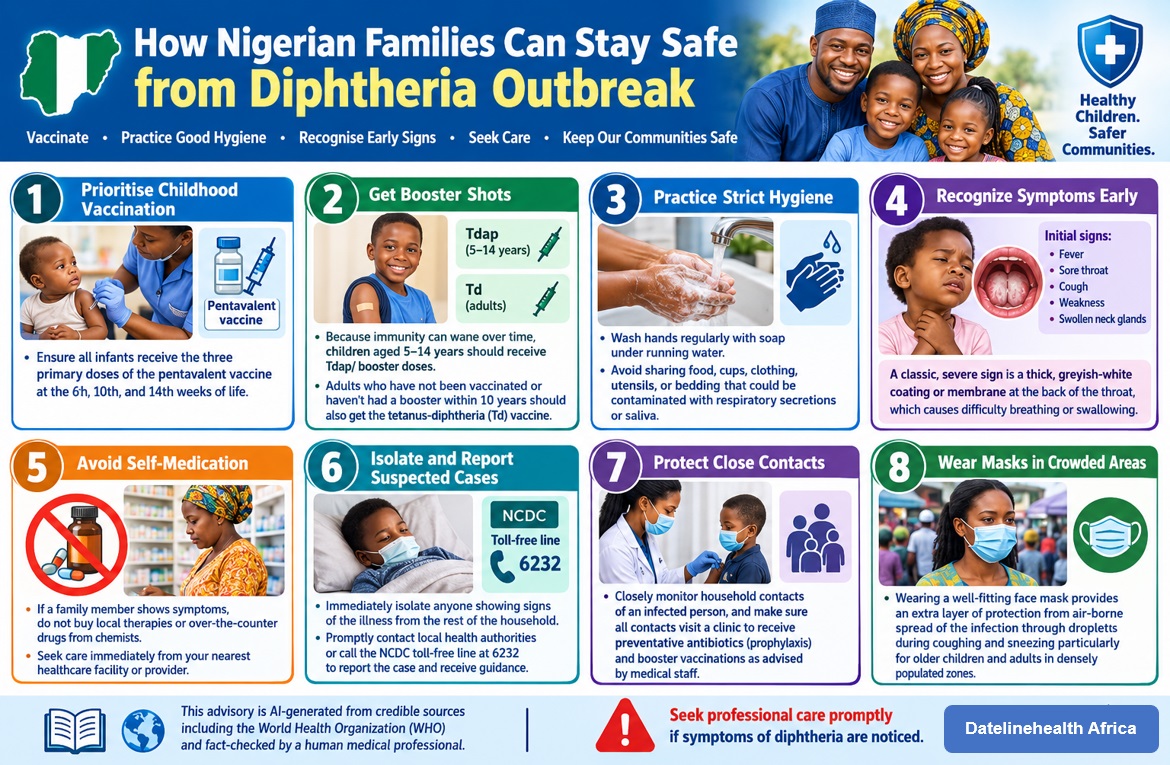
Infographic showing steps that families can take to stay safe from diphtheria outbreak. Image AI-generated from ChatGPT and human fact-checked by a medical professional. Click on image to enlarge.
To protect yourself and your family from the ongoing diphtheria outbreak in Nigeria, the Nigeria Centre for Disease Control and Prevention (NCDC), the National Primary Health Care Development Agency (NPHCDA), and the World Health Organization (WHO recommend the following safety and preventive actions:
Nigeria’s rising diphtheria cases highlight the continued risk posed by gaps in routine immunization and early detection. Although the disease is vaccine-preventable and treatable, delayed vaccination and access to care can increase the risk of severe illness and death.
With most confirmed cases concentrated in northern states, health authorities are strengthening surveillance, vaccination, public awareness and case management. For families, ensuring that children receive their recommended vaccines and seeking medical care promptly when symptoms appear remain important steps in reducing the spread and impact of diphtheria. Diphtheria is deadly, but with awareness, immunization, early vaccination, treatment when symptoms appear, and collective responsibility, it can be contained.
Diphtheria is a serious and highly contagious bacterial infection caused mainly by a toxin-producing bacterium known as Corynebacterium diphtheriae. Symptoms usually appear two to five days after exposure and may include a sore throat, fever, swollen glands in the neck, weakness, and a thick grey coating or membrane in the nose, tonsils, or throat. The membrane can make breathing and swallowing difficult. In severe cases, the toxin can damage the heart, nerves and kidneys and may cause complications including paralysis.
For unvaccinated people without adequate treatment, diphtheria can be fatal in around 30% of cases, with young children facing a higher risk of death. Anyone who is not immune, including people who are unvaccinated or under-vaccinated, can develop diphtheria. The disease can also resurge when vaccination coverage falls. Importantly, Diphtheria is primarily transmitted through respiratory droplets released when an infected person coughs or sneezes, as well as through close contact with an infected person. This means households, schools, markets, healthcare facilities, and other crowded settings can facilitate transmission.
Diphtheria requires prompt medical attention because early treatment can significantly reduce the risk of complications and death. Treatment usually involves diphtheria antitoxin to neutralise the toxin, together with antibiotics to eliminate the bacteria and reduce transmission. Treatment should begin as soon as diphtheria is suspected rather than waiting for laboratory confirmation.
Ultimately, vaccination remains the most effective way to prevent diphtheria. The WHO recommends a three-dose primary series of a diphtheria-containing vaccine followed by booster doses to maintain protection. In Nigeria, children should receive three doses of the pentavalent vaccine at 6, 10 and 14 weeks of age under the routine childhood immunization schedule.
Seek medical attention quickly if symptoms isuggestive of develops.
Sources:
1. World Health Organization (WHO). Diphtheria. 2026 July 15. Geneva: WHO. [Cited 2026 September 21]. Available from here.
2. Médecins Sans Frontières (MSF). Nigeria: MSF supports Kano State Ministry of Health administering over 835,000 diphtheria vaccines as the organisation marks end of emergency response to diphtheria in the state. 2026 July 7. [Cited 2026 September 21]. Available from here.
3. Channels Television. Diphtheria: Data Shows About 68% Of Confirmed Cases Are Unvaccinated — NCDC. 2026 September 5. [Cited 2026 September 21]. Available from here.
Related: Diphtheria Cases Rise in Nigeria as Lagos Becomes Worst-hit State
Published: September 23, 2026
© 2026. Datelinehealth Africa Inc. All rights reserved.
Permission is given to copy, use and share content for non-commercial purposes without alteration or modification and subject to source attribution.
DATELINEHEALTH AFRICA INC., is a digital publisher for informational and educational purposes and does not offer personal medical care and advice. If you have a medical problem needing routine or emergency attention, call your doctor or local emergency services immediately, or visit the nearest emergency room or the nearest hospital. You should consult your professional healthcare provider before starting any nutrition, diet, exercise, fitness, medical or wellness program mentioned or referenced in the DatelinehealthAfrica website. Click here for more disclaimer notice.