Same Fever, Different Causes: Malaria and Typhoid Explained
By: Foluke Akinwalere, Health & Medical Writer. DLHA Fellow. Medically reviewed by: O. Olatunbosun, MBBS, MSc. (Clinical Microbiology and Parasitology).
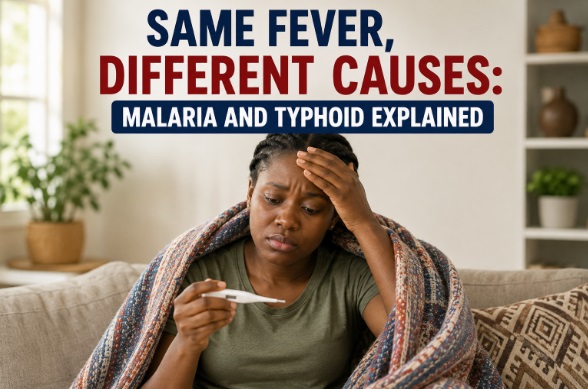
Image captioned, Same Fever, Different Causes: Malaria and Typhoid Explained. It shows a sick African ladysitting on a sofa with a blanket across her shoulder. She is checking her body temperature with a digital thermometer. Image created from ChatGPT. Click on image to enlarge.
It starts the same way almost every time. A dull ache creeps into your joints. Your body feels unusually warm. By evening, you are shivering under a blanket even though the room is warm. In many African households, there is only one word for what happens next: Malaria. A family member rushes to the nearest chemist or pharmacy, buys you antimalarial medication, and you start self-treatment.
Sometimes that guess is right. Often, it is not.
Fever is one of the most common reasons people across the world, including Africa, seek treatment, and two of the most frequent causes are malaria and typhoid fever. They are entirely different illnesses, caused by different organisms, spread in different ways, and treated with different medications, yet they can look almost identical when they begin. This overlap is not just a medical curiosity. It shapes how millions of people are treated every single day, and getting it wrong has real consequences for health, money, and time.
This article breaks down what separates malaria from typhoid, why the confusion between them is so common in African communities, and what you should actually do the next time you have fever.
Before comparing the two illnesses, it helps to understand what fever actually is.
Fever is your body’s defence mechanism, a sign that your immune system has detected something it needs to fight, whether that is a parasite, a bacterium, a virus, or something else entirely. A raised temperature on its own does not tell you what is attacking your body. It only tells you that a battle has begun.
This is precisely why malaria and typhoid are so easily mistaken for one another. Both can cause fever, headache, body pains, weakness, loss of appetite, nausea, and general discomfort in their early stages.
A person experiencing these symptoms for the first day or two often cannot tell, just by feeling, which of these two illnesses they have, and in some unlucky cases, they may even have both at once.
Research across the region has repeatedly shown that malaria and typhoid overlap not just in symptoms, but also in the communities and seasons where they are most common, which is part of why co-infection happens, even if it is not standard [1].
Knowing this shared starting point is the first step to understanding why “it’s probably malaria” is such a risky assumption to base treatment on. Fever behaves differently from person to person too; a child’s fever may spike faster than an adult’s, and an older person may run only a mild temperature even with a serious infection. None of these variations point clearly to malaria or typhoid on their own; they simply confirm that the body is responding to something, without naming what that something is.
Related: Be Aware: Not Every Fever in African Adults Is Caused By Malaria
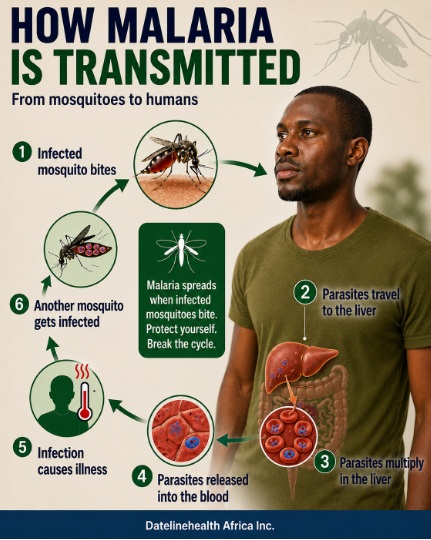
Infographic image illustrating how malaria is transmitted from mosquitoes to humans. Click on image to enlarge.
Malaria is caused by a parasite from the Plasmodium family. It does not spread from person to person through touch, shared food, or coughing. It spreads through the bite of an infected female Anopheles mosquito, which is why malaria rates rise so sharply during the rainy season, when stagnant water creates breeding grounds close to homes.
Once the parasite enters the bloodstream, it multiplies inside red blood cells, and this is often what gives malaria its distinctive pattern: cycles of chills, followed by a high fever and heavy sweating, repeating every couple of days depending on the type of parasite involved. Alongside this cycle, a person may experience headache, muscle and joint pain, fatigue, and sometimes nausea or vomiting.
Malaria remains heavily concentrated in Sub-Saharan Africa, where the majority of the world’s cases and malaria-related deaths occur, particularly among young children and pregnant women [2]. This is one reason awareness is so widespread across the continent, but that same familiarity is part of what makes it the default explanation for almost any fever, whether or not it is the correct one.
The reliable way to confirm malaria is through testing, not guesswork. Two main tests are used:
This gives a result within about 15-20 minutes using a small finger-prick blood sample. The RDT works by detecting specific malaria antigens in the blood, and its speed and simplicity make it especially useful in primary health centres, rural clinics, and even pharmacies with limited laboratory equipment.
This takes a little longer but offers more detail. A trained laboratory scientist stains thin and thick blood smears and examines them under a microscope. This allows them not only to confirm the presence of the parasite but also to identify which species of Plasmodium is responsible and estimate how heavily infected the blood is. This extra detail can help guide treatment decisions in more complicated cases, which is why microscopy remains the standard reference test that RDTs are measured against.
Both are far more accurate than relying on symptoms alone. Not every malaria infection looks the same, either: some people in high-transmission areas carry low levels of the parasite without feeling seriously unwell, a form of partial immunity built up through repeated exposure, while young children and pregnant women with little prior exposure can move from mild symptoms to severe illness surprisingly quickly [3].
Side-by-Side Comparison Table Malaria Vs.Typhoid
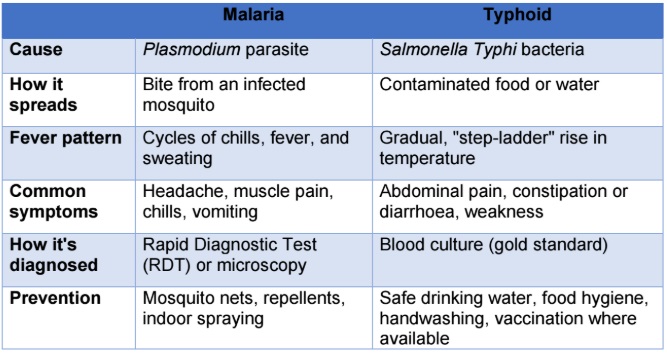
This table provides general and summary information about the clinical features of malaria and typhoid. It should not be used to make self-diagnosis. Symptoms between the two conditions overlap, and other infections can cause similar fever. Click on image to enlarge.
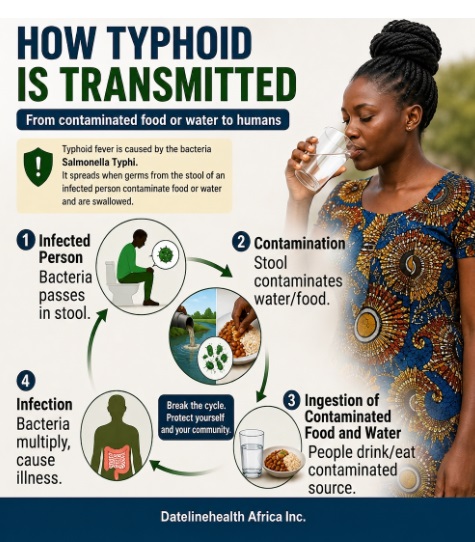
Infographic illustrating how typhoid is transmitted from contaminated food and water to humans. Click on image to enlarge.
Typhoid is caused by bacteria, specifically Salmonella Typhi. It spreads when food or water becomes contaminated, mostly as a result of poor sanitation, unsafe water sources, or food handled without proper hygiene. This is why typhoid tends to cluster in areas with limited access to clean water and safe food handling practices.
Typhoid symptoms tend to build up rather than occur at once. In the early stage, a person may notice fever that climbs gradually rather than spiking suddenly, usually described as a “step-ladder” pattern, where the temperature is a little higher each day. Alongside the fever, typhoid commonly causes headache, general body weakness, abdominal pain or discomfort, and changes in bowel habits; sometimes constipation or diarrhoea [4].
If typhoid is left untreated, or is treated poorly, it can lead to more serious complications and, in some cases, the person can continue to carry and spread the bacteria even after they feel better.
Confirming typhoid is where things get a little more complicated. The gold standard test is a blood culture, which directly detects the bacteria in the bloodstream. However, in many parts of sub-Saharan Africa, the more commonly used test is the Widal test, largely because it is cheaper and more widely available [5].
It is important to be honest here: the Widal test has well-documented reliability limitations. It can produce false positives in people who have previously been exposed to typhoid or vaccinated against it, and its results can be difficult to interpret without a proper baseline [5]. This means a positive Widal test is not always definitive proof of active typhoid infection, and clinicians often need to weigh it alongside symptoms and, where possible, more reliable testing.
Typhoid also carries a quieter, longer-term risk: a small number of people who recover can become carriers, continue to harbour the bacteria, often in the gallbladder, without feeling unwell themselves, and unknowingly pass it on through food or water they handle. This is one reason hygiene and hand-washing remain important even after someone has recovered [4].
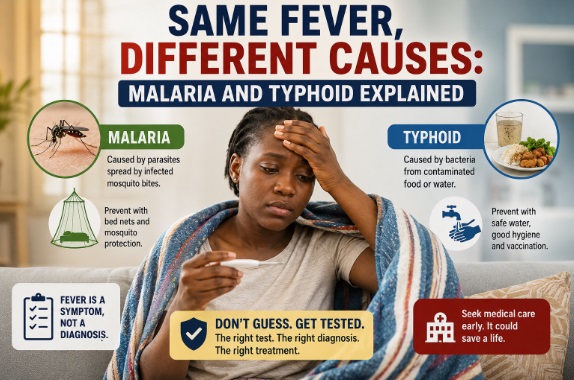
Infographic captioned Same Fever, Different Causes. Malaria and Typhoid Explained. It features a sick African lady holding a digital thermometer and contains texts explaining the differences between malaria and typhoid. Click on image to enlarge.
The mix-up between malaria and typhoid is not simply a case of people not knowing better. It is shaped by real, practical realities.
The trouble is that treatment based on guessing carries hidden costs. Treating malaria when the real problem is typhoid means the fever continues, the household spends more money buying yet another round of medications, and the actual infection remains unaddressed for longer, increasing the risk of complications. On a large scale, this pattern of taking antimalarials and antibiotics without confirmed need contributes to drug resistance, which is a growing concern for both diseases across the region.
There is also a social dimension worth mentioning. In many communities, a trusted neighbour, relative, or pharmacist’s confident opinion about “this kind of fever” often feels more reassuring than waiting to see a healthcare provider or for a test result. But shared lay experience is not the same as a laboratory-confirmed diagnosis.
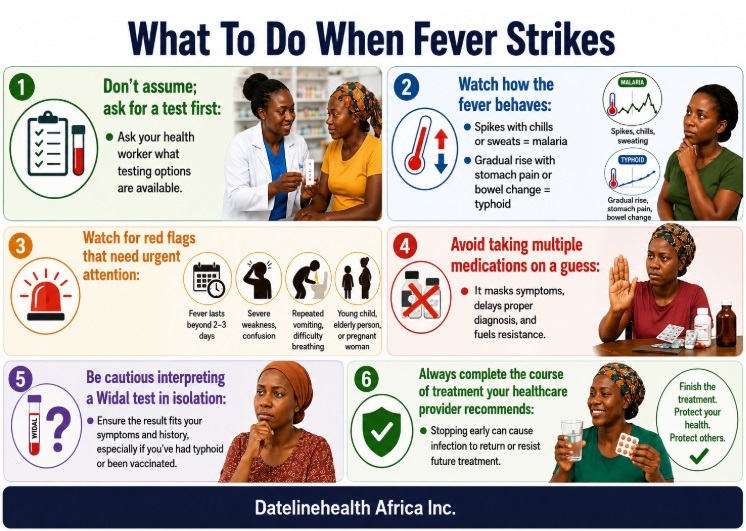
Infographic captioned: What to dow hen fever strikes. It contains text and images that provide guidance on how to respond to fever. Click on image to enlarge.
None of what's been stated so far is meant to cause panic; it is meant to encourage an important shift in behaviour: test before you treat, wherever that is realistically possible.
If you, or a family member, develops fever, here is a practical approach:
Many pharmacies, clinics, and primary health centers now offer malaria RDTs quickly and affordably. If typhoid is suspected based on symptoms like abdominal pain or a gradually rising fever, ask your health worker what testing options are available.
A fever that spikes and comes with chills and sweating episodes leans toward malaria. A fever that climbs gradually over several days, especially with stomach pain or a change in bowel habits, leans toward typhoid. This is a clue, not a diagnosis; testing still matters.
Seek care immediately if:
Taking antimalarial and antibiotics together “just in case” is a common but risky habit. It masks symptoms, delays proper diagnosis, and fuels resistance.
If typhoid is diagnosed solely on a Widal test result, ask your health worker whether the result fits your symptoms and history, especially if you have previously had typhoid or been vaccinated against it.
Stopping early because you “feel better” is one of the most common reasons infections return or resist future treatment.
Malaria and typhoid may knock on the door with the same symptom— fever—, but they are not the same illness, and they do not respond to the same treatment. The only reliable way to tell them apart is testing, not tradition or habit. In communities where presumptive treatment has become the norm, shifting toward “test first, treat second” is one of the simplest changes that can protect both individual health and the wider fight against drug resistance.
Yes. Because both illnesses are common in the same regions and seasons, co-infection does happen, though it is not the norm. This is another reason testing matters more than guessing.
This commonly performed test for typhoid has real limitations. It can show false positives in people previously exposed to typhoid or vaccinated against it, and it is generally less reliable than a blood culture. It remains widely used mainly because it is cheaper and more accessible.
Yes, typhoid vaccines exist and are recommended in some settings, particularly where access to clean water is limited. Availability varies, so it is worth asking a health worker about options near you.
General fever relief, such as rest, fluids, and paracetamol for comfort, is reasonable while awaiting results. Starting antimalarials or antibiotics without a confirmed diagnosis is not advisable, since it can mask symptoms and delay proper treatment. Avoid irresponsible self-medication while waiting for results.
Yes, both illnesses can recur. Malaria immunity built through prior exposure is only partial and can fade over time, so repeated infections remain possible in high-transmission areas. Typhoid can also recur, especially if the earlier infection was treated incompletely or if someone becomes a carrier without realising it.
References
1. Sohanang Nodem FS, Ymele D, Fadimatou M, Fodouop SC. Malaria and Typhoid Fever Coinfection among Febrile Patients in Ngaoundéré (Adamawa, Cameroon): A Cross-Sectional Study. J Parasitol Res. 2023 Sep 25;2023:5334813. doi: 10.1155/2023/5334813. PMID: 37790287; PMCID: PMC10545472. Available from here.
2. CDC, Malaria’s Impact Worldwide, Internet April 1, 2024, Accessed August 22, 2026. Available from here.
3. World Health Organisation, Malaria, (Internet, 4 December 2025), Accessed August 24, 2026. Available from here.
4. World Health Organisation, Typhoid (Internet, 30 March 2023), Accessed August 25, 2026. Available from here.
5. Ofori EK, Kpabitey IL, Aidoo NE, Amponsah SK. Epidemiologic trends, diagnostic limitations, and public health challenges of enteric fever in sub-Saharan Africa: A narrative review. IJID Regions, Volume 19, 2026, 100898, ISSN 2772-7076, Available from here.
Related:
Tips for African Parents on Caring for a Child with Fever at Home Safely
10 Common Causes of Fever in Children in Sub-Saharan Africa
10 Reasons For Concern About Your Child’s Fever (Tips for African Parents)
Fever in children: What African parents need to know
This article is for general health education and does not replace professional medical advice. If you or someone you know has a persistent or severe fever, please consult a qualified health worker for proper assessment and treatment.
Published: September 3, 2026
© 2026. Datelinehealth Africa Inc. All rights reserved.
Permission is given to copy, use, and share content freely for non-commercial purposes without alteration or modification and subject to source attribution.
DATELINEHEALTH AFRICA INC., is a digital publisher for informational and educational purposes and does not offer personal medical care and advice. If you have a medical problem needing routine or emergency attention, call your doctor or local emergency services immediately, or visit the nearest emergency room or the nearest hospital. You should consult your professional healthcare provider before starting any nutrition, diet, exercise, fitness, medical or wellness program mentioned or referenced in the DatelinehealthAfrica website. Click here for more disclaimer notice.