Take Control: An African Adult’s Guide to Asthma
By Foluke Akinwalere. Health & Medical Writer. Medically reviewed by: Michelle B. Abebrese, MD.
January 15, 2026

Image of an African adult asthma patient using an inhaler. Image from ChatGPT. Click on image to enlarge
Imagine struggling to breathe while walking to work, climbing stairs, or even lying down to sleep. For millions of African adults, this is not imagination; it is the daily reality of living with asthma.
Asthma is usually misunderstood as a childhood disease, but it significantly affects adults across Africa. With rapid urbanisation, increasing air pollution, and changing lifestyles, the burden of asthma in African adults is rising steadily. Unfortunately, many people remain undiagnosed, untreated, or poorly managed, which leads to avoidable complications and reduced quality of life.
This article is written for you, whether you have asthma, suspect you might, care for someone who does, or simply want to be better informed. You will learn what asthma is, how common it is across Africa, what causes and triggers it, how it is diagnosed and treated, and most importantly, how to live well with it.
Asthma is a long-term (chronic) condition that affects the airways, the tubes that carry air in and out of your lungs. In a person with asthma, these airways become:
When exposed to certain triggers, the airways swell, produce excess mucus, and the muscles around them tighten, making the airway passage very narrow. This is what causes the familiar symptoms: difficulty breathing, wheezing, chest tightness, and coughing
It is important to understand that asthma is not a temporary illness you recover from, like a cold. It is a lifelong condition that can be controlled but not cured. However, with the right management, people with asthma can lead fully active, healthy lives [1].
Asthma is often mistaken for other respiratory conditions, such as chronic obstructive pulmonary disease (COPD), pneumonia, or tuberculosis (TB), all of which are also common in Africa.
The key distinction is that asthma symptoms typically vary over time, are reversible (either on their own or with medication), and are triggered by specific factors. A proper diagnosis from a healthcare provider is essential.
.jpg)
Infographics: Africa asthma prevalence by country. Created from Gemini Nano Banana. Click on image to enlarge.
Asthma is more common in Africa than many people realise, and the numbers are rising. Across the continent, studies show that asthma prevalence in Africa ranges from under 2% to over 20%, depending on the country and age group. Some of the highest rates have been recorded in South Africa, followed by Egypt, Nigeria, Ethiopia, and Kenya [2].
Globally, asthma cases grew from around 74 million people in 1990 to over 119 million by 2010, and Africa is very much part of this trend. What makes the situation especially serious is that asthma in Africa is also linked to higher death rates. In Uganda, for example, the asthma mortality rate is estimated to be nearly 90 times higher than in the United Kingdom; a sobering reminder of how urgently better care is needed [2].
Beyond the death toll, the day-to-day burden of asthma on African adults is heavy. Research shows that roughly 60% of asthma patients across parts of Africa experience at least one severe flare-up per year, yet only about one-third have their symptoms well-controlled. Severe asthma is also more widespread than expected. Studies report severe asthma prevalence of nearly 20% in Ethiopia, 27% in Uganda, and 27% in Kenya. These numbers put enormous pressure on already stretched healthcare systems, particularly in remote or hard-to-reach communities where access to asthma treatment in Africa is limited [2].
One of the biggest challenges is that asthma is usually under-diagnosed and under-treated, particularly in low- and middle-income countries [3].
Many people live with symptoms for years without ever receiving a correct diagnosis, children presenting with asthma symptoms are incorrectly treated for pneumonia with antibiotics, which means the underlying condition goes unaddressed.
For adults, limited access to diagnostic tools, low awareness among patients and healthcare workers, and the tendency to dismiss breathing difficulties as something minor all contribute to this gap. The true prevalence of asthma in Africa is most likely much higher than current figures show.
Asthma does not have a single cause. Instead, it develops from a combination of genetic and environmental factors.
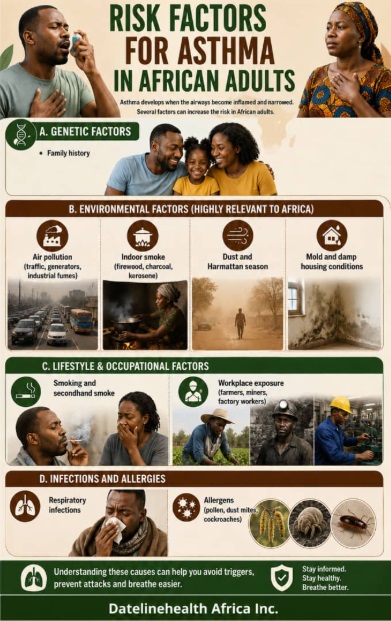
Info-poster: Risk factors for asthma in African adults. Image created from ChatGPT. Click on image to enlarge.
Asthma runs in families. If one or both of your parents have asthma, or if there is a family history of allergic conditions such as eczema or hay fever, your risk of developing asthma is higher. This genetic link means that asthma can appear even when environmental conditions are relatively clean.
Environmental exposure plays a major role in the development of asthma in Africa.
Rapid urban growth has significantly increased exposure to polluted air, especially in major cities.
Many African households still cook with firewood, charcoal, or kerosene. The smoke produced by these fuels significantly increases the risk of respiratory diseases. It can contribute to the development and worsening of asthma, especially among women and children who spend more time in the kitchen.
The Harmattan season, which brings dry and dusty winds across West Africa, is a well-known respiratory hazard. Even outside the Harmattan season, dry and dusty environments remain a year-round concern.
Poorly ventilated, damp, or overcrowded housing, which is common in informal settlements and many urban areas, fosters mold growth. Mold spores are a powerful asthma trigger.
Tobacco smoking remains a significant risk factor, both for the smoker and those around them. Secondhand smoke is particularly dangerous for children and non-smoking adults who share enclosed spaces with smokers.
Occupational exposure is another underappreciated factor. Farmers inhale pesticide dust and grain particles. Miners are exposed to silica and dust. Factory workers encounter industrial chemicals and fumes. All of these can cause or worsen asthma over time.
Severe respiratory infections during childhood, particularly those requiring hospitalisation, have been associated with a higher risk of developing asthma later in life. Cases of pneumonia, bronchitis, or even respiratory syncytial virus (RSV) are among the most strongly linked to later asthma development. In Africa, where childhood infections are common and sometimes undertreated, this is a significant pathway. Allergens such as pollen, dust mites, and cockroach droppings (common in urban African homes) are also well-established asthma triggers.
Even in people whose asthma is well-controlled, certain exposures can cause symptoms to flare up. Knowing your personal triggers is one of the most important tools for managing asthma. Common triggers in the African context include:
Recognising asthma symptoms is the first step toward getting a proper diagnosis and treatment. In adults, asthma may present differently from childhood asthma, symptoms can be subtle, intermittent, or easily mistaken for other conditions.
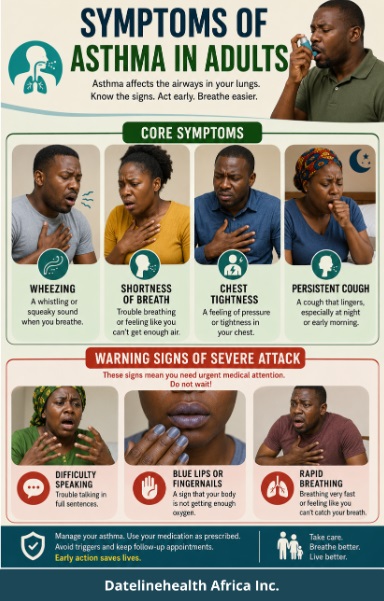
Info-poster: Symptoms of asthma in African adults. Image created from ChatGPT. Click on image to enlarge.
If you experience these symptoms regularly, or if they are triggered by specific exposures, speak to a healthcare provider as soon as possible.
A severe asthma attack is a medical emergency. Seek immediate help if you notice:
Many Africans delay seeking medical care for breathing problems, either due to limited healthcare access, cost concerns, or the normalisation of respiratory symptoms. Do not wait. You should see a doctor if:
Early diagnosis and treatment can reduce symptoms, prevent severe attacks, and help preserve lung function over time. The sooner you are properly assessed, the sooner you can start effective treatment.
Diagnosing asthma involves a combination of medical history, physical examination, and ideally, lung function testing. A good clinician will ask about your symptoms, such as:
The gold standard diagnostic test is spirometry, a simple, non-invasive test where you breathe into a device that measures how much air you can exhale and how quickly. Spirometry helps distinguish asthma from COPD, TB sequelae, and other conditions.
In many African healthcare settings, spirometry is not always available, particularly in rural clinics or primary health centres [4]. This is a significant challenge. However, a thorough clinical assessment, even without spirometry, can still lead to an accurate diagnosis and appropriate treatment. Advocacy for better diagnostic equipment across African health systems remains critical.
Asthma treatment aims to control symptoms, prevent attacks, and protect lung function over the long term. There is no cure, but with the right treatment plan, most people with asthma can live normal, active lives.
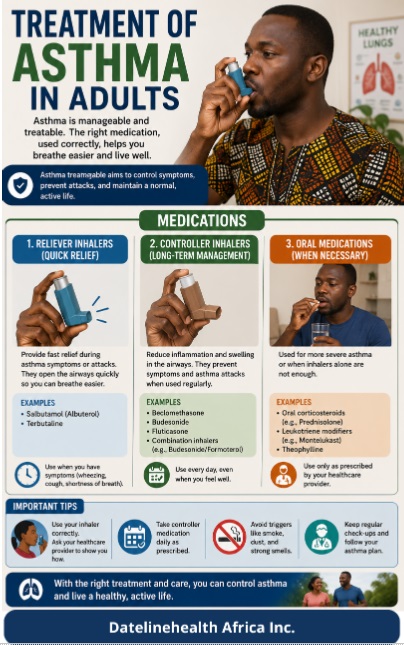
Info-poster: Treatment of asthma in African adults. Image created from ChatGPT. Click on image to enlarge.
Current international guidelines recommend that most adults with asthma should receive inhaled corticosteroids containing treatment rather than relying solely on a reliever inhaler. Overuse of inhalers without anti-inflammatory treatment increases the risk of severe asthma attacks.
Also called rescue inhalers or bronchodilators (the most common is salbutamol), these medications provide rapid relief during an asthma attack by relaxing the muscles around the airways. They work within minutes and are essential for anyone with asthma to carry at all times.
These usually contain inhaled corticosteroids (ICS) such as beclomethasone or budesonide. They reduce airway inflammation over time, preventing symptoms and attacks. They must be used daily, even when you feel well; they do not provide immediate relief but are the cornerstone of long-term asthma management. Your healthcare provider will recommend the approach that is best for you.
In some cases, short courses or oral corticosteroids may be prescribed during severe exacerbations. Other add-on treatments may be used when inhaled therapy alone is insufficient.
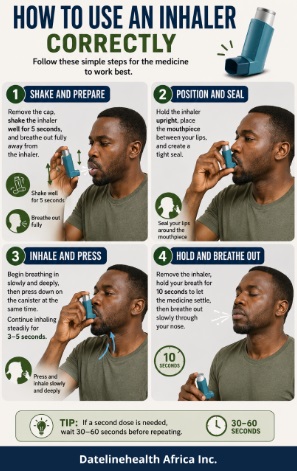
Info-poster: How to use an inhaler correctly. Image created from ChatGPT. Click on image to enlarge.
Inhalers are highly effective, but only when used correctly. Study show that a large proportion of asthma patients worldwide use their inhalers incorrectly. Poor technique means the medication does not reach the lungs, leading to uncontrolled symptoms despite being ‘on treatment.’ Ask your healthcare provider or pharmacist to demonstrate correct inhaler technique and watch you use it. This single step can dramatically improve your asthma control.
Access to essential asthma medications, particularly controller inhalers, remains a significant challenge in many African countries. Cost, inconsistent supply chains, and the absence of medications at rural health facilities mean that many adults with asthma go without adequate treatment. Advocacy, health insurance expansion, and government inclusion of asthma medications on essential medicines lists are crucial steps toward closing this gap.
Good daily asthma management is the difference between a life dominated by symptoms and one where asthma barely slows you down. Key daily practices include:
While you cannot always prevent asthma, you can take practical steps to reduce the frequency and severity of attacks, especially within the African context:
Having asthma does not mean giving up the activities you love. With good management, you can exercise, travel, work, and live fully. Here is how:
Exercise safely: Physical activity is beneficial for people with asthma. Choose lower-impact activities like swimming, walking, or cycling. Warm up gradually and cool down properly. Use your reliever inhaler before exercise if your doctor has advised this.
Eat well and stay hydrated: A balanced diet rich in fruits, vegetables, and omega-3 fatty acids supports lung health. Evidence suggests that antioxidant-rich foods may reduce airway inflammation. Avoid foods that you know trigger symptoms.
Manage stress: Emotional stress is a known asthma trigger. Practices such as breathing exercises, mindfulness, prayer, community support, and adequate rest all contribute to better asthma control.
Build a support system: Do not manage asthma alone. Share your diagnosis with family and trusted friends. Educate them about your condition, your medications, and what to do in an emergency. Community and peer support can be powerful tools for long-term well-being.
Misinformation about asthma is widespread across Africa and prevents many people from getting the help they need.
Myth: ‘Asthma is a childhood disease; adults grow out of it’
Fact: Asthma can persist from childhood into adulthood, and it can also develop for the first time in adulthood. Adult-onset asthma is increasingly recognised globally. Age is no barrier to asthma.
Myth: ‘Inhalers are addictive and will weaken my lungs.’
Fact: Inhalers are not addictive. Reliever inhalers are used as needed; controller inhalers are prescribed for daily use because consistent anti-inflammatory treatment protects the lungs. Avoiding or misusing inhalers leads to worse asthma control, not better.
Myth: ‘Asthma is caused by spiritual factors or a curse.’
Fact: Asthma has clear, well-understood biological causes involving genetics, immune responses, and environmental exposures. It is not a spiritual condition. Believing otherwise delays life-saving medical treatment.
Myth: ‘Asthma cannot be controlled; you just have to live with the attacks.’
Fact: Asthma is one of the most controllable chronic conditions when properly managed. With the right medication, trigger avoidance, and education, most people with asthma have a few or no symptoms.
When asthma is left untreated or poorly managed, the consequences can be serious and far-reaching:
These outcomes are largely preventable. The goal of asthma care is to keep you out of hospital and living your life to the fullest.
Asthma in African adults is a real, growing, and often underappreciated health challenge. It is driven by a complex mix of genetic factors, environmental pollution, indoor smoke, occupational hazards, and limited healthcare access; challenges that are deeply embedded in the daily realities of millions of people across the continent.
But here is the most important truth: asthma is manageable. With proper diagnosis, the right medications, trigger avoidance, and good daily habits, you can control your asthma before it controls you.
If you have been living with unexplained breathing difficulties, please do not wait. See a healthcare provider, get a proper diagnosis, and ask about a management plan. If you have already been diagnosed with asthma, commit to your treatment; take your controlled inhaler daily, carry your reliever inhaler always, and know your triggers.
References:
1. NIH, National Heart, Lung, and Blood Institute, What Is Asthma? [Internet] April 17, 2024. Accessed May 26, 2026. Available from here.
2. Faniyi, A.A., Okesanya, O.J., Nukpezah, R.N. et al. Addressing the asthma crisis in Africa: challenges, strategies, and recommendations for improved management. Egypt J Intern Med 36, 76 (2024). https://doi.org/10.1186/s43162-024-00340-6 Available from here.
3. World Health Organisation (WHO), Asthma. [Internet] April 28, 2026. Accessed May 28, 2026. Available from here.
4. Ingenhoff R, Robertson N, Munana R, Siddharthan T. Challenges to Implementation of Community Health Worker-Led Chronic Obstructive Pulmonary Disease (COPD) Screening and Referral in Rural Uganda: A Qualitative Study using the Implementation Outcomes Framework. International Journal of Chronic Obstructive Pulmonary Disease. 2023;18. 2769-2783. 10.2147/COPD.S420137. Available from here.
Related
Asthma in African Children: Causes, Symptoms and Care
Chest Infection in African Children
Tuberculosis in Nigerian Children: What You Need to Know
Published: June 15, 2026.
© 2026. Datelinehealth Africa Inc. All rights reserved.
Permission is given to copy, use, and share content freely for non-commercial purposes without alteration or modification, and subject to source attribution.
DATELINEHEALTH AFRICA INC., is a digital publisher for informational and educational purposes and does not offer personal medical care and advice. If you have a medical problem needing routine or emergency attention, call your doctor or local emergency services immediately, or visit the nearest emergency room or the nearest hospital. You should consult your professional healthcare provider before starting any nutrition, diet, exercise, fitness, medical or wellness program mentioned or referenced in the DatelinehealthAfrica website. Click here for more disclaimer notice.