Never too late: How to safely build muscle strength after 50
By: Oluwasola Samuel, freelance health writer. Medically reviewed by: A. Odutola, MBBS, PhD, FRCSEd.
November 21, 2026
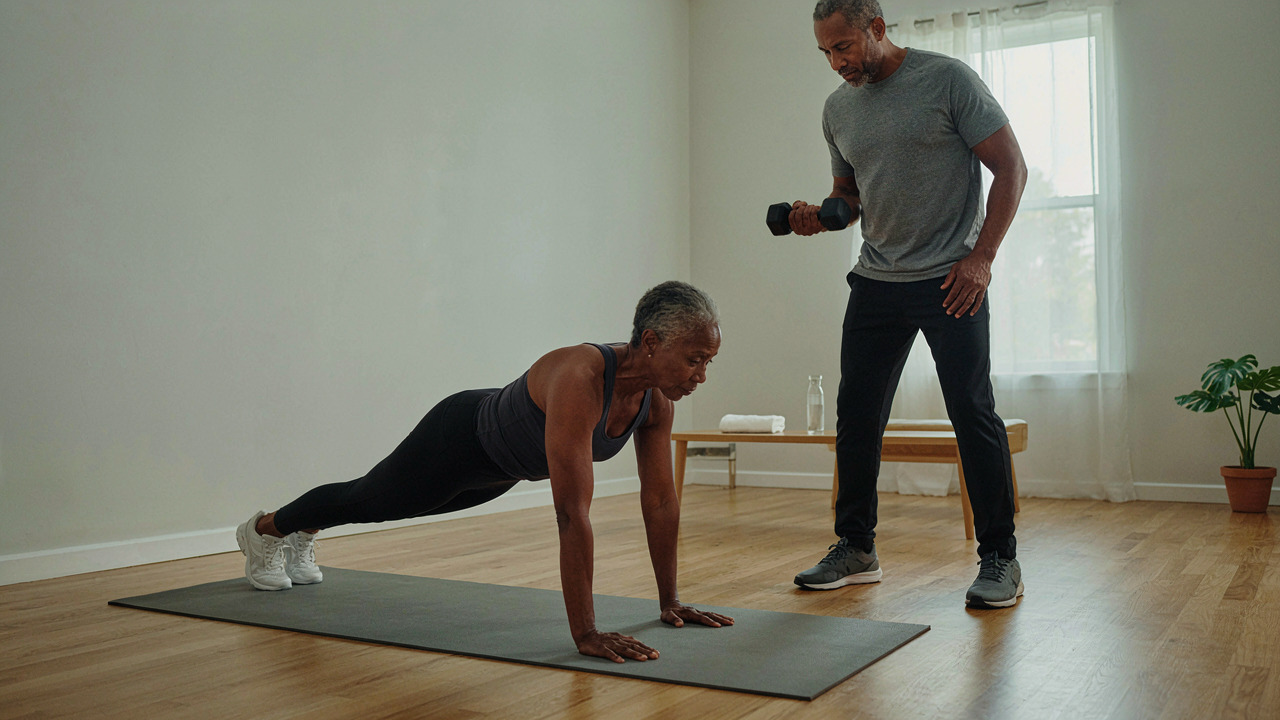
An older black woman in dark athletic wear holds a sturdy plank position on a gray yoga mat. Standing beside her near a sunlit curtained window, an middle aged black man in a gray T-shirt performs a single-arm dumbbell curl in a bright, minimalist room with hardwood floors. Image credit: ChatGPT. Click on image to enlarge.
Getting up from a low chair used to be a no brainer. Now you push off with both hands. Carrying a bag of groceries from the market leaves your arms shaking, and climbing the stairs makes you pause at intervals.
Is it too late to do something about these issues? No, it is not.
Research involving over 6,000 older adults across 121 trials found that people who train their muscles against resistance become stronger, no matter their starting age (1). Youth isn't what makes the difference. Starting, and starting safely, makes the difference.
This blog walks you through starting exercising at an older age step-by-step. You do not need a gym membership or fancy equipment. All you need is a plan that fits your body, budget, and your lifestyle. By the end, you will know what to do this week, what to eat, and when to see a doctor.
As you age, muscle loss and decrease in strength becomes common. This condition is also known as sarcopenia (natural loss of muscle) (2).
Research shows that after about age 50, muscle mass drops by roughly 1 to 2% a year. (3) Muscle strength falls even faster, by about 1.5% a year between 50 and 60, and by about 3% a year after that. This happens because nerve signals to muscles weaken over time and muscle fibres slowly shrink.
This is common across the world, and Africa is not left out. Two separate reviews looking at African studies found that roughly a quarter of older adults showed signs of sarcopenia, with a higher occurrence in men compared with women aged 50 and above. (4) Most of the studies considered in the two reviews were done in hospitals, so the true picture in the wider community is still not fully clear. However, the pattern is real and it deserves attention.
What this means is that muscle loss does not mean something is wrong with you. Muscle loss is normal and it's part of ageing. But being normal does not mean you have to sit back and accept it. The good thing about muscles is that they respond to use at any age, and this guide shows you how.
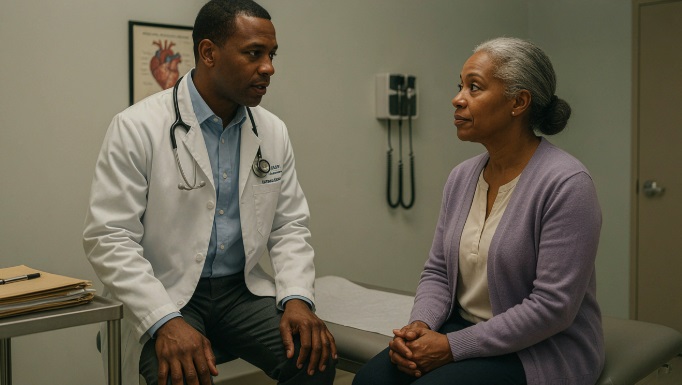
A black male doctor in a white lab coat and stethoscope sits across from an older black woman on an exam table. Wearing a lavender cardigan with her gray hair in a low bun, she listens attentively with her hands clasped in her lap while he speaks. Image credit: ChatGPT. Click in image to enlarge.
Before you start any strength routine, book a visit with your doctor. Get a basal physical check done by your doctor to include blood pressure, blood sugar and kidney function.
This step matters more than many people realise. In the WHO African Region, up to 44% of adults aged 30 to 79 have high blood pressure, yet in most countries fewer than half are diagnosed, and fewer than one in five have it under control. Many people carry this condition without knowing it. A visit to your doctor or a nearby health centre can catch this early, and it costs far less than dealing with a stroke or heart problem later.
If you are already managing a condition such as diabetes or arthritis, tell your doctor you want to start strength training. Your doctor will explain your risk and things to watch out for.
To do this week: Book an appointment with a doctor or visit your nearest primary health centre for a check-up.
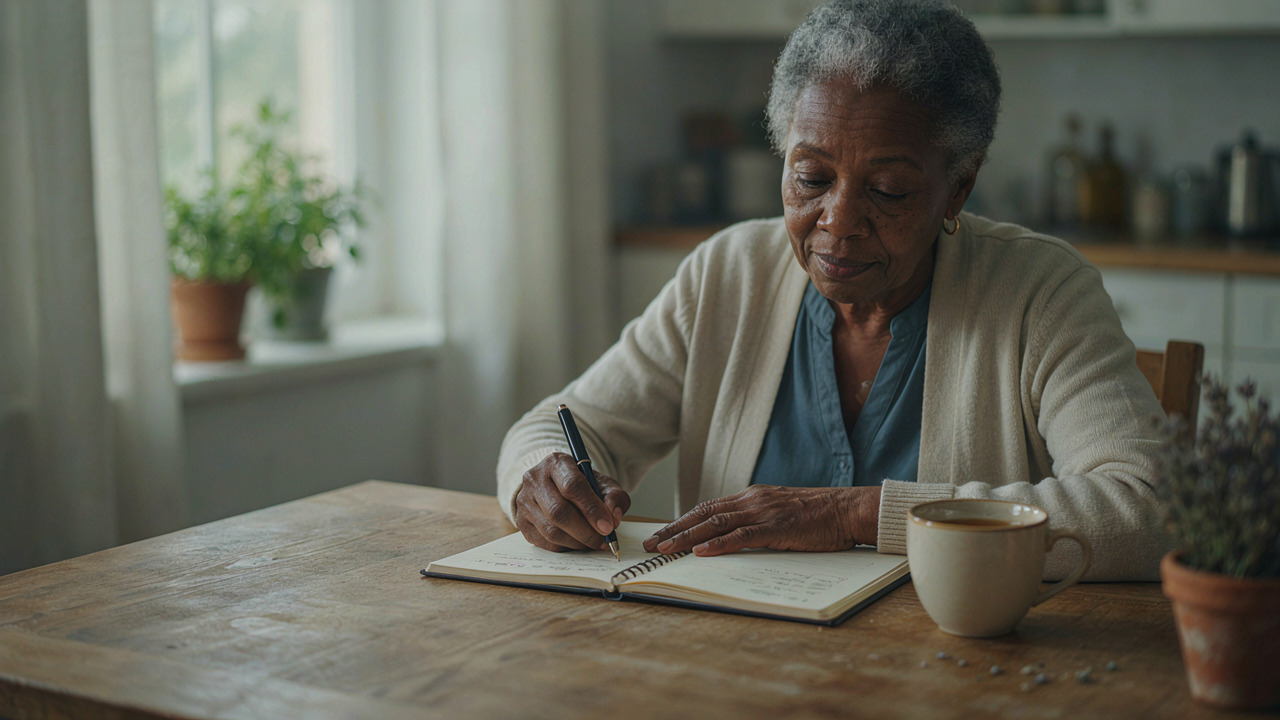
An older black woman in a cream cardigan sitting at a sunlit wooden table writes thoughtfully in an open spiral notebook. A ceramic mug and a small potted plant rest nearby, with soft natural light streaming through a curtained window behind her. Image credit: ChatGPT. Click in image to enlarge.
You cannot measure progress without knowing where you began.
Write down three things:
You do not need special equipment for this. A notebook or a note on your phone is enough. Many people share this kind of progress with a spouse, a sibling or an adult child on WhatsApp, and that small habit of accountability helps many people stay consistent.
To do this week: Write down your answers to these three questions.
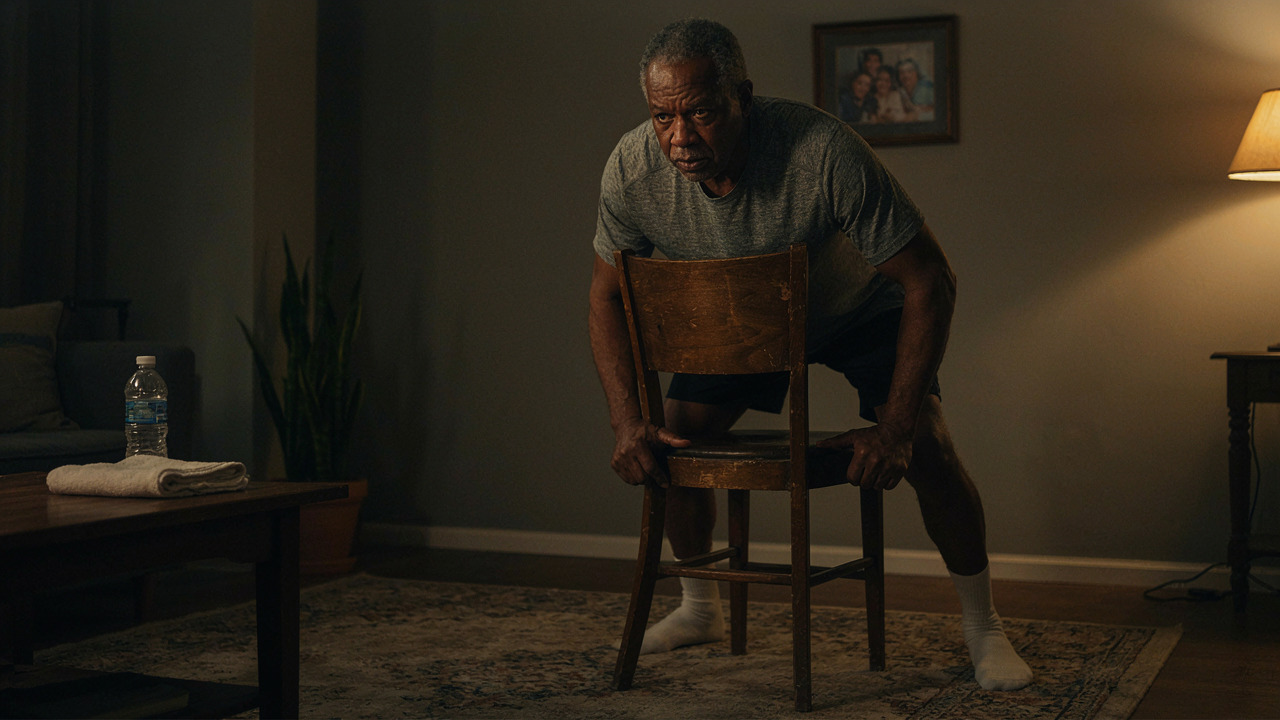
An older black man in a gray T-shirt, dark shorts, and white socks, standing on a patterned rug in a dimly lit living room, braces both hands on the seat of a sturdy wooden chair during a bodyweight exercise. To his left, a folded towel and a bottle of water sit ready on a low wooden coffee table. Image credit: ChatGPT. Click in image to enlarge
To start, you do not need a gym. All you need is a chair, a staircase, and your own body weight to begin. Five simple moves that cover the major muscle groups, and the number of repetitions you should do:
Stand in front, but with your back to a chair. Lower yourself until you almost sit, then stand back up.
Push against a wall or do push-ups from your knees to build arm and chest strength.
Loop a band around a door handle and pull it toward you to work your back.
Rise onto your toes, holding a wall or chair for balance.
Lie on your back, knees bent, and lift your hips off the floor.
N.B: Do 8 to 10 repetitions of each move listed above. As it gets easier over a few weeks, build up to 10 to 15 repetitions. Rest until you feel ready, then repeat the round once more if you feel good. Ensure each move is slow and controlled.
You can get a resistance band to help you during your exercise. They are good for the joint, strength and muscle training, and it aids recovery.
Always focus on doing each move slowly and correctly rather than fast and sloppy.
To do this week: Try all five moves once, using a chair or wall for balance if you need to.
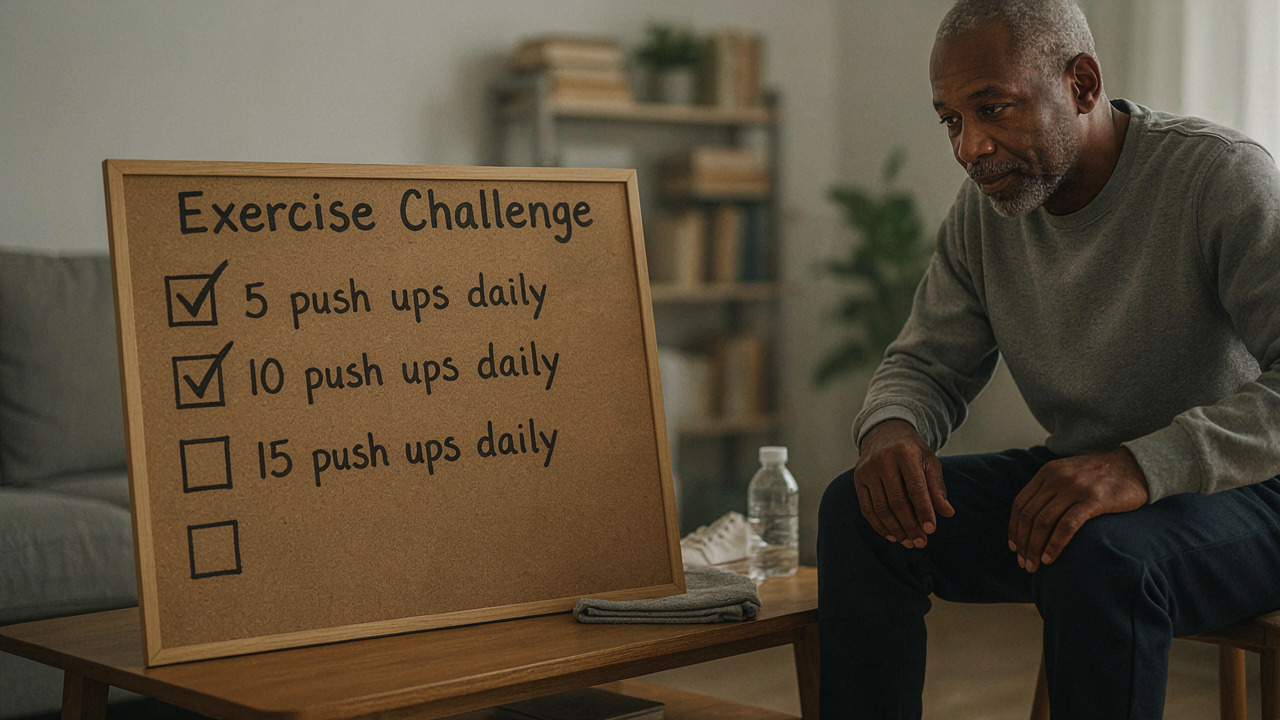
An older black man in a gray sweatshirt sits beside a wooden coffee table, looking at a framed corkboard titled "Exercise Challenge." The board lists "5 push-ups daily" and "10 push-ups daily" with checked boxes, followed by an unchecked box for "15 push-ups daily," alongside a water bottle, towel, and sneakers. Image credit: ChatGPT. Click in image to enlarge
Global health guidance recommends muscle-strengthening activity on at least 2 days a week for all adults, with a rest day between sessions so your muscles can recover.
Once an exercise starts to feel easy, that is your cue to progress. Fitness experts commonly recommend increasing the challenge by small amounts, such as a slightly heavier band or a few extra repetitions, rather than jumping to something much harder. Add a little more challenge once it feels easy, and don't overthink the exact number. Small, steady increases are safer than big jumps, especially when you are still learning your body's limits.
To do this week: pick two days this week for your strength session, with at least one rest day in between.

An older black man and woman sit facing each other across a wooden dining table, sharing a quiet dinner. The man holds a warm mug while the woman eats from a plate of food, engaged in conversation in a cozy, dimly lit room. Image credit: ChatGPT. Click in image to enlarge.
Muscles need protein to grow and repair, and many older adults do not eat enough of it.
The National Council of Aging recommends that people over 65 should aim for at least 1.0 to 1.2 grams of protein per kilogram of body weight each day, and more if they are physically active (5). If you have severe kidney disease, ask your doctor first, since protein needs are different in that case.
You do not need imported powders to meet this. Everyday foods work well: beans, eggs, fish, chicken, groundnuts and milk are all good sources, and most families already have some of these in their kitchen. Try to include a protein food at each main meal rather than saving it all for dinner.
To do this week: Add one extra serving of beans, eggs or fish to your meals on your training days.
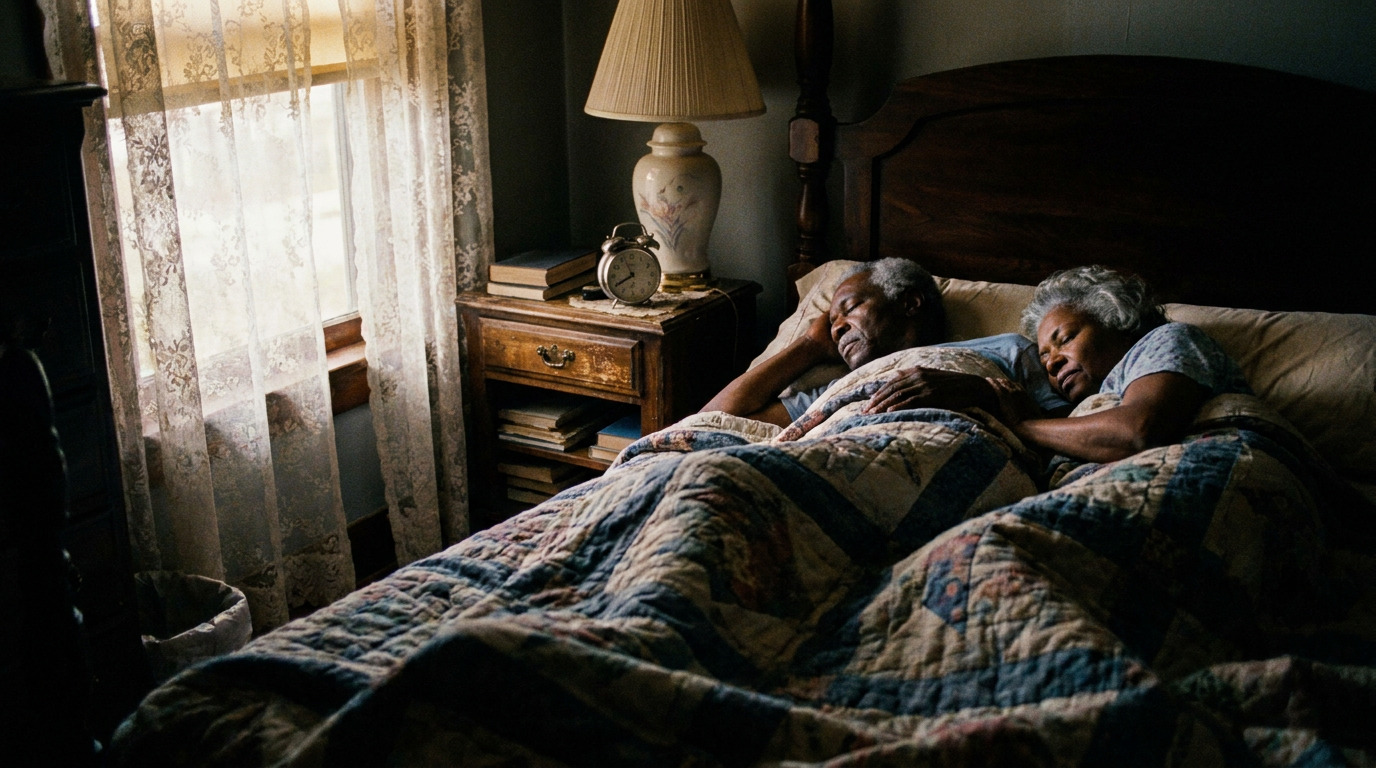
An older Black man and woman sleep side by side under a cozy patchwork quilt in a wooden bed. Soft morning light filters through a lace-curtained window beside a wooden nightstand holding a lamp, books, and a classic alarm clock. Image credit: ChatGPT. Click in image to enlarge.
Muscles do not grow during the workout. They grow afterward, while you rest. Give yourself at least one full day to rest between strength sessions. Always aim for enough sleep most nights.
Every two weeks, repeat the three checks from Step 2. Notice if standing from a chair feels easier, or if you climb the stairs with less effort. These small, real-life wins matter more than any number on a scale.
Share your progress with someone. Share with someone you trust and who can help you stay on track. If your children aren't living with you, a quick WhatsApp update can turn into real encouragement.
To do this week: Set a reminder to repeat your Step 2 checks in two weeks.
After engaging in a new exercise, it's normal for your muscles to feel sore after a day or two. The soreness will usually fade within a few days.
Sharp pain during an exercise is not normal. If you feel any sharp pain or discomfort during your exercise session, stop immediately.
Pain and discomfort like:
Stop the exercise and contact your doctor. Do not try to push through it.
Complete Steps 1 and 2.
See your doctor and write down your starting point. Try the five moves in Step 3 once, and focus only on form.
Do your five moves twice this week, with a rest day between sessions. Add one extra protein-rich meal on training days.
Repeat your Step 2 checks. Keep training twice a week. If any move feels easy, try a slightly stronger resistance band or a few more repetitions.
Continue your twice-weekly sessions. Repeat your checks again and compare them with Week 1. Decide whether to keep this routine or gradually add a third training day, based on how your body responds and what your doctor advises.
It is never too late to get stronger. Muscle loss after 50 is common, but it is not permanent. It is not something you have to face alone. Start with what you have, be slow and steady with your muscle--building exercises, eat well, and check in with your doctor along the way.
If you are unsure where to begin or you have a health condition that needs closer attention, speak with a doctor before starting any new exercise routine.
Yes it can be reversed. Muscle strength can be improved with specific resistance exercises. If you engage in resistance exercises, you will become noticeably stronger. You will also be able to perform daily tasks, like standing from a chair, more easily.
This does not mean you will fully return to the muscle you had at age 25, but you will notice real measurable improvement over time.
No it doesn't count as strength training. Walking is a good aerobic exercise and it benefits your heart, but it does not build muscle strength the way resistance exercises do. You need moves that push your muscles against resistance, such as squats, push-ups or band exercises, to build strength.
No, not usually. Whole foods like beans, eggs, fish and groundnuts can meet your daily protein needs. Researchers who reviewed protein and ageing noted that there is not yet enough evidence to make firm recommendations about supplements for older adults. (6) Food first is the safer and cheaper approach, unless your doctor advises otherwise for a specific medical reason.
Yes, it's safe for most people. Health bodies including the American Heart Association note that resistance training is generally a safe and effective way to support heart health, and it may even help lower blood pressure over time. (7) The key is starting slowly, breathing normally instead of holding your breath, and getting your doctor's approval first, especially if your blood pressure is currently very high or not well controlled.
Yes, you can in many cases. A large review of studies found that resistance training reduced pain for people with osteoarthritis, alongside improving their strength. (8) Always check with your doctor first, since the right approach depends on which joints are affected and how severe the arthritis is.
For some people, they notice everyday tasks, like standing up or climbing stairs, feel a little easier within the first few weeks of consistent training. Others may feel slight pain or soreness of the muscle. Everyone's body responds differently, so use your own Step 2 checks to track your personal progress rather than comparing yourself to others.
1. Liu C ju, Latham NK. Progressive resistance strength training for improving physical function in older adults. Cochrane Database of Systematic Reviews. 2022, Issue 4. Art. No.: CD002759. DOI: 10.1002/14651858.CD002759.pub2. Available from here.
2. Harvard Health [Internet]. Age and muscle loss. 2026 February 23. [Cited 2026 Sep 28]. Available from here.
3. von Haehling S, Morley JE, Anker SD. An overview of sarcopenia: facts and numbers on prevalence and clinical impact. J Cachexia Sarcopenia Muscle. 2010 Dec;1(2):129–33. doi:10.1007/s13539-010-0014-2. Available from here.
4. Yene BVM, Lee SY, Park KS, Kang YJ, Seo SH, Yoo JI. Prevalence of Sarcopenia in Africa: A Systematic Review. CIA. 2023 Jul 4;18:1021–35. doi:10.2147/CIA.S407917. Available from here.
5. National Council on Aging. How Much Protein Do Older Adults Need? [Internet]. 2025 Dec. 11. [Cited 2026 Sep 28]. Available from here.
6. Nowson C, O’Connell S. Protein Requirements and Recommendations for Older People: A Review. Nutrients. 2015 Aug 14;7(8):6874–99. doi:10.3390/nu7085311. Available from here.
7. Paluch AE, Boyer WR, Franklin BA, Laddu D, Lobelo F, Lee D chul, et al. Resistance Exercise Training in Individuals With and Without Cardiovascular Disease: 2023 Update: A Scientific Statement from the American Heart Association. Circulation. 2024 Jan 16;149(3). doi:10.1161/CIR.0000000000001189. Available from here.
8. Lim J, Choi A, Kim B. The Effects of Resistance Training on Pain, Strength, and Function in Osteoarthritis: Systematic Review and Meta-Analysis. J Pers Med. 2024 Nov 30;14(12):1130. doi:10.3390/jpm14121130. Available from here.
Related:
5 Ways to Prevent Muscle Wasting in the Elderly
Best Exercise for Healthy Ageing (Tips)
Moving Aids Healthy Ageing: Study finds
Short Bursts of Exercise Can Lower Risk of Major Diseases, Study Finds
Health Effects of Exercise in African Females: Myths, Facts and Benefits
10 Reasons African Should Exercise
7 Tips for Sustainable Exercise for Beginners in Africa
Does exercise promote good health?
Daily exercise can prevent hospitalisation, study finds
Published: November 21, 2026.
© 2026. Datelinehealth Africa Inc. All rights reserved.
Permission is given to copy, use and share content for non-commercial purposes without alterations or modifications and subject to source attribution.
DATELINEHEALTH AFRICA INC., is a digital publisher for informational and educational purposes and does not offer personal medical care and advice. If you have a medical problem needing routine or emergency attention, call your doctor or local emergency services immediately, or visit the nearest emergency room or the nearest hospital. You should consult your professional healthcare provider before starting any nutrition, diet, exercise, fitness, medical or wellness program mentioned or referenced in the DatelinehealthAfrica website. Click here for more disclaimer notice.