WHO Warns of Intensifying Spread of New Ebola Virus Strain in DR Congo
Tamunobelema Bamson. B.Sc. Microbiology. Health & News Reporter and DLHA Volunteer. Medically reviewed by the DHA Team.
September 19, 2026
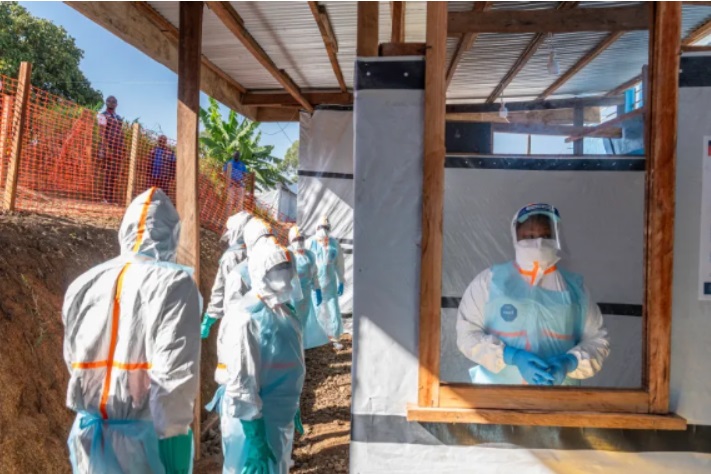
Health workers in full protective gear fighting the Ebola outbreak in DR Congo. Photo Credit: WHO. Click on image to enlarge.
The Democratic Republic of the Congo (DRC) is facing a growing outbreak of Ebola disease caused by the Bundibugyo virus. The outbreak, which started in Ituri Province, has now spread to five provinces, with thousands of cases and deaths reported, according to the World Health Organization (WHO).
The World Health Organization (WHO) has warned that all chains of transmission must be identified and stopped to contain the Ebola outbreak in the Democratic Republic of Congo (DRC). Although containing the outbreak has been difficult because of insecurity, limited healthcare facilities, population movement and the lack of an approved vaccine specifically for the Bundibugyo virus.
The Ebola outbreak in the Democratic Republic of Congo (DRC) has continued to spread since it was first reported in May 2026. The World Health Organization (WHO) said that more than 6,000 confirmed cases and 2,911 deaths had been reported as of August 31, making it the country’s largest recorded Ebola outbreak. The figures correspond to a crude case fatality ratio (CFR) of 48.3%.
The outbreak has also continued to spread geographically, beyond areas where it was first detected. Since the last Disease Outbreak News was published by the World Health Orgabization (WHO), the number of affected health zones has increased from 54 to 61. Cases were reported across six of the DR Congo’s 26 provinces: Bas-Uélé, Haut-Uélé, Ituri, North Kivu, South Kivu and Tshopo.
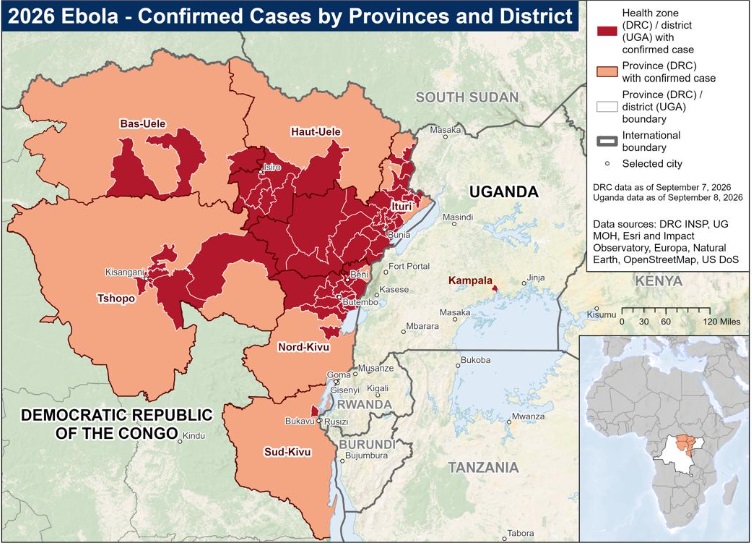
Ebola-affected health zones in the Democratic Republic of Congo. Report by CDC. Click image to enlarge.
Notably, the situation has worsened since then. As of September 7, additional cases and deaths had been reported in the DRC, bringing the total number of confirmed cases across the country, Uganda and France to 6,778. The DRC accounted for 6,757 cases, including 3267 deaths. Uganda reported 20 cases and 2 deaths, while France reported one case.
The outbreak has so far caused a total of 3,269 deaths, including the two recorded in Uganda. The increase in cases, fatalities and affected health zones indicates that the outbreak is still spreading. Despite the growing number of cases, at least 1,611 patients had recovered by September 7. This included 1,590 recoveries in the DRC, 18 in Uganda, two in Germany and one in France.
Meanwhile, the United States Centers for Disease Control and Prevention (CDC) has warned that the response to the outbreak remains below established targets. The agency reported that as many as 80% of new infections are being detected outside known chains of transmission, creating additional challenges for health authorities trying to trace contacts and stop further spread.
Speaking to reporters in Geneva on Wednesday, World Health Organization (WHO) Director-General Tedros Adhanom Ghebreyesus stressed that the outbreak cannot be fully contained until every chain of transmission is identified and interrupted. He warned that continued transmission would pose an ongoing threat not only to the Democratic Republic of Congo (DRC), but also to neighbouring countries and the wider region.
Health authorities in the Democratic Republic of Congo (DRC), in collaboration with the World Health Organization (WHO) and other partners, are implementing a range of measures to contain the outbreak and limit further transmission of the virus:
Health teams are setting up surveillance and response units in affected and at-risk areas to detect suspected cases early and investigate them quickly. They are also paying closer attention to unexplained deaths and groups of people with similar symptoms. Contact tracing is being increased in affected communities and along border areas. This helps health workers identify people who may have been exposed to the virus and monitor them for possible symptoms.
Laboratory testing is being expanded to help health workers quickly confirm suspected cases. Healthcare facilities are also stepping up infection prevention and control measures to reduce the risk of further transmission, following reports that the virus may have spread within some healthcare settings. Health workers are receiving training on infection control, while hospitals and clinics are being provided with personal protective equipment (PPE). Health facilities are also being assessed to identify gaps and improve their ability to safely manage Ebola patients.
Specialized treatment centres and isolation units are being set up close to outbreak hotspots. These facilities allow suspected and confirmed patients to receive medical care while reducing the risk of spreading the virus to others. Health authorities are also improving referral systems so that patients can be moved safely between healthcare facilities when necessary.
Because people regularly move between the DRC and neighbouring countries, health authorities are also working with other countries to reduce the risk of cross-border transmission. Measures include stronger surveillance at border crossings, faster sharing of information, early warning systems and joint emergency response exercises.
There are currently no licensed vaccines or approved treatments specifically developed to prevent or treat Bundibugyo virus disease. The World Health Organization (WHO), together with its partners, is supporting efforts to speed up research and development aimed at assessing potential vaccine candidates and investigational treatments. Countries affected by the outbreak, as well as those considered at risk, are being encouraged to put the necessary regulatory processes and operational systems in place to allow clinical trials. Furthermore, if suitable products become available, possible emergency use of investigational vaccines and treatments.
Preparedness efforts are also focused on improving the systems needed to support future research. These include strengthening cold-chain infrastructure to ensure vaccines and other biological products can be stored safely, identifying suitable locations for clinical trials, and training healthcare workers in good clinical practice. Authorities are also working to expand laboratory diagnostic capacity, which will be important for identifying cases and generating reliable data during future vaccine and treatment studies.
Despite the measures put in place to contain the Bundibugyo virus disease (BVD), several challenges continue to slow the response. Conflict in parts of the DRC, poor infrastructure and strikes by unpaid healthcare workers have made it difficult for health teams to reach affected communities. Cultural practices, including some burial traditions, can also increase the risk of transmission.
Another concern is that health authorities do not know how many people may have been exposed to the virus before dying. This makes it harder to identify and break every chain of transmission. Tedros said this remains a major concern.
“That means there are chains of transmission we don’t know about,” he said.
Funding is another major challenge. WHO is facing a funding gap of more than $1 billion as it works to maintain the response while humanitarian funding continues to fall. Despite these challenges, authorities are trying to keep essential services running in affected communities. A DRC official told sources on September 2 that schools in some of the worst-hit areas had reopened after plans for remote learning were dropped. The official said authorities decided that remote learning would severely affect students’ education.
While the outbreak is spreading rapidly in Central Africa, health authorities across the region and beyond are closely monitoring the situation. The risk is particularly important for countries that share borders with the DRC.
Health authorities are therefore strengthening surveillance at border crossings and improving information sharing to detect and respond to cases quickly. At the same time, the intensifying outbreak is highlighting the need for better tools to prevent and treat Bundibugyo virus disease. With no licensed vaccine or approved treatment specifically for the disease, the current outbreak serves as a reminder that:
The Ebola outbreak caused by Bundibugyo virus remains a serious public health concern for the DRC and the wider African region. Although health authorities and their partners are working to detect cases, trace contacts, provide treatment and prevent further transmission, conflict, weak infrastructure, limited funding and unknown chains of transmission continue to make the response difficult.
With no approved vaccine or specific treatment for Bundibugyo virus disease, early detection and strong infection prevention remain especially important, staying informed, practicing preventative measures, and supporting public health efforts, communities can play a vital role in controlling the spread. Ebola is deadly, but with awareness, early action, and collective responsibility, it can be contained.
The viral strain causing the outbreak is known as Bundibugyo virus, a species of Ebola virus for which there is currently no approved vaccine or specific treatment. The disease it causes, known as Bundibugyo virus disease (BVD), is a severe illness that can spread from animals to humans and between people. Fruit bats are suspected to be the natural reservoir of the virus.
People can become infected through close contact with the blood or other body fluids of infected wildlife, including bats and non-human primates. Once the virus enters the human population, it can spread through direct contact with the blood, secretions or other body fluids of an infected person. It can also spread through contaminated surfaces and materials.
Transmission can increase in healthcare settings when infection prevention and control (IPC) measures are inadequate. Unsafe burial practices that involve direct contact with the bodies of infected people can also contribute to further spread.
The incubation period for BVD ranges from two to 21 days. People are generally not infectious before symptoms appear. Early symptoms include fever, fatigue, muscle pain, headache and sore throat. Because these symptoms can occur with many other illnesses, the disease may be difficult to identify at first, which can delay diagnosis. As the disease progresses, patients may develop vomiting, diarrhea, rash and problems affecting the liver and kidneys. In severe cases, the disease can also cause bleeding and death.
Source:
World Health Organization (WHO). Ebola disease caused by Bundibugyo virus - Democratic Republic of the Congo. [Internet] 2026 August 28. Geneva. [Cited 2026 September 10]. Available from here.
Published: September 19, 2026
© 2026. Datelinehealth Africa Inc. All rights reserved.
Permission is given to copy, use, and share content freely for non-commercial purposes without alteration or modification and subject to source attribution.
DATELINEHEALTH AFRICA INC., is a digital publisher for informational and educational purposes and does not offer personal medical care and advice. If you have a medical problem needing routine or emergency attention, call your doctor or local emergency services immediately, or visit the nearest emergency room or the nearest hospital. You should consult your professional healthcare provider before starting any nutrition, diet, exercise, fitness, medical or wellness program mentioned or referenced in the DatelinehealthAfrica website. Click here for more disclaimer notice.