If Your Parents Live to 100, Will You?
By Adebowale Bello. B.Tech. Microbiology, Freelance Health Writer. Medically reviewed by the Datelinehealth Africa Team.
October 20, 2026.

Photo of an older African man in a wheelchair and his adult son sitting besides him. Image Credit: Open AI. Click on image to enlarge.
Have you ever wondered why some people live well into their 90s or even beyond 100 years, while others develop serious health problems much earlier in life? You may also have noticed that some families have several members who live to an old age. This often raises an interesting question: could living longer run in families?
The answer may be more complicated than you think. While genetics can influence how long we live, our environment, daily habits and access to healthcare also play important roles in our health as we age.
A study examined this question by investigating the health of people whose parents lived to at least 100 years. The researchers wanted to know whether these individuals were more likely to live longer and develop certain age-related diseases later in life than people whose parents had shorter lifespans.
The scientists examined people who had at least one parent who reached 100 years. They compared their health outcomes with those of people whose parents had shorter lifespans.
Hence, they analysed data from three long-term studies comprising 4,030 participants and focused on five main outcomes namely death, cardiovascular disease, high blood pressure, stroke and cancer. They examined whether people with exceptionally long-lived parents had a lower risk of developing these conditions and whether the conditions occurred later in life.
By using three separate cohorts, the researchers could assess whether similar patterns appeared across different groups of people rather than relying on findings from a single population. Furthermore, the study was observational, meaning the researchers examined existing health information and followed participants over time instead of assigning people to different groups or stepping in to make changes in their lifestyles.
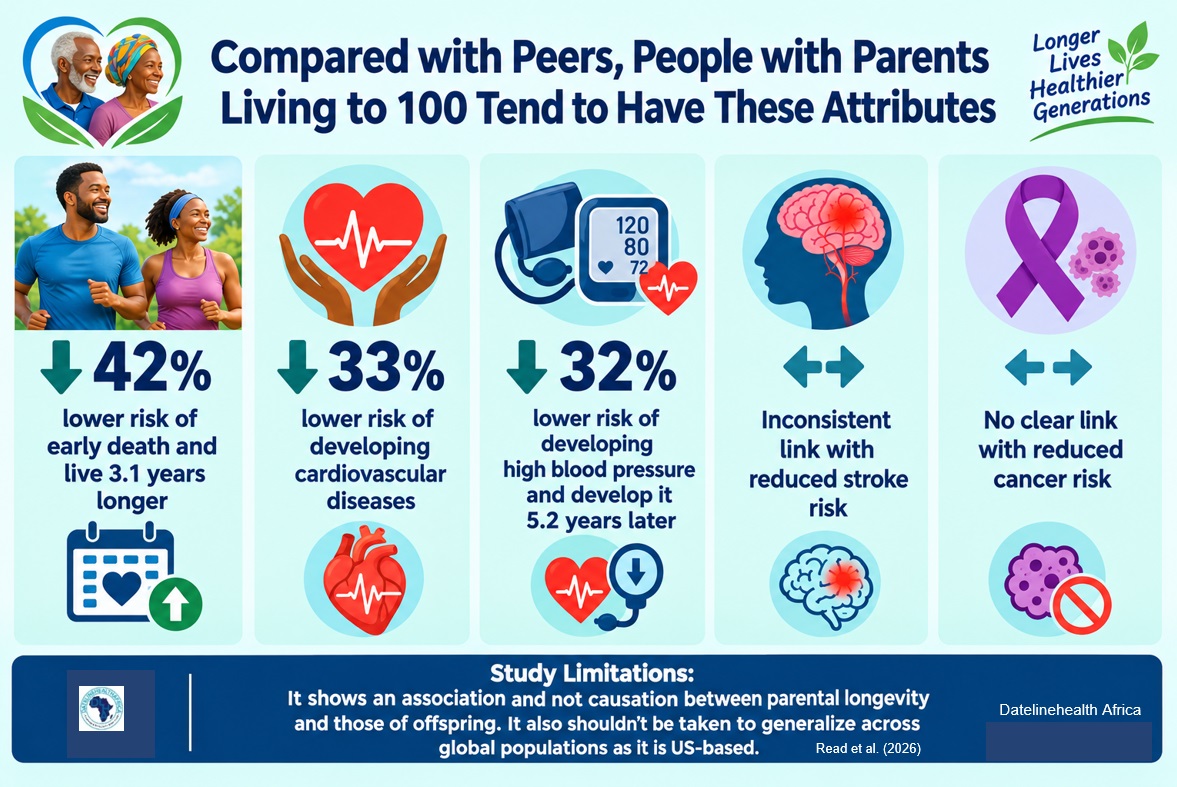
AI-generated infographic showing health attributes of offspring of parents living up to 100 according to a study. Image credit: ChatGPT. Click on the image to enlarge.
People whose parents lived to at least 100 years were less likely to die during the study period than those whose parents had shorter lifespans. Their risk of early death was estimated to be 42% lower, and they tended to live about 3.1 years longer.
This does not mean that having a parent who lived to 100 automatically adds three years to your life. Rather, the finding suggests that people from families with exceptionally long lifespans may have certain inherited characteristics or shared experiences that help them live longer.
People whose parents lived to 100 had an estimated 33% lower risk of developing cardiovascular diseases. Although this finding suggests a possible family link to better heart health, it does not mean that having a long-lived parent will protect you from these conditions. Other factors, including diet, physical activity, smoking and existing health problems, can also influence your risk.
High blood pressure often causes no obvious symptoms but can increase the risk of heart disease, stroke and kidney damage if left uncontrolled. The study found that people whose parents lived to 100 had an estimated 32% lower risk of developing high blood pressure.
They also tended to develop the condition about 5.2 years later than those in the comparison groups. Once again, this does not mean that people with long-lived parents can ignore their blood pressure. Regular checks remain important because anyone can develop high blood pressure, regardless of their family history.
The study found that people whose parents lived to 100 had a lower risk of stroke in two of the three groups examined, but this pattern did not appear consistently across all three groups.
This means there is not enough consistent evidence to conclude that having a long-lived parent necessarily lowers your risk of stroke. More research is needed to understand whether the relationship is genuine and what might explain it.
Unlike the findings for heart disease and high blood pressure, the study did not establish a clear link between having a parent who lived to 100 and a lower risk of cancer. In other words, the results did not show that people with exceptionally long-lived parents were less likely to develop cancer.
This does not prove that family longevity has no relationship with cancer. It simply means that this study did not find convincing evidence of such a link. Family history can still be important in assessing the risk of certain cancers, so appropriate screening and medical advice remain valuable.
The researchers did not conduct the study in Nigeria or any other African country. We therefore cannot assume that the same results would apply to Africans to the same extent. Nevertheless, the findings raise several important questions about ageing, family history and preventive healthcare across Africa.
If your parents or grandparents lived to an advanced age, this may provide useful information about your family's health history. It could reflect inherited traits that influence how the body responds to ageing or develops certain diseases.
However, a long-lived parent does not guarantee a long life for their children. Similarly, people whose parents died relatively young can still live long, healthy lives.
In African communities, where access to routine health checks may vary, some people may not discover that they have conditions like hypertension until complications develop. The study's findings are a useful reminder that healthy ageing involves more than living to an advanced age.
Adults should check their blood pressure regularly, attend recommended health screenings and seek medical advice when necessary while people with a family history of cardiovascular disease should discuss their individual risk factors with a healthcare professional.
Although genetics may contribute to longevity, everyday choices can also influence health as we age. Eating a balanced diet that includes vegetables, fruits, beans and other nutritious foods can support overall health while reducing excessive salt intake can help with blood pressure control. Even though these habits do not guarantee that someone will avoid every age-related disease, they can help reduce several preventable health risks.
Similar research involving sub-Saharan African populations could help scientists understand whether the same associations occur across different communities. It could also explore how genetics interact with diet, living conditions, healthcare access and other environmental factors.
Africa is not a single, uniform population and the differences in ancestry, lifestyle, economic circumstances and healthcare systems mean that findings from one country or community may not apply equally across the continent. Research involving African populations could therefore provide valuable evidence for developing more relevant approaches to healthy ageing and preventing age-related diseases.
Although the study provides useful evidence, several limitations should be considered before drawing conclusions.
These limitations do not make the study unhelpful. Instead, they show why further research is needed to understand how inherited characteristics and environmental influences contribute to healthy ageing.
Having a close family member like a parent living to 100 years or beyond is an exceptional achievement, but the more important question is whether children or close relatives of such people can also live as long and healthy.
For Africans, the findings offer an opportunity to think more carefully about family health history, preventive healthcare and the importance of research that reflect the continent's populations. Ultimately, the goal should not be to assume the expectation of longevity because a parent lived long, but to adopt healthy living habits in awareness of the role that these play in increasing the number of years we can live in good health.
Source: Reed ER, Wysocki M, Gal M, et al. Exceptional Parental Longevity and Onset of Morbidity and Mortality Across Cohorts. JAMA Netw Open. 2026;9(8):e2630964. Available from here
Related:
Want to Reach 70 and Beyond in Good Health? Follow This Diet According to Science
Stroke in Africa: What you need to know
Cancer Screening in Sub-Saharan Africa: When to Start
Published: October 20, 2026.
© 2026. Datelinehealth Africa Inc. All rights reserved.
Permission is given to copy, use and share content for non-commercial purposes without alteration or modification and subject to attribution as to source.
DATELINEHEALTH AFRICA INC., is a digital publisher for informational and educational purposes and does not offer personal medical care and advice. If you have a medical problem needing routine or emergency attention, call your doctor or local emergency services immediately, or visit the nearest emergency room or the nearest hospital. You should consult your professional healthcare provider before starting any nutrition, diet, exercise, fitness, medical or wellness program mentioned or referenced in the DatelinehealthAfrica website. Click here for more disclaimer notice.