Is Your Street Food Safe? How to Spot the Warning Signs
By Helen Ohunene Otailku, B.Sc. Ed, Health Education, Freelance Health Writer. Reviewed by the DLHA Team.
September 18, 2026
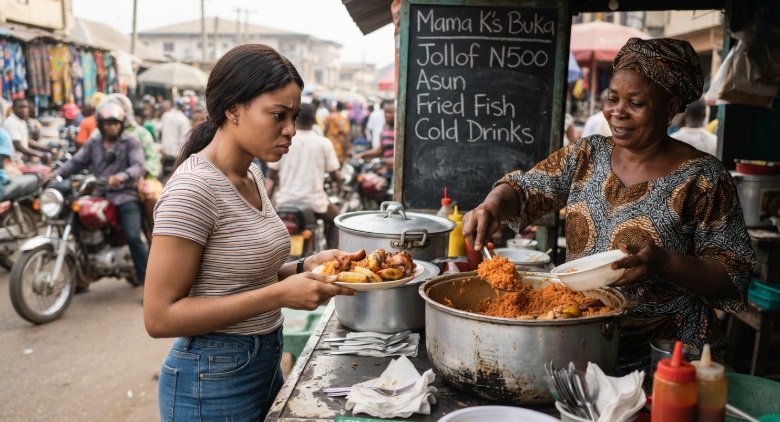
A young Nigerian woman with a hesitant expression looks closely at a plate of street food she is holding, standing at a busy roadside eatery (e.g., “buka” stand in Nigeria). A friendly local vendor wearing traditional attire is scooping jollof rice from a large aluminum pot into her plate. There is a chalkboard menu in the background listing items like Jollof, Asun, and Fried Fish. The surrounding street features is busy with traffic and pedestrians in daylight. Photo Credit: Google Gemini. Click on image to enlarge.
Street food is everywhere in African countries; sizzling “suya” at night time, steaming bowls of pepper soup, bags of roasted groundnuts sold from a wheelbarrow at the bus stop. It is fast, affordable, and often more satisfying than anything from a restaurant kitchen. But the same conditions that make street food convenient, i.e., open-air stalls, informal setups, and limited access to running water can also make it risky when hygiene is not considered. This does not mean giving up your favourite roadside meal. It means knowing what to look for, so you can tell a safe stall from one that can make you sick.
Street food refers to ready-to-eat meals and snacks prepared and sold in public places such as roadsides, motor parks, streets, market corners usually by informal vendors rather than licensed restaurants (1). Street food is a major part of daily life and local economies in cities and villages across Africa, feeding students, workers, and families who need something quick during rush hours, on transit, or a cheaper cost.
Many vendors operate without reliable piped water, refrigeration, or waste disposal, and without close oversight from local food-safety authorities (1). Cooking often happens in the open, exposed to dust, exhaust fumes and flies. None of this means a stall is automatically unsafe but it does mean the burden of checking the street food you buy depends more on you, the customer, than it would in a regulated restaurant.
Contaminated street food introduces bacteria, parasites or toxins into food that looks perfectly normal on the surface (2). Oftentimes, most street food safety problems trace back to a handful of preventable sources which may include:
Watch how the vendor handles the food, not just how it tastes or looks. Do they wash their hands or wear gloves between handling money and handling food? Do they use tongs or spoons rather than bare hands for ready-to-eat items? A vendor who touches cash, then food, without pausing to clean up should be a warning sign.
Raw and cooked items should be kept separate, not placed together in the same container. Perishable (food that spoils fast) food such as meat, fish, dairy, cooked rice need to be either steaming hot or properly chilled; food that stays lukewarm for hours is where bacteria multiply fastest. Covered containers are safer than open trays exposed to dust and insects.
A cluttered, greasy preparation surface, overflowing waste bins, or a stall sited next to a dirty gutter all suggest warning signs you cannot see in the food itself.
Trust your senses. An off smell, an unusual colour, or a slimy texture are all reasons to pass. Cooked food should look and smell fresh, not like it has stayed for days.
5. Customer Turnover
A busy stall with a steady stream of customers is generally safer than one with food that has been sitting untouched for hours because high turnover usually means fresher batches and less time for bacteria to build up.
Salmonellosis: Salmonellosis is caused by Salmonella species which includes non-typhoid strains, often found in contaminated meat, poultry, and eggs kept at unsafe temperatures [3]. The symptoms that follow are fever, vomiting, diarrhoea, and stomach (abdominal) pain which may develop after hours of eating contaminated street food.
Colibacillosis / E. coli Infection: E. coli Infection is caused by strains like Escherichia coli which spread through unwashed hands, dirty utensils, or contaminated water used in food preparation. The symptoms that accompany eating this unsafe street food are watery or bloody diarrhoea, serious stomach pain and vomiting.
Staphylococcal Food Poisoning: Staphylococcal Food Poisoning is caused by Staphylococcus aureus toxins, which often transfers from food handlers handling ready-to-eat foods with bare hands. Vomiting, stomach cramps, severe nausea and even headache are symptoms linked to eating contaminated street foods [4].
Cholera: Cholera is caused by Vibrio cholerae, linked to contaminated drinking water, ice, or unwashed raw vegetables [5]. The symptoms are leg cramps, watery stool, restlessness and vomiting.
Shigellosis: Shigellosis is caused by Shigella species which leads to severe dysentery and spread through poor personal hygiene. The symptoms are fever, stomach pains, and vomiting.
Campylobacteriosis: Campylobacteriosis is caused by Campylobacter species which is common in undercooked or cross-contaminated poultry. The symptoms that people feel when this bacteria is in the body are fever, stomach cramps, and bloody diarrhea [6].
Bacillus Intoxication: Bacillus Intoxication is caused by Bacillus cereus, often growing in starchy staples (like rice or pasta) left unrefrigerated for hours. It can lead to vomiting and diarrhea after eating this unsafe street food.
Cryptosporidiosis and Giardiasis: Cryptosporidiosis and Giardiasis are waterborne parasites (Cryptosporidium and Giardia) spread through untreated wash water on raw salads or fruits [7]. The symptoms are stomach pain, weight loss, extreme tiredness, bloating and even farting.
Viral Hepatitis A: A type of hepatitis known as Hepatitis A is spread through contaminated water or food handlers carrying the virus. When infected a person feels feverish, loses appetite, nauseous, abdominal discomfort and passes out dark-colored urine with yellowing of the eyes and skin [8].
Consumers are not the only ones with a role to play. Vendors who wash hands regularly, keep raw and cooked food separate, and invest in refrigerators protect both their customers and their business's reputation.
Local government food-safety authorities also have a role to play through routine inspection, training programmes for informal vendors, and public awareness campaigns that help both buyers and sellers understand the risks and the ways to protect consumers [9].
Street food is not something you need to give up for the sake of safety, it is something you can enjoy more confidently once you know what to look for. A quick glance at how a vendor handles food, how it is stored, and how busy the stall is can tell you a lot before you take your first bite. Watch out for these warning signs the next time you are at your favourite street food vendor. And if you do develop symptoms like persistent fever, severe stomach pain, or diarrhoea that does not improve after a day or two, do not wait it. See a healthcare provider promptly.
1. Codex Alimentarius Commission. Guidelines for the design of control measures for street-vended foods in Africa. CAC/GL 22-1997. [Internet]. Rome: Food and Agriculture Organization of the United Nations; [Cited 10 September 2026]. Available from here.
2. Khetrapal Singh P. World Food Safety Day: “Safer food, better health”. [Internet]. 7 June 2022. New Delhi: World Health Organization Regional Office for South-East Asia; [Cited 10 September 2026]. Available from here.
3. World Health Organization. Salmonella (non-typhoidal). [Internet]. 20 February 2018. WHO Fact Sheet. [Cited 10 September 2026]. Available from here.
4. Odetokun IA, Adetona MA, Ade-Yusuf RO et al. Staphylococcus aureus contamination of animal-derived foods in Nigeria: a systematic review, 2002–2022. Food Safety and Risk. 2023;10:6. doi:10.1186/s40550-023-00106-y. Available from here.
5. Eneh S, Onukansi F, Anokwuru C, Ikhuoria O, Edeh G, Obiekwe S, Dauda Z, Praise-God A, Okpara C. Cholera outbreak trends in Nigeria: Policy recommendations and innovative approaches to prevention and treatment. Frontiers in Public Health. 2024;12:1464361. doi:10.3389/fpubh.2024.1464361. Available from here.
6. Cleveland Clinic. Is campylobacter to blame for your diarrhea? [Internet]. Last reviewed 5 May 2025. [Cited September 11, 2026]. Available from here.
7. Prabakaran M, Weible LJ, Champlain JD, et al. The gut-wrenching effects of cryptosporidiosis and giardiasis in children. Microorganisms. 2023;11(9):2323. doi:10.3390/microorganisms11092323. Available from here.
8. World Health Organization. Hepatitis A. [Internet]. 28 July 2026. [Cited September 11, 2026]. Available from here.
9. Singh PK. How safe is your food? [Internet]. World Health Organization Regional Office for South-East Asia. New Delhi: WHO; 7 April 2015. [Cited 10 September 2026]. Available from here.
Related:
Published: September 19, 2026
© 2026. Datelinehealth Africa Inc. All rights reserved.
Permission is given to copy, use, and share content freely for non-commercial purposes without alteration or modification and subject to source attribution.
DATELINEHEALTH AFRICA INC., is a digital publisher for informational and educational purposes and does not offer personal medical care and advice. If you have a medical problem needing routine or emergency attention, call your doctor or local emergency services immediately, or visit the nearest emergency room or the nearest hospital. You should consult your professional healthcare provider before starting any nutrition, diet, exercise, fitness, medical or wellness program mentioned or referenced in the DatelinehealthAfrica website. Click here for more disclaimer notice.