The Hidden Toll: How Malaria Disrupts Menstrual Health
By: Favour Gospel. 600-level student PharmD and DLHA Volunteer. Medically reviewed by: E. Odekina, MBBS
Ovtober 31, 2026
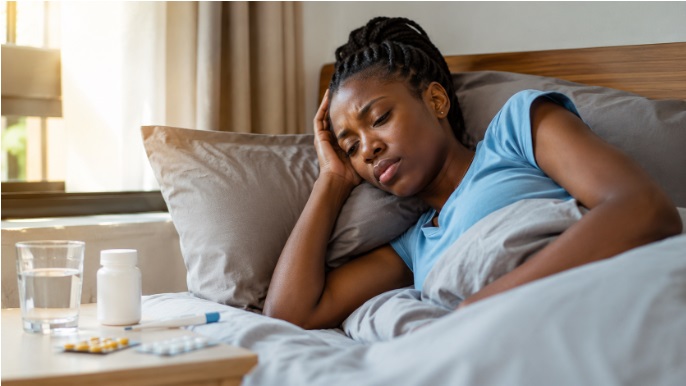
A young African woman rests in bed while recovering from malaria. There is a thermometer, a glass of water, and malaria medicines on a bedside table nearby. Click on image to enlarge.
Your period is late, but you recently had malaria. Now you are wondering whether the infection is responsible or whether something else is causing the delay.
Malaria can place the body under physical stress. Fever, inflammation, reduced food intake, anaemia, and weight loss may affect the hormonal signals involved in ovulation. When ovulation occurs later than expected, the next period may also arrive later.
The evidence directly linking malaria to delayed menstruation is limited. A late period may also result from pregnancy, stress, weight changes, hormonal conditions, or other health problems. Some antimalarial medicines may also interact with hormonal contraceptives or affect menstrual bleeding.
This article examines what research says about malaria and menstrual changes, including delayed periods, irregular bleeding and the possible effects of antimalarial medicines.
Malaria is a parasitic disease transmitted by an infected mosquito giving rise to general symptoms such as fever, chills, headache, weakness and fatigue (1). In cases of severe malaria infection, symptoms may include; loss of alertness and reduced awareness, multiple convulsions, difficulty breathing, yellowing of the eyes, and abnormal bleeding (2, 3).
Plasmodium is the parasite responsible for causing malaria. There are five types of it and the most common ones are Plasmodium falciparum (which is the deadliest) and Plasmodium vivax.
In women of reproductive age, malaria symptoms may occur alongside menstrual symptoms making it difficult to determine whether the infection, physical stress, medication, pregnancy or other factors caused the menstrual symptoms.
What is the Menstrual Cycle?
The menstrual cycle is a chain of events that happen monthly in a woman of child bearing age as her body prepares for the possibility of pregnancy.
The cycle runs from the first day of one period to the first day of the next period. The cycle lasts between 21–35 days, with an average of 28 days, while the period lasts between 2–7 days (4).
The process through which malaria affects the menstrual cycle is complex and can be grouped into direct and indirect.
In the presence of malaria, hormonal rhythm can be disturbed. Fever, inflammation, poor appetite, weakness, anemia, and high physical stress can cause delayed periods, lighter, heavier, or prolonged menstrual bleeding that leaves you feeling tired and weaker than usual. In some women, premenstrual symptoms such as body ache, fatigue, abdominal discomfort, and mood changes may also feel worse because malaria itself produces overlapping symptoms (5).
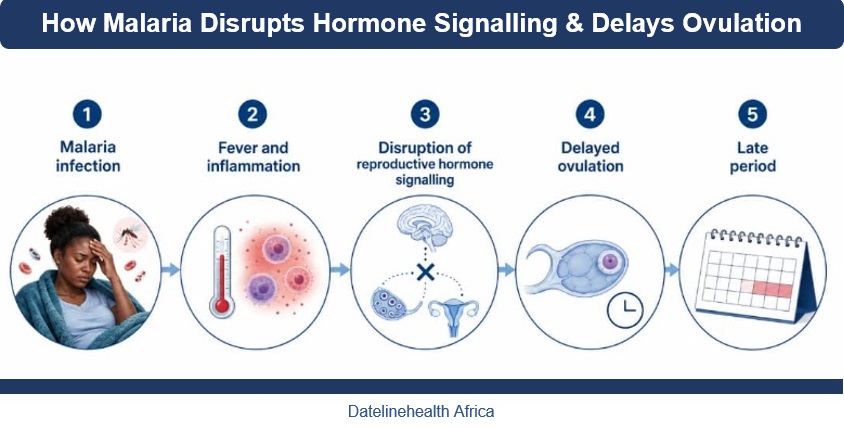
Infographic: Showing how malaria, fever, and inflammation may disrupt hormone signalling and delay ovulation, potentially causing a late period. Click on image to enlarge.
Malaria causes fever. Fever and inflammation place physiological stress on the body as it tries to fight off the malaria infection. Inflammation is the body’s natural response to injury, infection, or irritation. It can cause an area to become red, swollen, warm, painful, or tender.
Cortisol, also known as the ‘stress hormone’ that is produced in the adrenal glands, which sits on top of each kidney, is responsible for regulating stress responses, immune functions and all the chemical reactions that happen in the body to sustain life.
Severe stress and therefore cortisol, can reduce the release of hypothalamic gonadotropin releasing hormone (6).
The hypothalamus is a small part of the brain and it produces Gonadotropin Releasing hormone (GnRH) which informs the pituitary gland to release two reproductive hormones: the Luteinising hormone (LH) and Follicle stimulating hormone (FSH).
Research indicates that cortisol levels are higher than normal in the presence of malaria parasites and when there is severe malaria infection, it causes physiological stress, and increases in cortisol levels. Increased levels of cortisol may interfere with gonadotropin releasing hormone (GnRH) signalling. This can affect the release of LH and FSH, which regulate ovulation and ovarian hormone production. As a result, ovulation may be disrupted. If ovulation occurs later than usual, the next period may also arrive later.
A study was done on female mice and it was discovered that Plasmodium berghei (the plasmodium species which causes malaria in rodents) infection interfered with their reproductive cycle (6). The infection reduced the phases needed for ovulation and prolonged a phase when ovulation did not occur (diestrus). The findings suggest that malaria may interfere with normal female reproductive function, although more research is needed to understand exactly how this happens.
Malaria may also affect hormones involved in the menstrual cycle. Some studies have reported lower levels of estradiol and progesterone in patients with malaria (5). Estradiol supports follicle development and ovulation, while progesterone helps regulate the menstrual cycle after ovulation. Although changes in estradiol and progesterone may help explain menstrual changes during or after malaria, direct evidence linking these hormone changes to delayed ovulation or changes in menstrual timing is limited (5).
Anemia occurs when there are low levels of red blood cells to carry oxygen throughout the body (7).
Malaria has the ability to destroy red blood cells which can cause anaemia.
Anemia reduces the ability of blood to carry oxygen thereby causing tiredness, weakness, dizziness and shortness of breath.
The additional physiological stress may reduce the activity of the gonadotropin releasing hormone (GnRH) which would in turn affect ovulation regulation and cause absence of period (amenorrhea) or delayed period.
During malaria, the body responds to the infection by producing more substances that cause inflammation. One of these responses increases a hormone called hepcidin (which controls how iron moves through the body). When hepcidin levels are higher than normal, iron will be trapped in the cells that store them, making less iron available to the bone marrow for producing new red blood cells. This reduced iron availability can contribute to anemia during malaria.
The result can be extreme tiredness, dizziness, breathlessness, paleness, poor concentration, and slower recovery causing additional physiological stress (5).
Malaria can reduce appetite and food intake. Fever and digestive problems may also make eating difficult.
The menstrual cycle needs enough energy to function normally. Severe energy deficiency can disrupt the hormones that control ovulation, leading to missed periods or periods that stop completely.
Artemisinin based combination therapies are used to treat malaria, especially P. falciparum malaria.
A Nigerian study examined artemether plus lumefantrine in three women and reported changes in reproductive markers.(8) The researchers reported ovulation defects, reduced cervical mucus, and altered luteal phase progesterone during the treatment cycle and the following cycle.
These findings could suggest that some antimalarial treatments may influence reproductive function. However, the study involved only three women. That makes the evidence too limited to conclude that artemisinin based medicines commonly delay ovulation or menstruation (8).
Another study examined how chloroquine affects the reproductive cycle and ovulation in female rats.
Researchers gave rats chloroquine for four weeks and before ovulation. They found that chloroquine
The researchers concluded that chloroquine may interfere with the hypothalamic pituitary ovarian system, which regulates reproductive hormones and ovulation (9).
Ovulation helps regulate the hormonal changes that precede menstruation, so disrupting ovulation may affect the menstruation time and pattern of bleeding.
Quinine is a strong medication that was used to treat severe or chloroquine-resistant malaria. It has effects on the uterus that have mainly been studied in pregnancy and laboratory settings (10).
Animal studies show that a single 30 mg/kg dose of quinine given during pro-oestrus (the stage of the reproductive cycle just before ovulation) blocked ovulation and also reduced luteinizing hormone (LH) levels. Daily administration of the same dose for 28 days contributed to stress in ovarian tissue (10).
Quinine has a mild property of stimulating uterine contractions, which according to history led to failed and dangerous attempts at self-induced abortion. However, there is no strong clinical evidence showing that standard quinine treatment routinely delays menstruation or changes menstrual flow in humans.
If you experience a missed period while taking quinine, consider other causes such as pregnancy, illness related hormonal disruption and nutritional stress.
The uterus (womb) is made of smooth muscle. During menstruation, uterine contractions help move blood and tissue out of the uterus.
Laboratory studies suggest that high doses of chloroquine can reduce or block contractions of the uterus (11). This means chloroquine could potentially affect menstrual flow, although there is limited evidence that normal doses of chloroquine actually changes menstrual flow in women.
Some antimalarial medicines can potentially affect how well hormonal contraceptives work. An example is Artemether plus lumefantrine, a common treatment for malaria.
Artemether can increase the activity of certain liver enzymes, (including CYP3A4 enzyme) which helps break down many medicines, including some contraceptives. This could lower the amount of the contraceptive available in the body which would potentially reduce the effectiveness.
If hormonal contraceptive levels become too low, the hormonal control of the menstrual cycle may also change. This can sometimes lead to spotting or breakthrough bleeding between periods.
If a hormonal contraceptive becomes less effective, ovulation may occur when it would normally be suppressed. If unprotected sex occurs around this time, pregnancy becomes possible.
Current product information therefore recommends that women using systemic hormonal contraception use an additional non hormonal or barrier method during treatment with artemether plus lumefantrine. Some product information recommends this additional protection for about one month.
Menstrual changes after malaria can vary between women.
You may notice:
These changes are not specific to malaria. Pregnancy, thyroid disorders, Polyendocrine metabolic ovarian syndrome (PMOS) [formerly PCOS-Polycystic ovary syndrome], weight changes, stress, hormonal contraception and other illnesses can also affect menstruation.
If you are sexually active and your period is late, take a pregnancy test rather than assuming malaria caused the delay.
Prompt malaria diagnosis and appropriate treatment should come first. As the infection resolves, fever and other systemic symptoms will improve. Recovery from the physical stress of illness can allow normal menstrual function to resume.
Do not stop an antimalarial because your period changes, instead discuss suspected adverse effects with your healthcare provider.
Changes in diet can help reduce anaemia in some cases. Eating foods that are rich in iron, folate, vitamin B12, vitamin A, and other nutrients is recommended. Taking supplements if a qualified health-care provider recommends them is useful (7).
Anaemia management depends on its cause. Iron deficiency may require change in diet or use of iron supplements when a qualified healthcare provider recommends them. WHO recommends that the cause of anemia is identified before treatment instead of assuming that every case of anemia is caused by iron deficiency or malaria.
If you have persistent fatigue, dizziness, shortness of breath or unusually heavy menstrual bleeding, speak with a healthcare professional. A comprehensive assessment may be needed.
Treating anemia and correcting nutritional deficiencies can support recovery but it does not guarantee immediate restoration of ovulation.
Most people with absence of periods benefit from a healthy diet and exercise. Reducing stress also may help (12).
Artemether, dihydroartemisinin, and lumefantrine did not affect the breakdown of some contraceptive hormones in laboratory studies. However, artemether may weakly increase certain liver enzymes that break down medicines which could potentially reduce the effectiveness of hormonal contraceptives. Women taking these contraceptives may need an additional or non-hormonal contraceptive method during treatment (13).
This does not apply to all antimalarials. Chloroquine, for example, has not been shown to reduce levels of some contraceptive hormones.

Image of a young African woman resting in bed recovering from malaria. She is tracking her menstrual cycle on her phone. Click on image to enlarge.
Reorder menstrual cycle tracking for 3 months after recovery from severe malaria to confirm menstruation date, duration, flow pattern. See a doctor if the pattern remains irregular 2 - 3 months after clearing infection.
Malaria can be associated with menstrual changes, particularly when the infection causes significant fever, physical stress, poor nutrition or anemia. These factors can interfere with the hormonal signals that regulate ovulation.
A delayed period after malaria does not prove that malaria caused the delay. Other factors such as pregnancy, contraception, thyroid disorders, Polyendocrine metabolic ovarian syndrome (formerly polycystic ovary syndrome), weight changes and other illnesses can also affect your time of menstruation.
Evidence about antimalarial medicines and menstruation is limited but chloroquine and some artemisinin based treatments have produced reproductive findings in experimental or small human studies.
If your period changes after malaria, track the pattern during recovery. Seek medical assessment if irregularity persists, bleeding becomes unusually heavy, or pregnancy is possible.
Yes. Malaria may affect the timing of your period and in some cases, the pattern of bleeding. Fever, infection related stress, reduced food intake, weight changes, and disrupted ovulation may contribute to these changes. But direct evidence specifically proving that malaria causes delayed periods is limited.
Yes. Fever can increase cortisol levels which may affect the activity of the gonadotropin releasing hormone of the hypothalamus thereby interfering with the hormonal processes that regulate ovulation.
Consider pregnancy first if pregnancy is possible. Continue tracking your cycle and monitor your recovery. If your period remains absent for three months, or your cycles repeatedly exceed 45 days, seek medical assessment.
Yes. A delayed period does not necessarily mean ovulation has stopped completely. Ovulation can occur before the first period after menstrual disruption.
If you have had unprotected sex, pregnancy is possible. Use a pregnancy test when appropriate.
1. Buck E, Finnigan NA. Malaria. [Updated 2023 Jul 31]. In: StatPearls [Internet]. Treasure Island (FL): StatPearls Publishing; 2023 Jan-. Available from here.
2. NHS. UK. Malaria. [Internet]. 2025 July 29. Accessed September 1, 2026. Available from here.
3. Nyunt M, Plowe CV. CHAPTER 82 - MALARIA, Pharmacology and Therapeutics, Editor(s): Scott A. Waldman, Andre Terzic, Laurence J. et. Al. W.B. Saunders, 2009, Pages 1141-1170. Doi 10.1016/B978-1-4160-3291-5.50086-X. Available from here.
4. Obialor B. Demystifying the menstrual cycle for African women. [Internet]. Datelinehealth Africa. Updated 2026 October 31. [Accessed October 31, 2026]. Available from here
5. Usman MA, Ibrahim MA, Salman AA, Sallau AB. Depletion of cholesterol could be associated with modulation of progesterone but not other sex hormone levels during Plasmodium falciparum infection in humans: a cross-sectional study from Zaria, Nigeria. Parasitology Research. 2020;119(12):4143-4150. doi:10.1007/s00436-020-06826-w. Available from here.
6. Oluwapelumi EA, Ezeofor CO, Okpara GU, Badejo JA, Michael OS, Iwalewa EO. Malaria infection suppresses proestrus and estrus while prolonging diestrus in mice. The Nigerian Journal of Pharmacy. 2026;60(1):83-89. Available from here.
7. Suprapti E, Hadju V, Ibrahim E, Indriasari R, Erika KA, Balqis B. Anemia: etiology, pathophysiology, impact, and prevention: a review. Iran J Public Health. 2025;54(3):509-520. doi:10.18502/ijph.v54i3.18244. Available from here.
8. Achebe F. Evaluation of Effects of Artemether + Lumefantrine (Artemisinin-based Combination Therapy) on Women’s Reproductive Cycle using Creighton Model FertilityCare System and NaProTECHNOLOGY. Nig. J. Gen. Pract. 2017;15(2):31-4. Available from here.
9. Okanlawon AO, Ashiru OA. Effect of chloroquine on oestrus cycle and ovulation in cyclic rats. J Appl Toxicol. 1992;12(1):45-48. doi:10.1002/jat.2550120110. Available from here.
10. Gbotolorun SC, Inikori O, Bamisi OD, Osinubi AAA, Okanlawon AO. Quinine inhibits ovulation and produces oxidative stress in the ovary of cyclic Sprague-Dawley rats. Afr Health Sci. 2018;18(2):253-259. doi:10.4314/ahs.v18i2.8. Available from here.
11. Ladipo CO, Elias SO, Oduwole BP, Ojelkere O, Ojobor PD, Sofola OA. Effect of chloroquine on strips of non-pregnant and pregnant mice uteri in-vitro. Niger Q J Hosp Med. 2007;17(1):13-17. doi:10.4314/nqjhm.v17i1.12534. Available from here.
12. Datelinehealth Africa. Amenorrhea: Causes, Symptoms, Diagnosis, Treatment. [Internet]. Last updated: 2026 October 31. Accessed October 31, 2026. Available from here.
13. Novartis Pharma AG. COARTEM® (artemether and lumefantrine) tablets, for oral use [prescribing information]. Revised August 2019. Accessed August 25, 2026. Available from here.
Related:
How Stress Affects Your Period (With Coping Tips)
Demystifying the Menstrual Cycle for African Women
Menstrual Health Issues in sub-Saharan Africa: An Overview
Published: October 27, 2026.
© 2026. Datelinehealth Africa Inc. All rights reserved.
Permission is given to copy, use and share content for non-commercial purposes without alterations or modifications and subject to source attribution.
DATELINEHEALTH AFRICA INC., is a digital publisher for informational and educational purposes and does not offer personal medical care and advice. If you have a medical problem needing routine or emergency attention, call your doctor or local emergency services immediately, or visit the nearest emergency room or the nearest hospital. You should consult your professional healthcare provider before starting any nutrition, diet, exercise, fitness, medical or wellness program mentioned or referenced in the DatelinehealthAfrica website. Click here for more disclaimer notice.