5 Ways to Use Social Media to Fight Health Misinformation in Africa
By Mosope Ososanya. Freelance Health Writer. Reviewed by the DLHA Editorial Team
November 10. 2026
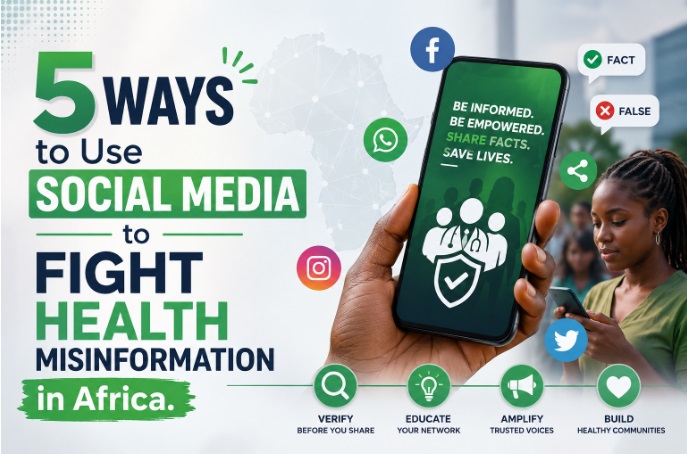
A modern health infographic captioned 5 ways touse social media to fight health misinformation in Africa. Featured are, fact-checking, education, trusted voices, and community engagement. Photo Credit: ChatGPT-4. Click on image to enlarge.
Social media is a huge source of health misinformation in sub-Saharan Africa, but it can also be a powerful tool for fighting it.
False claims about vaccines, herbal remedies, and other health issues can spread quickly through social networks. A survey of 5,307 Facebook users across six sub-Saharan African countries found that misinformation related to HPV, polio, and COVID-19 vaccines spread widely through social networks where the judgement of what is true and accurate can be very low but peer trust is high [1].
However, the same speed and reach that make social media effective for spreading misinformation can also help counter it.
The WHO Africa Infodemic Response Alliance (AIRA), for example, uses social media to monitor false health claims, understand why they spread, and share quick, factual responses that have reached millions of people [2].
Still, more needs to be done. Since health misinformation spreads across different platforms, communities, and languages, tackling it requires action from social media platforms, health organisations, and individual users. A previous article has explained how technology including social media can be a facilitator for health misinformation. This article will explore practical ways social media can also become a tool for fighting health misinformation in sub-Saharan Africa while simultaneously promoting accurate and verifiable information.
Social media is not a minor source of information in sub-Saharan Africa. It is where millions of people get news, communicate, and find health information. Africa and Southeast Asia now account for the majority of new global social media users, with worldwide usage crossing 5.66 billion in late 2025 [3]. Facebook, TikTok, X, and WhatsApp are the most common in Africa today. Nigerians, for example, spend an average of 3 hours and 44 minutes on social media every day [4].
This is where people are. And it is where health information, accurate or not, spreads fastest.
Research shows that false information often spreads faster and reaches more people than the truth [5]. In Africa, WhatsApp groups make the problem harder because misinformation can spread privately. WhatsApp’s end-to-end encryption makes it difficult for the platform to monitor misinformation in private groups. Researchers in Kenya found that even users who recognised misinformation on WhatsApp were reluctant to correct it, fearing embarrassment or conflict within family and friend groups [6].
This is why fighting health misinformation requires using social media itself. A government website or press release may contain accurate information, but it will not necessarily reach someone in a WhatsApp group being told that vaccines cause infertility. Corrections need to appear in the same spaces, formats, and languages as the misinformation.
Meta’s third-party fact-checking programme is one of the most established efforts against misinformation in Africa. It works with independent organisations such as Africa Check, Dubawa, PesaCheck, AFP, and France 24 Observers to fact-check content across 15 African countries and in several languages [7]. When content is found to be false, Meta reduces its reach and adds a warning label to limit how many people see it. During Nigeria’s 2023 general elections, FactCheckHub fact-checked 127 claims, and Facebook was identified as the platform where health and political misinformation was most common [8].
TikTok has also taken steps to address health misinformation. In September 2024, it partnered with the WHO’s Fides network, a community of more than 800 healthcare professionals and health creators, to promote reliable health information through engaging, science-based videos [9]. The WHO’s Africa Infodemic Response Alliance (AIRA) also monitors social media for false health claims and produces rapid video responses that have reached millions across the continent [2].
These efforts are important, but they still have significant gaps.
Limitations
One major problem is that these efforts do not cover enough of Africa. Meta’s fact-checking programme is available in only 15 African countries. Fact-checking organisations have also reported having limited access to Meta’s data and little influence over its algorithms [10]. While TikTok’s partnership with WHO initially included no African creators [9].
Meta’s decision in 2025 to end its third-party fact-checking programme has also raised concerns among African fact-checkers and digital rights groups [11].
WhatsApp is another challenge because much of the misinformation spreads in private groups, making it difficult to identify and correct. Although WhatsApp has introduced measures to slow the spread of false information, these have had limited impact [12].
Overall, social media platforms are taking steps to address health misinformation, but their efforts are still not enough to match the scale of the problem.
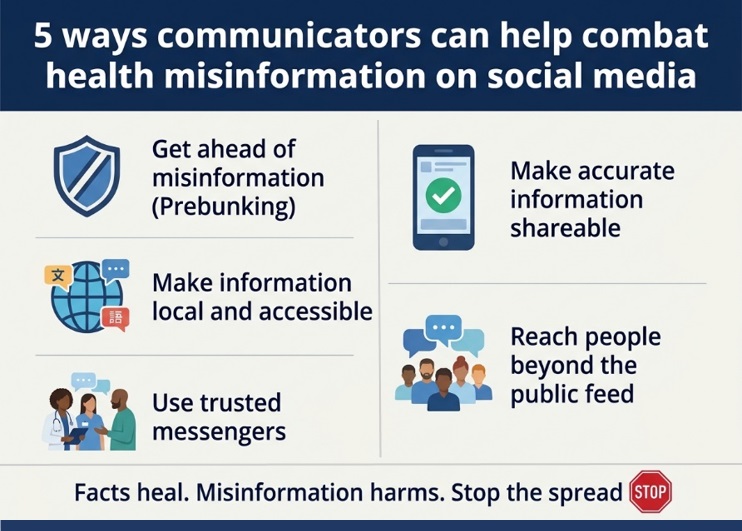
Infographic showing 5 ways that communicators in sub-Saharan Africa can help combat health misinformation on social media. Image credit: Gemini AI. Click on image to enlarge.
Platform policies alone will not solve the problem. Health communicators — journalists, public health bodies, clinicians, NGOs, and anyone producing credible health content — have an important role to play.
Waiting for false health claims to go viral before responding is not an effective strategy. By the time a correction is published, the original claim may have already reached thousands of people, and false information often spreads faster than corrections [5].
A better approach is prebunking. Addressing false claims before they spread widely [13]. Instead of waiting for misinformation to appear, health communicators can identify the claims that are likely to circulate around events such as vaccine campaigns, disease outbreaks, or new treatments and provide clear, accurate information in advance.
For example, when a new malaria vaccine is introduced, many false claims about its safety and effectiveness can be predicted. Sharing accurate information before these claims spread can help people recognise and reject them when they encounter them.
Accurate health information posted only in English reaches only a small part of the people who need it. Africa has over 2,000 languages, and communities most at risk of health misinformation are often those with the least access to health content in English. Health communicators should create content in local languages, not just translate it, but also adapt it to the culture and health needs of each community.
Language is not the only issue. Health information also needs to be simple. Misinformation spreads easily because it is usually clear, confident, and easy to repeat. Accurate information filled with complex terms will not do any good. If people cannot easily read it, understand it, and explain it to someone else, it will most likely not spread far enough to make a difference.
The credibility of health information in African communities often depends on who is sharing it. Research from rural Tanzania found that religious leaders are highly trusted and can effectively share health information with their communities, making them useful partners for campaigns on hypertension, HIV, and other health issues [14]. Health extension workers have also been effective in Ethiopia and other sub-Saharan African countries, especially through direct, community-based communication [15].
Social media influencers can play a similar role. A study in Kenya and Nigeria found that 94.87% of participants followed social media influencers, with nearly half saying they regularly trusted their opinions [16]. This means a trusted local doctor, nurse, or health advocate with 5,000 engaged followers may have more influence on health behaviour than a national health organisation whose post reaches 10 times more people. Trust matters more than reach.
Misinformation spreads because it is easy to share. A single image, short voice note, or 30-second video can reach many people quickly. Accurate health information needs to be just as easy to share. Short videos, infographics, carousels, and voice notes are some of the main ways people receive and share information on African social media and messaging apps.
For example, a simple infographic in Pidgin or Hausa explaining the truth about a false claim on contraception, and designed to be shared on WhatsApp, may reach more people than a 1,500-word article. Health communicators should therefore create content with sharing in mind, not just asking, “Is this accurate?” but also, “Would someone share this with their family?”
Public social media platforms like Facebook, X, Instagram, and TikTok are only part of the picture. A lot of health misinformation in Africa also spreads through private and semi-private spaces such as WhatsApp family groups, Telegram communities, and closed Facebook groups based on shared identities like religion, ethnicity, or location. These spaces are harder to reach, but they are often where people discuss health and make health decisions.
Health communicators should therefore look beyond public social media posts and find ways to reach these private communities. This could include working with group administrators, creating content that is easy to share in private groups, and giving trusted community members accurate, ready-to-share information.
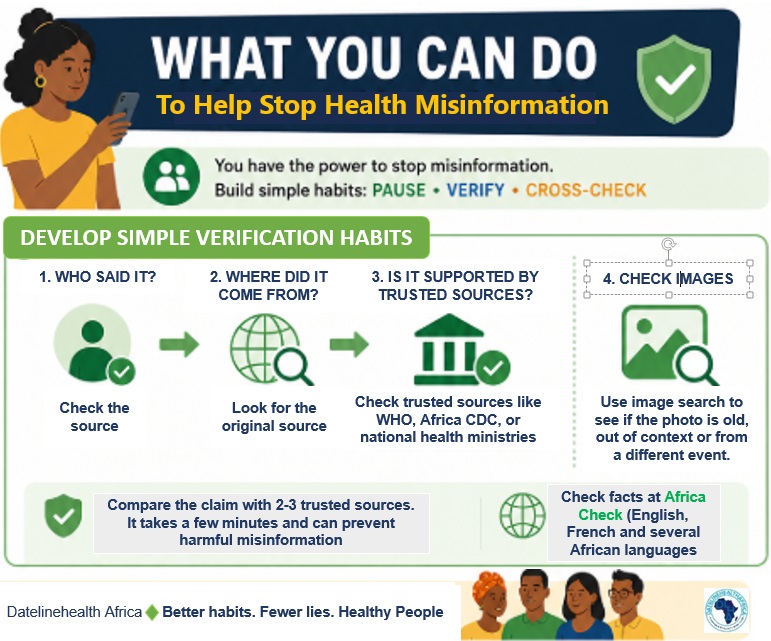
Infographic showing ways individuals can help stop the spread of health misinformation on social media. Image created with ChatGPT: Click on image to enlarge.
Individuals do have roles to play in fighting misinformation too. Every time people see health information online, they choose whether to believe it, share it, or question it. Building better habits when using health information online can make a difference.
Checking health information does not require special training. Before believing a health claim, ask: Who said it? Where did it come from? Is it supported by trusted sources like the WHO, Africa CDC, or a national health ministry?
Checking a claim against two or three trusted sources takes only a few minutes and can help stop harmful misinformation from spreading. Africa Check also provides verified fact-checks in English, French, and several African languages, making its website a useful place to check health claims.
One of the simplest ways individuals can help fight health misinformation is to pause before sharing. Misinformation spreads quickly when people share things based on emotion rather than checking if they are true. [5] Before forwarding a health claim in a WhatsApp group, simply asking, “Do I know this is true?” can help stop it from spreading.
This matters especially in group chats, where one message can reach many people within minutes. Nigerian fact-checkers studying COVID-19 misinformation found that one of the most effective things people could do was simply not share false claims in the first place [17].
Efforts to build better digital habits are already growing across Africa. Africa Check has run fact-checking and media literacy programmes since 2015, including school resources that teach students how to identify and stop misinformation in South Africa, Nigeria, and Kenya [18]. The Africa Facts Network has also grown from two organisations in 2017 to more than 50 by 2025, working across Africa in English, French, and Arabic [19].
These efforts are good, but digital illiteracy remains a challenge. As one Ghanaian journalist noted, fact-checking alone cannot stop misinformation [20]. The habits these programmes promote (pause, verify, and cross-check) are what people can rely on when no fact-checker is available.
As explored in Tech Age Woes: How Digital Health Misinformation Cost African Lives, technology is a double-edged tool, and social media is part of it. The fight against health misinformation is already in progress, but much more needs to be done. Platforms have introduced fact-checking systems, but their coverage across Africa remains limited. Health communicators are creating reliable and shareable content, but it does not always reach private communities where many health decisions are made. Digital literacy programmes are also growing, but misinformation continues to spread faster.
Social media use will continue to grow across Africa, bringing more health information, both true and false, to more people. The goal should not be to limit access to social media, but to improve how health information spreads through it
References:
1. Unfried, K., & Priebe, J. Who shares fake news on social media? Evidence from vaccines and infertility claims in sub-Saharan Africa. PLOS One. 2024. 19(4), Article e0301818. Available from here
2. WHO Regional Office for Africa. Countering COVID-19 Misinformation in Africa. [Internet] 23 July 2021. Accessed September 1 2026. Available from here
3. Conbersa. Social Media Statistics Worldwide in 2026. [Internet] April 2026. Accessed September 1 2026. Available from here
4. African Business. Social media giants stream into Africa. [Internet] 2024. Accessed September 1 2026. Available from here
5. Vosoughi, S., Roy, D., & Aral, S. The spread of true and false news online. Science. 2018. 359(6380), 1146–1151. Available from here
6. Mudavadi, K. C., Tully, M., & Lomoywara, D. B. Exploring Kenyans' interactions with misinformation on WhatsApp. Mobile Media & Communication. 2025. 13(1), 69–87. Available from here
7. Meta. How Meta Is Preparing for the 2024 South African Elections. [Internet] 2024. Accessed September 1 2026. Available from here
8. Africa at LSE. African social media is likely to see a rise in viral propaganda. [Internet] 2025. Accessed September 1 2026. Available from here
9. World Health Organization (WHO). WHO and TikTok to collaborate on more science-based information on health and well-being. [Internet] 2024. Accessed September 1 2026. Available from here
10. Reuters Institute. Amid war, vicious attacks and political turmoil, global fact-checkers fear the impact of the end of Meta's programme. [Internet] 2025. Accessed September 1 2026. Available from here
11. Rest of World. Global fact-checkers were disappointed, not surprised, Meta ended its program [Internet] 10 January 2025. Accessed September 1 2026. Available from here
12. de Freitas Melo, P., Vieira, C. C., Garimella, K., de Melo, P. O. S. V., & Benevenuto, F. Can WhatsApp Counter Misinformation by Limiting Message Forwarding? arXiv. 2019. Available from here
13. Linegar, M., Sinclair, B., van der Linden, S., & Alvarez, R. M. Towards Generalizable AI-Assisted Misinformation Inoculation. arXiv. 2024. Available from here
14. Lambert, V. J., Kisigo, G. A., Nzali, A., Laizer, E., Paul, N., Walshe, L., Kalokola, F., Okello, E. S., Sundararajan, R., Mwakisole, A. H., Downs, J. A., & Peck, R. N. Religious Leaders as Trusted Messengers in Combatting Hypertension in Rural Tanzanian Communities. American Journal of Hypertension. 2021. 34(10), 1042–1048. Available from here
15. Asfaw, S., Morankar, S., Abera, M., Mamo, A., Abebe, L., Bergen, N., Kulkarni, M. A., & Labonté, R. Talking health: trusted health messengers and effective ways of delivering health messages for rural mothers in Southwest Ethiopia. Archives of Public Health. 2019. 77, Article 8. Available from here
16. Simba, H., & Girma, E. Optimizing social media influencers for health communication in Africa. Global Health Action. 2025. 18(1), Article 2572009. Available from here
17. Tully, M., & Singer, J. B. Fact-checking the COVID-19 Infodemic in Sub-Saharan Africa. African Journalism Studies. 2023. 44(2), 97–115. Available from here
18. Africa Check. Raising informed media consumers starts at school. [Internet] 2023. Accessed September 1 2026. Available from here
19 Africa Check. The Africa Facts Network. [Internet] Accessed September 1 2026. Available from here
20. Nieman Reports. Fact-Checking in Africa: Combating disinformation amid political strife and ethnic conflict. [Internet] 2025. Accessed September 1 2026. Available from here
Related:
Policy Solutions to Combat Health Misinformation Online in Africa
How to Use AI to Combat Health Misinformation in Africa
Tech Age Woes: How Digital Health Misinformation Cost African Lives
Published: Noverber 10, 2026
© 2024. Datelinehealth Africa Inc. All rights reserved.
Permission is given to copy, use and share content for non-commercial purposes without alteration or modification and subject to source attribution.
DATELINEHEALTH AFRICA INC., is a digital publisher for informational and educational purposes and does not offer personal medical care and advice. If you have a medical problem needing routine or emergency attention, call your doctor or local emergency services immediately, or visit the nearest emergency room or the nearest hospital. You should consult your professional healthcare provider before starting any nutrition, diet, exercise, fitness, medical or wellness program mentioned or referenced in the DatelinehealthAfrica website. Click here for more disclaimer notice.